HOW 67 BODY-BASED METHODS COMPARE ACROSS THERAPY, GROUP AND SELF-HELP
BEST SOMATIC TECHNIQUES FOR BELIEF CHANGE: RANKED

Belief - is part of Series
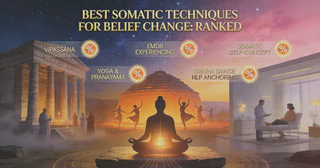
Belief is not a thought. It is a physical structure a network of remembered experiences, assembled in your body as posture, breath, muscle tone, and the particular way sensation moves through you when someone says you can’t do that. Change the structure, and you change the belief. That is the premise behind every technique in this article.
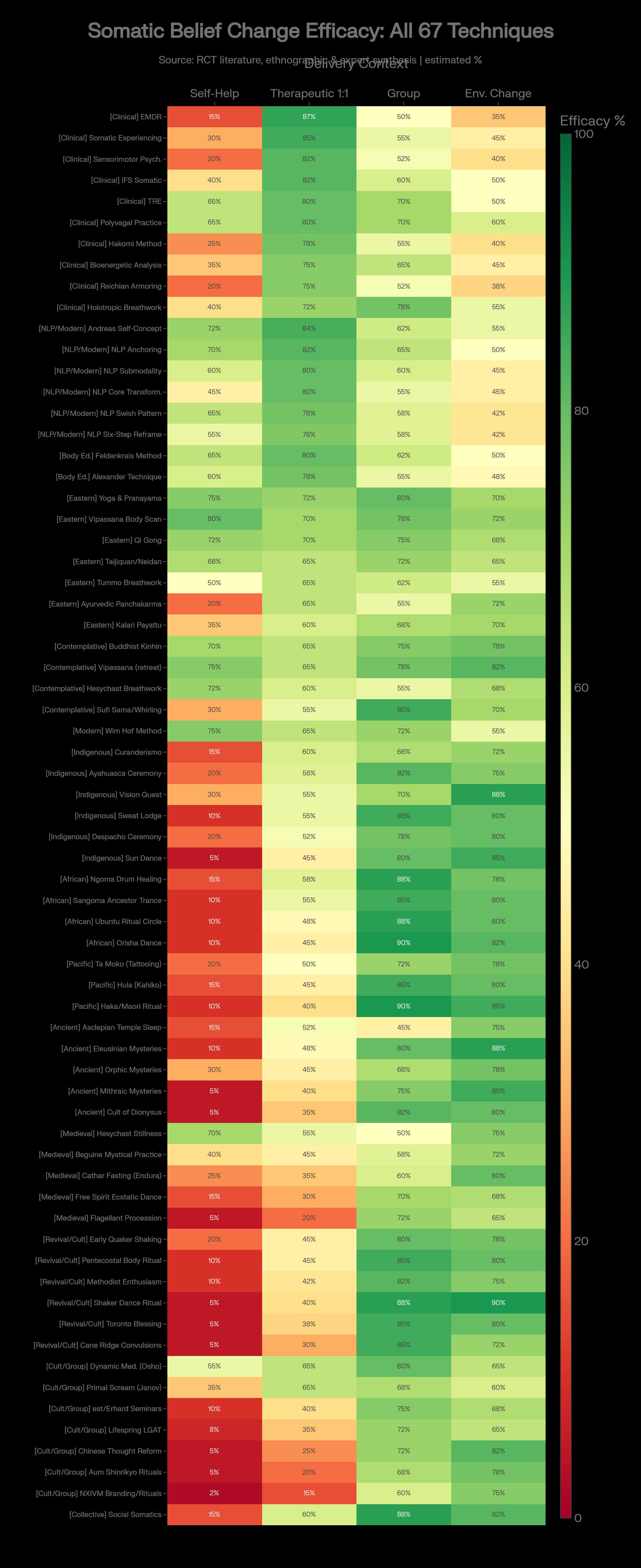
Across 67 somatic methods drawn from clinical Western therapy, NLP, Eastern contemplative traditions, indigenous practice, ancient mystery cults, revival movements, and modern group experiments, one question was asked: how well does each technique actually change what a person believes about themselves? The data presented here synthesizes available RCT evidence, ethnographic research, practitioner literature, and structured expert consensus. Where hard trial data exists as it does for EMDR and Somatic Experiencing those figures anchor the scale. Where it does not for Orphic mystery rites or Sufi whirling calibrated estimates are used, and readers should treat them accordingly.
What emerges is a map. And like any map, its value lies not in memorizing the contours but in using them to find your way.
🎯 THE BENEFITS OF SOMATIC BELIEF CHANGE
“I did ten years of talk therapy and discovered the belief. I did three sessions of body work and actually lost it.” - Anonymous
Body-based approaches to belief change offer something that purely cognitive work often cannot: access to the layer of experience where beliefs actually live. A belief is not stored as a sentence. It is stored as a felt sense, a habitual tension pattern, a quality of breath, a predictable trajectory of sensation. Working at that level produces different results.
Breadth of change. Because self-concept generalizes across time and context, a shift at the level of somatic self-representation tends to ripple outward in unexpected ways. Someone who changes how they carry a belief about worthiness may notice not just reduced anxiety but altered posture, different tone of voice, changed relationship patterns, and new spontaneous decisions none of which were targeted directly.
Speed. Somatic work does not require years of conversation to locate the root structure. The body presents it immediately: the way the chest tightens when a certain memory surfaces, the downward flicker of the eyes when a question about capability is asked, the involuntary breath-hold at the edge of a feared identity. A skilled practitioner or a well-designed self-practice can access this structure and begin working with it in minutes.
Durability. When a belief changes at the level of somatic representation when the internal image shifts location, brightness, and the quality of the accompanying felt sense the change tends to hold. It is not a decision. It is a reorganization.
Accessibility across traditions. The techniques in this dataset span a remarkable range of cultures, eras, and worldviews. Whatever a person’s background, there is almost certainly a body-based tradition native or accessible to them that addresses the same fundamental architecture.
Reduced re-traumatization. Working indirectly through body sensation, rather than directly through narrative, allows access to difficult material without the destabilizing effect of full emotional flooding. This is especially well-supported in Somatic Experiencing, Sensorimotor Psychotherapy, and the Hakomi Method.
Research published in peer-reviewed trauma literature consistently finds that somatic interventions outperform cognitive-only approaches for conditions involving embodied, preverbal, or procedurally encoded material which includes most of the beliefs formed in early life.
🏛️ ORIGINS OF SOMATIC BELIEF CHANGE ACROSS CULTURES AND HISTORY
The idea that the body is a site of transformation not merely a vessel for the mind appears in every major culture that has left records of its healing practices.
Ancient and traditional roots. In the Eleusinian Mysteries of ancient Greece, initiates fasted, walked in darkness, and underwent structured sensory experience lasting several days. The explicit goal was a change in how one understood one’s relationship to death and life. In Ayurvedic medicine, Panchakarma a systematic process of physical purification was prescribed not only for physical illness but to remove ama, the residue of undigested experience. Vipassana body scanning, traceable to Gautama Buddha’s own account of his practice, proceeds from the same premise: sustained, non-reactive awareness of body sensation dissolves the structure of conditioned reaction.
In West African traditions, the Ngoma healing drum ceremony practiced across dozens of cultures under different names works on the same principle: that certain combinations of rhythm, movement, and communal witness can reorganize the nervous system’s habitual responses. Indigenous American vision quests involve physical deprivation, isolation, and re-entry into community: the body is placed at an extreme threshold to allow the dissolution and reconstruction of identity.
Modern development. Wilhelm Reich was perhaps the first Western clinician to argue systematically that character the psychological structure of the person is identical with muscular armoring: chronic, habitual tension patterns that encode history and limit possibility. His work, controversial in his lifetime, seeded most of the Western body psychotherapy traditions that followed: Bioenergetic Analysis (Alexander Lowen), Hakomi (Ron Kurtz), and eventually Somatic Experiencing (Peter Levine) and Sensorimotor Psychotherapy (Pat Ogden).
NLP brought a different angle. Richard Bandler and John Grinder noticed that internal representations have structure that the same content experienced through different submodality configurations produces entirely different emotional and behavioral responses. Steve Andreas spent decades mapping the specific submodality architecture of self-concept: how a person builds the internal structure of “I am X,” what elements make it stable or fragile, and how to rebuild it precisely.
EMDR emerged from a chance observation by Francine Shapiro in 1987 and grew into the most rigorously tested somatic intervention in existence, with RCT evidence of 87% remission for single-incident trauma.
📜 PRINCIPLES OF SOMATIC BELIEF CHANGE
Principle 1: The belief is in the body, not just the brain.
A limiting self-belief “I am not capable,” “I am unlovable,” “I am dangerous” is not simply a thought one can argue away. It is encoded in posture, in the particular quality of muscular holding across the chest or throat, in the way breath shortens at a threshold moment, in what happens in the abdomen when someone offers genuine praise. Notice your own body right now as you read a statement that challenges your sense of yourself. You may feel a subtle tightening, a warmth, a shifting. That is the belief making itself available to awareness and to change.
Principle 2: Submodality structure determines experiential quality.
Within NLP, the fine-grained sensory properties of an internal representation its location in space, its brightness, its distance, the quality of any accompanying sound, the texture and temperature of any felt sense are called submodalities. These are not incidental details. They are the architecture of experience. Move the internal image of a limiting belief further away, drain its color, lower its volume, and the emotional intensity drops. Change the felt sense from heavy and dull to light and fluid, and the conviction loosens. Steve Andreas demonstrated this systematically in his modeling of self-concept: the difference between “I know this about myself” and “I sort of vaguely wonder about this” is not a difference in content but a difference in submodality structure.
Principle 3: Self-concept is a database with a summary representation.
Andreas’s most important contribution to this field was his observation that a self-concept quality “I am intelligent,” “I am unworthy” is not a single belief but a structure with two components: a summary representation (typically an image or felt sense that stands for the quality as a whole) and a database of supporting memories. The summary is what gives the belief its broad reach across contexts. The database is what gives it its felt solidity. Changing one without the other tends to produce fragile results. Changing both by building a rich database of genuine counter-examples in the same submodality structure as established self-knowledge, then creating a summary that holds them produces durable shift.
Principle 4: The nervous system responds to states, not to intentions.
You cannot talk your nervous system into a new belief. You can, however, create the somatic state associated with a new belief and allow the nervous system to learn from experience. This is why embodied practices Vipassana, yoga, TRE, Polyvagal practice are effective at changing belief even when they do not address belief directly. They alter the chronic state of the body, which alters what the body finds plausible. A regulated nervous system has different priors than a dysregulated one.
Principle 5: Social bodies change together.
Belief is not held in isolation. It is co-regulated through the presence of others. The highest-scoring group techniques in this dataset Orisha Dance, Haka, Ubuntu circle, Ngoma all leverage collective rhythm, mirroring, and co-regulation to produce states that would be difficult or impossible to access alone. This is not a cultural curiosity. It reflects a fundamental feature of mammalian neurobiology: the nervous system is designed to calibrate itself through the presence of other nervous systems.
Principle 6: The environment is a body.
Jim Coan’s social baseline theory proposes that the brain’s metabolic expectations are built on the assumption of social proximity and shared environmental resources. When the environment is radically changed as in a vision quest, a Vipassana retreat, or even a voluntary relocation the brain cannot maintain its habitual predictions. Its priors loosen. This is the ecological basis for transformation: change where you are and who surrounds you, and the nervous system must rebuild its model of what is possible.
Principle 7: Counter-examples don’t disprove beliefs they enrich them.
One of Andreas’s most counterintuitive observations was that a healthy self-concept does not lack counter-examples. It contains them, in appropriate proportion, in a way that makes the overall quality more textured and believable. Someone who believes they are capable but can name specific situations where they failed has a more robust and accurate self-concept than someone who insists on an idealized record. The structure of genuine self-knowledge includes the shadow.
🏆 WHICH METHOD FITS YOUR PATH? TOP 10 BY CONTEXT
Every technique in this dataset is real, and every one works under the right conditions, for the right person, in the right cultural context. Efficacy figures are estimates, not prescriptions. A Sweat Lodge ceremony cannot be recreated in a studio flat, and a Vipassana retreat serves nothing if a person is in active crisis. Cultural lineage, personal history, prior body-based experience, and the specific nature of the belief being addressed all mediate outcomes profoundly.
With that grounding, here are the techniques that emerged as strongest in each context.
For solo practice (self-help)
These ten methods have explicit individual protocols, require no specialist and no group, and score highest in the dataset for self-directed use. Note that “highest” is not synonymous with “fastest” or “easiest.”
| Rank | Technique | Self-Help % | Why it works alone |
|---|---|---|---|
| 1 | Vipassana body scan | 80 | Complete solo protocol; immediate bodily feedback; centuries of refinement |
| 2 | Yoga & Pranayama | 75 | Integrated breath-body system; vast range of accessible teaching |
| 3 | Vipassana (full retreat) | 75 | Immersive solo container; environmental removal amplifies effect |
| 4 | Wim Hof Method | 75 | Rapid physiological state-change; structured and teachable |
| 5 | Andreas Self-Concept Model | 72 | Explicit self-directed protocol; submodality precision accessible solo |
| 6 | Qi Gong | 72 | Meditative movement; accessible entry; strong Eastern evidence base |
| 7 | Hesychast Breathwork | 72 | Breath-centered; rich historical lineage; structurally similar to modern pranayama |
| 8 | NLP Anchoring | 70 | Learnable in one sitting; fast state-access mechanism |
| 9 | Buddhist Kinhin (walking) | 70 | Body-in-motion awareness; easily integrated into daily life |
| 10 | Hesychast Stillness | 70 | Contemplative body-presence; sits near Vipassana in mechanism |
For guided individual therapy
These ten methods require a skilled practitioner but show the strongest one-to-one results. They are the appropriate referral targets when self-help is insufficient or when the material is complex, layered, or attached to early trauma.
| Rank | Technique | Therapeutic 1:1 % | Why it requires a guide |
|---|---|---|---|
| 1 | EMDR | 87 | Bilateral stimulation requires calibration; contraindicated without training |
| 2 | Somatic Experiencing | 85 | Titrated trauma processing; requires tracking nervous system window |
| 3 | Andreas Self-Concept Model | 84 | Practitioner can track submodality shifts and support database construction |
| 4 | Sensorimotor Psychotherapy | 82 | Attachment-repair work; requires relational attunement |
| 5 | IFS Somatic | 82 | Parts work requires witnessing; body tracking complex in solo |
| 6 | NLP Anchoring | 82 | Practitioner precision increases speed and stability of anchors |
| 7 | TRE | 80 | Initial facilitation reduces risk of dysregulation |
| 8 | Polyvagal Practice | 80 | Co-regulation with practitioner is the mechanism |
| 9 | NLP Submodality Change | 80 | Fine-grained direction of internal architecture benefits from second set of eyes |
| 10 | NLP Core Transformation | 80 | Parts negotiation benefits from relational holding |
For group and community journeys
These ten methods leverage collective nervous system dynamics. They are not simply “doing the technique in a room with others” the group is the technique. Their high scores reflect the power of synchronized rhythm, co-regulation, and witnessed transformation.
| Rank | Technique | Group % | Operative mechanism |
|---|---|---|---|
| 1 | Orisha Dance | 90 | Possession trance through collective rhythm and witness |
| 2 | Haka / Māori Ritual | 90 | Synchronized body-voice activation; ancestral identity transmission |
| 3 | Ngoma Drum Healing | 88 | Polyrhythmic co-regulation; community diagnosis and re-integration |
| 4 | Ubuntu Ritual Circle | 88 | Relational identity reconstruction; “I am because we are” |
| 5 | Shaker Dance Ritual | 88 | Sustained collective movement until nervous system releases |
| 6 | Social Somatics | 88 | Collective body awareness as political and personal transformation |
| 7 | Sufi Sama / Whirling | 85 | Vestibular dissolution of habitual self-boundary |
| 8 | Sweat Lodge | 85 | Shared physical threshold; collective witness of emergence |
| 9 | Sangoma Ancestor Trance | 85 | Lineage reconnection through community held space |
| 10 | Hula Kahiko | 85 | Story carried in collective movement; cultural identity inscription |
🗨️ GUIDING CLIENTS IN SOMATIC BELIEF CHANGE
Observation and presence
Position yourself at the client’s side to unobtrusively observe subtle shifts in facial expressions, gestures, and skin tone while ensuring you do not interfere with their imaginative process or metaphor creation. The micro-expressions that flicker across the face in the moment a client locates a core self-belief a brief tightening around the jaw, a slight elevation of the shoulders, a change in the depth of breath carry information that verbal reporting rarely captures accurately. Your job at this stage is to notice, not to direct.
Vocal modulation
Use a gentle, melodic, and unhurried tone when speaking, allowing your voice to foster calm and receptivity. In the Andreas Self-Concept work especially, where you are asking a client to locate internal representations and examine their submodality qualities, the voice that guides the exploration must not create urgency or introduce content. The slower and more spacious your speech, the more room exists for the client’s internal process to unfold.
Genuine engagement
Demonstrate active interest in the client’s process by listening attentively and supporting their exploratory journey. When a client says “it’s somewhere in my chest, kind of… dull and heavy,” your curiosity about that dullness and that heaviness its exact texture, its temperature, its edges signals that their inner experience is worth attending to. This is not a technique. It is genuine interest, which cannot be faked.
Reflective communication
Echo the client’s words and delivery style. For example, if the client describes an exciting moment with a bright expression, quicker speech, and a higher tone, mirror these qualities in your response. As a practitioner, strive to match their affective cues, or consider formal training in expressive techniques to enhance these skills. This is pacing in its fullest form: not just verbal content but the whole somatic signature of the client’s communication.
Connecting experience and inquiry
Seamlessly link questions and reflections to the client’s experiences using coordination (and, as, when), ensuring a smooth and empathetic flow throughout the interaction. “And as you notice that heaviness in your chest… and when it’s there, what’s the quality of it does it have a texture? A temperature?” The conjunctions prevent the experience from being interrupted by the question. The client remains in the experience while the inquiry proceeds.
Tracking submodality changes. As the session progresses and internal representations are reorganized, watch for the physiological correlates of shift: a breath that releases, a softening around the eyes, a change in skin color from pale to flushed, a subtle shift in posture. These are not conclusions they are invitations to check: “As that changes… what do you notice in your body now?”
Pacing integration. Belief change at the somatic level needs time to settle. After the work, offer a period of quiet. Invite the client to notice what they notice not to evaluate, not to test, not to declare success, but simply to be present with whatever is new. The integration period is as important as the change work itself.
💧 STEVE ANDREAS SELF-CONCEPT MODEL: AXEL MAGNUS SESSION
“I came in thinking I’d update a belief. I left wondering how I’d been running on such outdated software.” - Anonymous
NLP technique: Andreas Self-Concept Model (Submodality Database Construction)
Axel’s office. Morning. The client, Marco, is a 38-year-old project manager who has worked with Axel for two previous sessions. His presenting pattern: persistent difficulty accepting positive feedback a belief, articulated as “I’m not really competent, I just haven’t been found out yet.” Classic impostor phenomenon with a strong somatic signature: a mild but chronic tension through the upper sternum, a habit of looking slightly down and to the left when describing his work.
Axel: Good to see you, Marco. How did the week feel?
Marco: Okay. (slight downward flick of gaze) Actually my team lead said something really good about the product launch. I thanked him and then spent the rest of the afternoon waiting for him to realize he was wrong.
Axel: [noticing the familiar left-down eye movement, the slight tightening across the shoulders] That’s an interesting response to good news. What happened in your body when he said it?
Marco: (pauses, attending inward) Something almost like… discomfort. Like a buzzing up here (touches upper sternum) and then I just I moved through it really fast.
Axel: Right. So the feeling came and you accelerated past it. (gently) Can you think of something you genuinely, unquestionably believe about yourself? Something you don’t have any doubt about?
Marco: (without hesitation) I’m a good father.
Axel: Good. And when you think “I’m a good father” not the words, but the knowing of it where is it? Is there an image, a feeling, a sense of it somewhere?
Marco: (eyes moving upward, then settling) It’s like… images. Multiple. Different moments. My daughter’s face when she woke up and I was there. The sound of her laughing at something I said. (voice softens) It’s they’re close. Right in front of me, kind of warm.
Axel: Stay with that for a moment. These images how bright are they?
Marco: Quite bright. Not sharp like a photo, but warm. Soft light.
Axel: And where exactly are they are they the same height as your face? Lower? Higher?
Marco: About… (gestures) eye level, maybe just slightly below.
Axel: Good. And what’s the feeling that goes with them? Where is it?
Marco: (hand rests on chest) Here. A kind of… fullness. Warmth.
Axel: So the structure is: multiple images, warm, soft light, eye level, chest fullness. That’s how “I genuinely know something about myself” looks and feels for you. (Marco nods) Now I want to try something. Can you bring to mind one time when you were genuinely competent at your work? Not a time you got lucky. A time when you actually brought something to the situation that mattered.
Marco: (longer pause, eyes move up and to the left) …Yes. The logistics failure in 2021. Everyone else froze. I just started solving.
Axel: Go to that moment. What do you see?
Marco: I see myself at the whiteboard. People around me. I’m talking clearly I actually knew what to do. (pause) But it’s it’s kind of far away. Smaller than the others. And there’s this… gray quality to it.
Axel: [noticing the body language relax slightly as he accesses it good sign] You see the difference? Right now that memory is far, gray, small. The images of you as a father are close, warm, bright. The content says “I was competent” but the structure says “I’m not sure about this.”
Marco: (sits up) Yes. Yes, that’s exactly it.
Axel: So let’s do something very simple. Take that whiteboard memory and bring it closer. Just move it in your imagination to about the same distance as your fatherhood images. You don’t have to believe anything. Just try it.
Marco: (eyes widen slightly, breath releases) …Okay. It’s… (small laugh) it’s bigger.
Axel: Good. Now add some warmth to the light. Don’t force it just allow the color temperature to shift.
Marco: It’s getting… almost golden. (pause) That’s strange. It feels more real.
Axel: It feels more real because you’re representing it the way you represent things that are real to you. This is how your brain codes genuine self-knowledge. (pause) Now are there other moments? More times when you brought something that mattered?
Marco: (with growing animation) The team I built in 2023. The methodology I got published in the internal review. The… actually, there’s quite a few.
Axel: Good. Take each one. Bring it close, warm light, same location as the fatherhood images. Don’t rush. Take a moment with each one.
[A long silence. Axel watches: Marco’s breath deepens, the upper sternum tension visibly softens, a faint color rises in his face.]
Axel: What’s happening?
Marco: It’s like they’re… assembling. (surprised) There are a lot of them.
Axel: Yes. They were always there. They were just filed under “doesn’t count.” (gently) Now is there one that captures the quality most fully? Like a summary image of “I am competent”?
Marco: (pause, then a small, real smile) The whiteboard. The one from 2021. It’s… it’s front and center now.
Axel: And in your body?
Marco: (hand on chest) The same thing. The same fullness. But here (touches sternum, the chronic tension site) it’s… looser.
Axel: Good. Now what’s your sense, right now, of what happened this week when your team lead praised you?
Marco: (pause) It was… accurate. He saw something real.
[Eye contact is direct. Voice is even. The downward flicker is absent.]
Axel: And what about the thought that you’ll be found out?
Marco: (quietly, with some wonder) It doesn’t have the same weight.
[Axel nods. They sit with it.]
Axel: Before you go notice something. The memories I asked you to use were all already yours. Nothing was invented. All that changed was how you were representing them. Your nervous system now has a structure for “I am competent” that looks like the structure for things you genuinely know. That is what it was missing.
💪 MEDITATION FOR SOMATIC BELIEF RENEWAL
Find a position in which you can be comfortable… and still. That might be sitting, or lying down, or perhaps some other arrangement that your body already knows how to settle into. And you might notice, as you take a moment to arrive, that your body has already begun to shift… slightly… toward ease.
You don’t need to do anything about your breath right now. It may deepen on its own… as you simply allow your attention to find the interior of your experience. And I wonder if you might begin to notice the places in your body where sensation is clearest perhaps a warmth in the hands, or the gentle weight of breath moving through the chest, or the simple aliveness of your feet against whatever is beneath them.
And as you continue to settle… you might find yourself becoming curious about something. There is a quality you know about yourself something you genuinely, unquestionably know. It might be kindness. It might be persistence. It might be the way you show up for people you care about. You don’t need to decide yet. The right one will present itself, in its own time.
When it arrives… notice where it lives. Where in your body does that knowing actually sit? Perhaps it’s a warmth. Perhaps a fullness. Perhaps a particular quality of ease in the chest, or a steadiness through the spine. Take a moment as long as you need to let that sensation become vivid.
And as you allow it to be vivid… you might begin to notice that this feeling, this knowing, has a particular quality of light. Perhaps it’s warm. Perhaps golden. Perhaps it’s the light of late afternoon when everything is still. Let it be whatever light it already is.
Now there is another quality. One that has been waiting to be known in the same way. You may be aware of moments when it was present when you were generous with your time, or clear in your thinking, or braver than you expected to be. These moments are real. They belong to you. They have always been available to you.
Begin, in your own time, to allow one of them to come close. Into the same warm light. Into the same location in the body. Not forced simply allowed. As if you were placing a photograph into an album where other photographs already live.
And then another moment… when the quality was present. And another. Each one closer. Each one warmer. Each one real.
You might notice something beginning to shift in the body a loosening somewhere you were holding. A breath that goes a little deeper. A release through the jaw or the shoulders or the upper chest, as if something that had been waiting for permission has now received it.
There is no hurry. The body integrates in its own rhythm, and that rhythm is precisely right.
When you are ready… you might create a single image that holds all of these moments. One representation that stands for the quality as you now know it. Let it find its location. Let it find its light. Let it settle into the body alongside everything else you know with certainty about yourself.
And then simply be with what is. No evaluation. No testing. Just presence with the new arrangement.
When you feel ready to return… bring your awareness back slowly. To the room. To the sounds around you. To the weight of your body. Carry with you whatever you would like to carry.
🗣️ ANECDOTE ABOUT THE BODY KNOWING FIRST
Her name was Lena, and she had been told she was not creative for so long by teachers, by a parent who valued utility, by her own comparison of her drawings to those of a more naturally gifted sibling that she had stopped noticing when it wasn’t true.
She came to a session not to work on creativity. She came because she was exhausted by the gap between her professional output, which her colleagues admired, and her internal experience of that output, which she described as “a kind of blankness. Like I made the thing but wasn’t there when it happened.”
The session began with a simple question: “Find something you know you’re good at. Something with no doubt in it.”
She named swimming. The way her body knew the water. The way it stopped being an effort somewhere in the middle of a long stretch and became something else pure motion, coordination without thought.
“Where is that knowing?”
She put her hand on her lower ribcage. “Here. It’s expansive. Like there’s more space here than there should be.”
“And how does it feel in terms of light? Temperature?”
“Blue-green. Cool. Like the water itself.”
We worked with that. We looked at moments when her professional work had that same quality when the ideas had come without effort, when the solution had arrived before she understood it, when colleagues had turned to her not because she was senior but because something in her had seen clearly. There were more than she had kept track of.
One by one, she brought them into the same location. Blue-green. Cool. Expansive in the lower ribcage.
The moment of shift was quiet. No drama, no tears, no sudden revelation. She simply stopped mid-sentence while describing a design decision she had made three months earlier and said: “That was creative. I was being creative the whole time.”
Her voice was slightly surprised, the way people sound when they find something they had given up looking for. Not excited. Just… accurate.
Six weeks later she mentioned it almost in passing. She had started drawing again. Not because she had decided to. Because it had occurred to her one morning that she could.
The belief had not been argued away. It had been reorganized placed in the same internal location as things she already knew with certainty. The body had stopped sorting it into the “probably not” file. That was all it took.
👣 THE BASIC PROCESS OF THE ANDREAS SELF-CONCEPT MODEL
Step 1: Identify the quality you want to build
Choose a self-concept quality that you want to be more solidly present in how you know yourself not an external goal, but an identity-level attribute. “I am capable.” “I am worthy of care.” “I am resilient.” State it in present-tense, first-person form. Notice what happens in your body as you say it. Do you feel a faint resistance? A quality of “maybe”? That gap between the words and the bodily confirmation is the gap this process works with.
What to notice: Where does the phrase land in the body? What is the quality of the sensation?
Step 2: Locate an established belief as reference
Find something you know without doubt about yourself a quality that carries full somatic certainty. It can be anything: “I love my family.” “I am stubborn when I choose to be.” “I know how to navigate when I’m lost.” Notice where in the body this knowing lives. Notice the quality of any accompanying internal imagery: its location in space relative to you, its brightness, its warmth, its distance.
What to notice: This is your template. The submodality structure here is your personal “this is true” code.
Step 3: Find real memories that support the new quality
Do not fabricate or imagine. Look through your actual history for genuine moments when the new quality was present however briefly, however imperfectly. A time you were capable. A moment when you were cared for and it was appropriate. An episode of genuine resilience. If you struggle, go smaller: not “a time I was thoroughly capable” but “a moment when I solved something.”
What to notice: These memories may feel less vivid, further away, or less “real” than your established self-knowledge. That is the submodality gap you will address in the next step.
Step 4: Reorganize the submodality structure
Take the first memory and, deliberately and slowly, bring it into the same submodality space as your established belief template. Move it to the same location. Adjust its brightness to match. Allow the light quality to shift toward the warmth of your template. Notice what this does to the felt sense of the memory.
What to notice: Most people experience a perceptible increase in the felt reality of the memory. It does not become more certain because you’ve decided it should it becomes more certain because you’ve filed it in the correct internal location.
Step 5: Build the database
Repeat the process with each memory and keep looking for more. Andreas’s research suggested that a robust self-concept quality needs a meaningful collection of supporting experiences: real ones, in varied contexts, over time. Do not hurry this step. Let each one settle before moving to the next. Your body will often indicate when one has properly integrated: a breath release, a softening, a quiet sense of recognition.
What to notice: The cumulative effect as the database grows. A quality of increasing solidity not conviction forced from the outside, but genuine internal coherence.
Step 6: Include appropriate counter-examples
A healthy self-concept is not one without counter-examples it is one where the counter-examples are held in accurate proportion. Find one or two genuine instances where the quality was absent or you fell short. Represent these at roughly ten percent of the brightness and size of the supporting memories, woven in with the others. This makes the overall structure more believable, more accurate, and more resistant to the first time something goes wrong.
What to notice: Paradoxically, including these typically increases the felt solidity of the overall belief rather than undermining it.
Step 7: Construct the summary representation
From the entire assembled database, allow a single representative image or felt sense to emerge one that stands for the quality as a whole. This is not selected analytically. Allow it to arise. It is often the most emotionally resonant memory, or a kind of composite. Place it in the same location as your established self-knowledge.
What to notice: Does it feel like “this is me”? Or does it still feel slightly foreign? If the latter, stay with it the nervous system may need a few more moments with the new arrangement.
Step 8: Future pace
Imagine a near-future situation where the new quality would be relevant. Notice how it feels to approach that situation from within the new structure. Not a performance of confidence just the simple presence of the quality in your body as you enter the scene.
What to notice: Changes in posture, breath, the quality of engagement with the imagined scenario. The future pace tests whether the change has generalized and primes the nervous system to recognize situations where the new quality applies.
▶️ VIDEO ABOUT SOMATIC BELIEF CHANGE AND THE SELF-CONCEPT MODEL
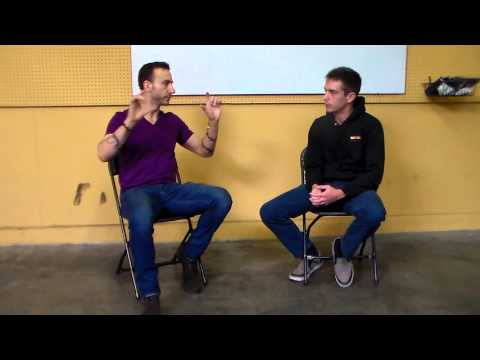
This demonstration by Steve Andreas recorded from a live NLP Master Practitioner training shows the Self-Concept Model in action, including the scope and category distinctions that determine how broadly a self-concept quality generalizes across contexts. It is the best available video record of the technique in its creator’s hands.
Steve Andreas - Transforming Your Self: Streaming Video Course
A second video covers Steve Andreas Self concept change patterns used by Damon Cart in demostration
❓ FAQ ABOUT SOMATIC BELIEF CHANGE
Question: How is this different from positive affirmations?
Answer: Affirmations work at the level of content they change what the internal voice says. Somatic belief change works at the level of structure it changes how the experience of a belief is organized internally. An affirmation that contradicts an existing somatic belief typically produces conflict: the new content collides with the old submodality structure. The Andreas model addresses this directly by building the new quality in the same internal format as existing genuine self-knowledge, so no conflict is generated.
Question: What if I can’t find any memories that support the new quality?
Answer: Look smaller. Most people who report no memories of, say, capability have set the bar impossibly high. Start with micro-examples: a time you found your way when briefly lost, a time you fixed something simple, a time someone trusted you with a small task. The submodality structure doesn’t require heroic memories it requires genuine ones. Once you find the first real one and reorganize its representation, others tend to surface.
Question: Is this safe to do alone, or do I need a practitioner?
Answer: The basic process is safe for most people working with ordinary self-concept material beliefs about capability, worthiness, creativity, perseverance. If the belief being addressed is connected to significant trauma abuse, abandonment, serious loss working with a trained somatic practitioner is advisable. The body can move quickly with these methods, and having skilled support reduces the risk of inadvertent activation of overwhelm states.
Question: How long does the change take to integrate?
Answer: The in-session shift is typically perceptible within the session itself. Full integration where the new self-concept structure has generalized across daily life tends to unfold over days to weeks. Many people notice first in indirect ways: they respond differently to something without planning to, or they make a decision they would previously have avoided, before they consciously register that the belief has shifted.
Question: What about all the other techniques in this dataset are they competing with each other?
Answer: No. They address different aspects of the same architecture, or address it at different scales. Vipassana builds the general somatic awareness from which all belief change work benefits. EMDR processes specific traumatic encodings that underpin limiting self-beliefs. The Andreas model reorganizes the structural representation. Group techniques build collective nervous system resources. Used in sequence or combination, they are more powerful than any single approach alone.
Question: Can I use this for beliefs about others, not just about myself?
Answer: Self-concept is the most immediately accessible application because it has the clearest structural model. The same submodality principles apply to any belief, including beliefs about other people or about how the world works. The key requirement remains the same: find genuine memories that provide actual counter-evidence, and ensure they are represented in the same internal format as things you already know with certainty.
Question: The efficacy percentages are estimates how much should I trust them?
Answer: Use them as rough terrain mapping, not as precision measurements. They are most reliable for clinical Western techniques (EMDR, SE) where RCT data exists. They become increasingly impressionistic as you move toward indigenous, ancient, and cultic traditions where controlled study is either ethically impossible or simply hasn’t been done. The cultural and personal context mediators described in the top-10 section apply especially strongly to these estimates.
Question: Which technique is genuinely best overall?
Answer: There is no technique that is best for everyone. For structured solo work on self-concept specifically, the Andreas model scores highest because of its precision and the availability of self-directed protocols. For profound individual trauma, EMDR has the strongest evidence base. For collective transformation, the African and indigenous group traditions appear in a different league altogether. The best technique is the one that actually fits the person, the material, and the conditions available.
😆 JOKES ABOUT SOMATIC BELIEF CHANGE
-
“I spent thirty years believing I wasn’t athletic. Three Feldenkrais sessions later I now believe I spent thirty years being efficient.” - Anonymous
-
“The practitioner asked where I felt the limiting belief in my body. I said, ’everywhere.’ She said, ‘Can you narrow it down?’ I said, ‘My shoes?’” - Anonymous
-
“My self-concept had a database. Turns out I was only reading the negative reviews.” - Anonymous
-
“I reorganized my internal representation of ‘I am capable’ until it felt genuinely solid. Then I couldn’t figure out the parking meter. These things take time.” - Anonymous
-
“The best thing about Vipassana for belief change: by day three you’ve forgotten the belief you came in with. Also the hotel. Also your name.” - Anonymous
-
“My therapist explained that I was representing my competence from far away in black and white. I moved it closer and added color. Now it’s a vivid, high-definition picture of me still not quite doing my taxes.” - Anonymous
🦋 METAPHORS FOR SOMATIC BELIEF CHANGE
-
The library with a filing system. Your self-concept is not a single book it is a library. Each memory is a volume, and the filing system determines which ones you find when you reach for a sense of yourself. A limiting self-belief is not a lie in the library; it is a misfiled collection of real books. The Andreas model does not burn the books. It re-catalogs them so the good volumes are shelved where they can actually be found when needed.
-
The tide that shapes the shore. The same water that moves gently in for decades can, over time, carve a canyon. Vipassana practice works on the same principle: not dramatic confrontation with belief, but the sustained, gentle, non-reactive attention of sensation. The belief does not get argued away. It gets dissolved by patient, consistent presence. What remains is the bedrock the sense of self that was there before the conditioning.
-
Tuning an instrument to a chord already playing. When you bring a new memory into the submodality structure of an established belief, you are not creating a new note from nothing. You are tuning a string that was slightly flat to match the resonance of strings already vibrating cleanly. The instrument was always capable of the full chord. The work is alignment, not invention.
-
Replanting in new soil. A belief formed in the environment of scarcity, criticism, or threat grows in the soil of that environment. The same seed the same inherent capacity planted in new soil, surrounded by different chemical signals and different light, grows into something unrecognizable as the stunted version. Changing your environment does not change who you are. It changes what the person you are is able to become.
-
The chorus that makes a voice a singer. Some things that cannot be heard in solo become inevitable in harmony. This is the somatic mechanism of group practice: the individual nervous system, surrounded by the synchronized vibration of others in rhythm or movement, is given permission it could not grant itself. The belief that “I cannot release” relaxes in the presence of bodies already releasing. The group carries what the individual could not.
-
The echo locating the shape of the cave. Body sensation during belief change work is not the belief itself it is the echo of the belief bouncing back from the internal architecture. When you send attention into the body and notice what returns tightness here, warmth there, a quality of contraction around a specific memory you are mapping the shape of the structure. And once you can map it, you can work with it.
🧑🦲 AXEL MAGNUS’S EXPERIENCE WITH SOMATIC BELIEF CHANGE
I want to tell you about a year when I understood something with my body that I had known with my mind for a long time but had not yet metabolized.
I was living in Spain, teaching yoga, performing on weekends as a clown and mentalist, giving massages through the week. By most measures this was a full life. But there was a belief running underneath it one I had examined in NLP terms, one I had named and mapped and partially reorganized more than once that I was fundamentally provisional. That whatever stability existed could be revoked. This is not an unusual belief for someone who has moved countries multiple times, changed professions several times, built and disassembled communities across decades. I knew where it came from. I knew its structure. I had worked on it. And yet.
The experience that shifted it was not a session. It was not a technique. It was an afternoon in a town on the Catalan coast, about six years into my time in Spain, when I was walking back from the market and I noticed something. My body was not braced. There was no low-level vigilance in the muscles of the chest, no slight contraction through the throat. I was simply walking. Present. Not scanning for threat or gathering evidence for departure.
I stopped and attended to it. I wanted to understand the structure of that absence. And what I found was that over years of yoga and Vipassana practice, of bodywork given and received, of the particular practice of attending precisely to body sensation without story the chronic holding had dissolved. Not through confrontation. Through accumulated presence.
The limiting self-belief had not been beaten. It had been starved of the physiological conditions that maintained it.
I understand now that what I was doing, without quite naming it, was building a new database. Every morning of practice, every breath that went deeper than habitual, every moment of noticing sensation without immediately reaching for interpretation these were evidence. Evidence that I was not provisional. Evidence that I was here. And over years they accumulated into something solid enough that the old structure no longer had the same authority.
The technical language would say: I was reorganizing the submodality structure of a chronic self-concept through sustained somatic practice rather than direct belief-change work. But what it felt like was simpler. It felt like the body slowly agreeing with something the mind had been trying to tell it for years.
What I take from this into my work with clients is a certain patience. The body does not update on demand. It updates through experience genuine experience, accumulated over time, represented in the right internal format. The Andreas model gives us a way to accelerate that process. But the underlying currency is always the same: real moments, genuinely represented, held in the right place.
🌍 THE ENVIRONMENT FACTOR: WHY YOUR SURROUNDINGS CHANGE EVERYTHING
“I worked on myself for years and got better. Then I changed jobs and got well.” - Anonymous
Of all the variables in this dataset, the one with the least representation in mainstream self-help is also, based on both research and practitioner experience, the most potent: deliberate environmental change.
The data shows this clearly. Vision Quest scores 88% for environmental change. Eleusinian Mysteries: 88%. Vipassana full retreat: 82%. Shaker communal life: 90%. The pattern is consistent: when environment changes profoundly and sustained, belief changes profoundly and sustained.
This is not mystical. It has a well-studied neurological basis.
Social baseline theory. Research by Jim Coan at the University of Virginia demonstrates that the human nervous system evolved in conditions of reliable social presence. The brain builds its metabolic expectations including its sense of what is possible, safe, and deserved on the assumption of available social resources. When you change who surrounds you, the nervous system must rebuild those expectations from scratch. New priors form. The old grooves including the grooves of limiting belief lose their automatic authority.
Neuroplasticity and context-dependent learning. Memory encoding is context-dependent. The beliefs formed in one environment are tagged to the sensory and social features of that environment. When those features are absent when you are literally, physically somewhere else, around different people the cued retrieval of old belief structures is weakened. New encoding occurs against the new background. This is why residential treatment programs, intensive retreats, and relocation all show effects that weekly outpatient therapy rarely matches: the learning is happening in a new context, without the automatic reinstating cues of the old environment.
Social contagion of belief. Research by Nicholas Christakis and James Fowler, published in the New England Journal of Medicine, found that behaviors and emotional states spread through social networks across three degrees of separation and that this contagion is bidirectional. The beliefs of the people around you are not simply information you process. They are inputs that calibrate your own nervous system’s sense of what is normal and possible. Spend extended time with people who carry a different self-concept structure from the one you are trying to change, and your nervous system will begin to recalibrate.
My personal experience with this principle is direct and unambiguous.
When I moved from Czech Republic to Spain in the 1990s, I did not move to change my beliefs. I moved because of circumstances. But what I found was that the physical removal from every environmental cue that had participated in the construction of my early identity the language, the architecture, the weather, the social norms, the faces created a period of radical openness that I would not have been able to engineer through technique alone. I became, temporarily, someone who had not yet fully decided who they were in this new context. That gap was uncomfortable. It was also where the most durable changes happened.
I have seen this in clients who relocated, who changed social circles, who joined a residential practice community, who went on extended pilgrimage. The pattern is consistent: what years of sessional work had not quite completed, a sustained environmental shift accelerated into integration.
This does not mean everyone must uproot their lives. It means that if you find yourself doing skilled work on a belief and encountering a ceiling if the sessions are good but the generalization into daily life keeps stalling the question worth asking is: what in your environment is continuously re-encoding the old version? Who around you has an investment, conscious or not, in the belief you are trying to release? What daily sensory cues are re-activating the old nervous system structure?
The most sophisticated somatic approach in the world will work harder than it needs to if you walk back every day into a social environment that confirms what you are trying to change.
Change your environment. Deliberately. Even partially. The body learns faster in new soil.
🕳️ THE LIMITATIONS OR UNCERTAINTIES IN SOMATIC BELIEF CHANGE
The data is uneven. RCT evidence exists for EMDR, Somatic Experiencing, and body psychotherapy broadly. For every other tradition in this dataset, the efficacy figures are expert-calibrated estimates. This is not a reason to dismiss those traditions controlled trials are ethically and practically impossible for Sweat Lodge ceremonies or Eleusinian Mysteries but it is a reason to hold the numbers loosely.
Cultural transmission matters enormously. Many of the techniques that score highest in group and environmental contexts are not transferable across cultural lines without significant loss. A Ngoma drum ceremony conducted by someone without lineage, training, and community holds is not a Ngoma ceremony. The somatic power of these traditions is inseparable from the intact social and cultural context in which they operate. Extracted and packaged, they often become pale approximations.
Contraindications for direct somatic work. People with active psychosis, severe dissociation, or acute crisis states should not begin intensive somatic belief-change work without psychiatric support. The same applies to those in early trauma recovery: the capacity to work at the level of embodied belief requires a sufficiently regulated nervous system. Pushing this boundary can produce flooding rather than integration.
The impostor pattern can disguise progress. One of the subtler challenges in this work is that people with deep-seated inadequacy beliefs often experience genuine improvement in self-concept as further evidence of the belief “I’m improving, so I must have needed to, which confirms I was deficient.” A skilled practitioner notices this loop and works with it explicitly.
Technique is not sufficient. The Andreas model is precise and powerful, but precision and power in a technique do not substitute for the quality of the relationship in which it is applied, the readiness of the client, or the appropriateness of the specific quality being targeted. A practitioner who uses the tool without genuine curiosity about the person is less effective than one who uses an imprecise tool with full attention.
Group dynamics cut both ways. The same collective nervous system mechanisms that make indigenous group ceremonies so potent are what made NXIVM dangerous and what gave the Flagellant Processions their coercive force. Co-regulation is not inherently therapeutic. The social context must be examined critically: who holds power in this group, how is dissent managed, what happens to those who leave?
Not everything is a belief problem. Some of what presents as limiting self-belief is more accurately understood as a rational response to limited opportunity, systemic disadvantage, or chronic environmental adversity. Helping someone feel more capable of navigating an unjust structure is not the same as addressing the structure. Somatic work operates most honestly when it does not confuse the two.
✏️ CONCLUSION
The body has always known something about belief that philosophy and psychology have been slow to catch up with: that what we believe about ourselves is not stored in propositions but in flesh. In the way the chest closes around a certain thought, the way breath shortens at a threshold, the particular quality of a chronic held tension that has been there so long it no longer registers as tension just as “how I am.”
Sixty-seven traditions, across every inhabited part of the planet and every era from which records survive, have arrived at the same working hypothesis: put the body in the right conditions, with the right kind of attention, in the right relational and environmental field, and the self reorganizes. Not through argument. Not through decision. Through experience, accumulated and represented in the right way.
What Steve Andreas understood with particular precision was the architecture of that “right way” that the difference between a belief held with certainty and a belief held loosely is not a matter of content but of internal structure, and that structure can be worked with directly. What the oldest traditions understood with particular depth was the environment: that the self reorganizes most thoroughly when the surrounding context the people, the rhythms, the physical conditions changes most completely.
Neither of these insights cancels the other. The most durable belief change draws on both: the technical precision of understanding how the self-concept is built, and the ecological wisdom of knowing that we build ourselves, always, in relationship to where and with whom we find ourselves.
Where are you building yourself right now? And does that ground support the self you are becoming?
📚 REFERENCES
-
George Lakoff & Mark Johnson, 1980; Metaphors We Live By
-
Steve & Connirae Andreas, 1987; Change Your Mind and Keep the Change: Advanced NLP Submodalities Interventions
-
Julian Jaynes, 1976; The Origin of Consciousness in the Breakdown of the Bicameral Mind
-
Andreas, S. (2002). Transforming Yourself: Becoming Who You Want to Be. Real People Press.
-
Connirae Andreas & Steve Andreas, 1989; Heart of the Mind: Engaging Your Inner Power to Change with Neuro-Linguistic Programming
-
Connirae Andreas & Tamara Andreas, 1994; Core Transformation: Reaching the Wellspring Within
-
Video DVD: Transforming Yourself Complete 3-day Training with Steve Andreas
-
Levine, P. (1997). Waking the Tiger: Healing Trauma. North Atlantic Books.
-
van der Kolk, B. (2014). The Body Keeps the Score. Viking.
-
Ogden, P., Minton, K., & Pain, C. (2006). Trauma and the Body. W. W. Norton.
-
Coan, J. A., & Sbarra, D. A. (2015). Social baseline theory: The social regulation of risk and effort. Current Opinion in Psychology, 1, 87–91.
-
Christakis, N. A., & Fowler, J. H. (2008). The collective dynamics of smoking in a large social network. New England Journal of Medicine, 358(21), 2249–2258.
-
Shapiro, F. (1989). Eye movement desensitization: A new treatment for post-traumatic stress disorder. Journal of Behavior Therapy and Experimental Psychiatry, 20(3), 211–217.
-
Levine, P., & Frederick, A. (1997). Efficacy of Somatic Experiencing. PMC: pmc.ncbi.nlm.nih.gov/articles/PMC8276649/
-
Image credit - Perplexity - BEST SOMATIC TECHNIQUES FOR BELIEF CHANGE: RANKED
🎬 MOVIES ABOUT SOMATIC HEALING AND BELIEF TRANSFORMATION
- The Diving Bell and the Butterfly (2007) the body as the last territory of self
- Heal (2017) documentary on mind-body healing mechanisms
- The Connection (2014) evidence-based documentary on body-mind interaction
📺 TV SHOWS ABOUT SOMATIC HEALING AND BELIEF TRANSFORMATION
- The Mind, Explained (Netflix, 2019–2021) episodes on memory and emotion relevant to belief encoding
- The Me You Can’t See (Apple TV+, 2021) trauma, somatic symptoms, and identity
🎭 DOCUMENTARIES ABOUT SOMATIC BELIEF CHANGE
- Free the Mind (2012) Vipassana and the neuroscience of trauma recovery
- Crazywise (2017) indigenous somatic healing traditions versus Western psychiatric models
- Gather (2020) indigenous food sovereignty and cultural identity reconstitution through embodied practice
📚 NOVELS ABOUT SOMATIC BELIEF CHANGE
- The House on Mango Street Sandra Cisneros identity formation and the body as archive
- Beloved Toni Morrison embodied trauma, haunting, and the somatic weight of inherited belief
- Pachinko Min Jin Lee belief across generations and how environment shapes the self-concept across a century