DISCOVER HOW SPECIFIC QUALITIES OF YOUR INTERNAL SENSATIONS, SOUNDS, AND IMAGES ACT AS POWERFUL LEVERS FOR INSTANT EMOTIONAL AND PHYSICAL CHANGE
🛣️ SUBMODALITY DRIVERS: THE CRITICAL SENSORY SWITCHES THAT TRANSFORM YOUR INTERNAL EXPERIENCE

Tools - is part of Series
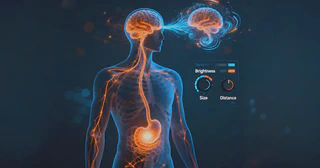
Imagine if you could change how you feel about a difficult memory or situation simply by adjusting where you feel it in your body, or by changing the direction a sensation spins. This is the power of submodality drivers, the critical sensory qualities that act as master switches for your internal experience. While most NLP training focuses heavily on visual submodalities, the kinesthetic realm of body sensations, movements, and physical qualities, along with auditory characteristics like location and tone, often hold the most profound keys to transformation. When you discover your personal driver submodalities, especially those involving the location and movement patterns of sensations in your body, you gain access to a control panel for your emotional and physical states. This article explores the landscape of submodality drivers with particular attention to the somatic dimension, revealing how the spin, flow, pressure, and placement of your internal sensations can become powerful tools for change.
🎯 THE BENEFITS OF WORKING WITH SUBMODALITY DRIVERS
“I used to think changing my feelings required years of therapy. Turns out I just needed to move that heavy feeling from my chest to my left hand and watch it dissolve. Who knew?” - Anonymous
Understanding and working with submodality drivers, particularly in the kinesthetic and auditory realms, offers immediate and lasting benefits that many people discover with surprise and delight.
Instant State Management
When you identify which sensory quality drives your experience, you can shift your emotional state in seconds rather than hours. A person who discovers that the spinning direction of anxiety in their solar plexus is their driver can reverse that spin and watch the anxiety transform into calm curiosity. The sensation might shift from a tight clockwise spiral to a gentle counterclockwise flow, and with that shift, everything changes. Your shoulders drop, your breath deepens, and the mental chatter quiets.
Physical Pain Relief
Many practitioners have found that physical discomfort often has submodality structure. A headache might appear as a red pulsing sensation, spinning clockwise in a specific location. When you identify the driver, perhaps the direction of spin or the intensity of the pulsing, and adjust it, the pain can diminish or vanish entirely. Tim and Kris Hallbom’s Dynamic Spin Release process specifically leverages this principle, using the spin direction of sensations as a primary driver for releasing both emotional and physical pain.
Enhanced Body Awareness
Working with kinesthetic drivers develops your somatic literacy. You begin noticing the subtle textures, temperatures, movements, and locations of sensations you previously ignored. This heightened awareness becomes a valuable feedback system. You notice the first whisper of stress as a tightening in your jaw, or excitement as a bubbling warmth rising from your belly. With practice, you can track how different thoughts, memories, and situations create distinct somatic signatures in your body.
Rapid Trauma Processing
Driver submodalities offer a content free way to work with difficult experiences. Instead of retelling traumatic stories, you can work directly with the sensory structure. If a disturbing memory manifests as a heavy, dark sensation in your chest, moving slowly downward, you might discover that changing its location, perhaps moving it outside your body or shifting it to your non dominant hand, automatically changes the emotional charge. The memory remains, but its grip on you loosens.
Improved Decision Making
Your body knows things before your conscious mind catches up. When you develop skill at noticing kinesthetic drivers, you tap into this somatic wisdom. A decision that feels wrong might show up as a sinking, contracting sensation in your gut. A good choice might manifest as an expanding, rising sensation in your chest. Learning to track these patterns, including their locations and movement qualities, enhances your intuitive decision making capacity.
Communication Enhancement
Understanding auditory drivers, particularly sound location and tonal qualities, transforms how you process communication. When someone’s critical voice lives in your head, located just behind your left ear, speaking in harsh tones, you can experiment with shifting that location further away, outside your body, or changing the tone to something curious rather than judgmental. This doesn’t change what was said, but it changes your relationship to the message.
Lasting Change with Minimal Intervention
Perhaps most remarkably, when you change a driver submodality, other submodalities shift automatically. Touch the right lever, and the entire system reorganizes. This explains why skilled NLP practitioners can facilitate profound shifts in minutes. They’re not working harder, they’re working smarter by identifying and adjusting the submodalities that drive the system.
🏛️ ORIGINS OF SUBMODALITY WORK ACROSS CULTURES AND HISTORY
The formal study of submodalities emerged in NLP during the early 1980s, but humans have worked with the qualities of internal experience for millennia.
Ancient Contemplative Traditions
Buddhist meditation practices developed sophisticated methods for exploring the qualities of sensation. Vipassana practitioners learn to observe sensations with extreme precision, noticing their location, intensity, movement, temperature, and how they arise and pass away. The Abhidhamma, ancient Buddhist psychology texts, categorize mental and physical phenomena with remarkable granularity, distinguishing subtle qualities that modern Western psychology is only beginning to acknowledge.
Taoist internal alchemy practices track the movement of energy, or chi, through the body. Practitioners develop sensitivity to the direction, speed, temperature, and quality of these flows. They work explicitly with spinning energy centers and circular movements of awareness, principles remarkably similar to Dynamic Spin Release.
Yogic traditions map the subtle body with precise attention to location, identifying chakras as spinning wheels of energy at specific points. Kundalini yoga describes energy rising through the spine, with practitioners learning to sense and guide these movements through their bodies.
Western Philosophical and Psychological Roots
Phenomenologists like Edmund Husserl and Maurice Merleau-Ponty explored the structure of lived experience, emphasizing embodiment and the primacy of perception. Merleau-Ponty’s work on the phenomenology of perception laid groundwork for understanding how sensory qualities shape meaning.
William James, in his Principles of Psychology, noted that emotions have distinct bodily signatures. His famous question, “Do we run from a bear because we’re afraid, or are we afraid because we run?” highlighted the intimate connection between bodily state and emotional experience.
NLP’s Systematic Development
In the late 1970s, Richard Bandler and John Grinder identified representational systems (visual, auditory, kinesthetic) as fundamental to how people code experience. However, submodalities remained primarily a way of enhancing experiences rather than transforming them.
The breakthrough came in 1983 when Richard Bandler explicitly taught how submodality shifts could change habits, beliefs, and motivation. He revealed that submodalities comprise the underlying structure of all experience, independent of content. Bandler also developed spinning techniques, working with the rotation of feelings and images to create change.
Steve and Connirae Andreas refined and systematized submodality work throughout the 1980s and 1990s, documenting patterns like the Swish, Mapping Across, and the Fast Phobia Cure. Their book, “Change Your Mind and Keep the Change,” became the definitive guide to submodality interventions.
Dynamic Spin Release
In March 2008, Tim and Kris Hallbom began developing Dynamic Spin Release, a specific approach emphasizing the spin quality of thoughts, feelings, and sensations. They observed that most problem states spin in one direction (typically clockwise or counterclockwise), while resourceful states spin in the opposite direction. By reversing the spin, the emotional charge transforms.
This work drew from Milton Erickson’s hypnotic approaches, Carl Jung’s understanding of symbols, and creative visualization while remaining grounded in NLP principles. The Hallboms presented their findings at international NLP conferences and have taught this approach worldwide, demonstrating how a single kinesthetic driver, the direction of spin, can catalyze rapid change.
Contemporary Neuroscience Validation
Recent research in embodied cognition provides scientific support for submodality work. Francisco Varela, Evan Thompson, and Eleanor Rosch demonstrated that cognition arises from sensorimotor interaction with the environment. Lawrence Barsalou’s Perceptual Symbol Theory shows that conceptual knowledge is grounded in sensory and motor experiences, which are reactivated during cognitive processing.
Neuroscientist Antonio Damasio’s work on somatic markers reveals that bodily sensations guide decision making and emotional processing. These findings validate what NLP practitioners have known experientially: the qualities of sensory experience matter profoundly.
📜 PRINCIPLES OF SUBMODALITY DRIVERS
Principle 1: Structure Determines Meaning, Not Content
The emotional impact of an experience depends more on how you represent it internally than on what actually happened. Two people can have identical experiences but feel completely differently about them because they code those experiences with different submodalities.
Consider a memory of giving a presentation. One person might see themselves from outside their body (dissociated), with the image small and distant, hearing their voice as calm and measured. They feel neutral or mildly positive about the memory. Another person might experience the same memory from inside their own eyes (associated), with the image large and close, hearing their voice as shaky and loud. They feel anxious recalling it.
The content is the same. The structure, the submodalities, creates the difference in feeling. This principle liberates you from being trapped by content. You can work with structure directly.
Somatically, this means that where you feel something in your body, how it moves, its temperature and texture, all matter more than the story about why you feel it. A tight sensation in your throat during conflict might feel very different if you move it to your fingertips, even though the conflict situation remains unchanged.
Principle 2: Driver Submodalities Create Cascade Effects
Not all submodalities are equally important. Most experiences have one or two critical submodalities that, when changed, automatically shift many others. These are your drivers.
Imagine trying to change your experience of a memory by adjusting every single submodality one by one: making it bigger, then brighter, then moving it left, then changing the sounds, then adjusting the sensations. You’d work for hours with mixed results.
But if you identify that the driver is the location of a sensation in your body, simply moving that sensation causes brightness, size, sound volume, and movement to shift automatically. You’ve found the master control.
In your body, you might notice that when you move a sensation from your chest to your hand, it simultaneously becomes lighter in weight, cooler in temperature, and starts moving in a different direction. The location was the driver that carried everything else with it.
Auditorily, changing the location of an internal voice from inside your head to three feet in front of you might automatically change its volume, tone, and emotional impact. The spatial location drove the other qualities.
Principle 3: Kinesthetic Drivers Often Hold the Most Power
While visual submodalities receive the most attention in NLP training, kinesthetic drivers frequently prove most transformative. This makes sense given that emotions are, fundamentally, felt experiences in the body.
When someone says “I feel anxious,” they’re usually describing a physical sensation: tightness in the chest, butterflies in the stomach, tension in the shoulders. These sensations have location, movement, temperature, pressure, and texture. Adjusting these kinesthetic qualities directly transforms the emotional state.
Tim and Kris Hallbom’s discovery that sensations have spin direction, and that reversing that spin changes the experience, highlights a kinesthetic driver many people never notice. Once you start paying attention, you might find sensations spinning, pulsing, vibrating, flowing, radiating, or moving in countless ways.
The body doesn’t lie. Your mind can tell you a situation is fine while your gut clenches, your jaw tightens, and your shoulders rise toward your ears. Learning to read and work with these somatic messages provides direct access to unconscious processing.
Principle 4: Submodalities Are Personally Unique
Your driver submodalities are yours. What works as a driver for you might not be critical for someone else. This is why cookbook approaches to change work sometimes fail. The technique might address a submodality that isn’t driving your particular experience.
One person’s anxiety might be driven by the spinning direction in their solar plexus. Another’s might be driven by the pressure in their chest. A third person’s might be driven by the location of a voice in their head. You must discover your own drivers through exploration and curiosity.
This principle requires practitioners to be detective-like, exploring with each client what makes the difference for them. It’s why the question “What would happen if you changed X?” proves so valuable. You’re testing to find the driver.
Your body will tell you when you’ve found a driver. You’ll feel a shift, sometimes subtle, sometimes dramatic. Other qualities will begin changing without effort. That’s how you know you’ve touched the right lever.
Principle 5: Movement Is a Powerful Kinesthetic Driver
Many people represent experiences as static sensations: a lump in the throat, a knot in the stomach, a weight on the shoulders. But when you pay closer attention, you often discover these sensations have movement qualities.
That lump might be pulsing. The knot might be tightening in a spiral. The weight might be pressing downward with a specific rhythm. And these movement patterns, when changed, often prove to be powerful drivers.
Dynamic Spin Release specifically leverages spin direction as a driver. A negative emotion spinning clockwise might transform into a resourceful state when spun counterclockwise. The same principle applies to other movement patterns: changing pulsing to steady, reversing flow direction, shifting from vibrating to still, or from contracting to expanding.
Your body is always in motion: breath flowing, heart beating, blood moving, subtle muscular adjustments. Your internal sensations mirror this dynamic quality. Learning to sense and work with movement patterns opens powerful change possibilities.
Principle 6: Location Functions as Both Kinesthetic and Auditory Driver
Where you experience something in your body profoundly affects how you experience it. A sensation in your chest feels different than the same sensation in your hand. Internal dialogue located inside your head impacts you differently than the same voice located outside your body.
Practitioners sometimes help clients externalize difficult sensations by having them place the feeling in an object they can hold, or move it to a less central location in their body. A crushing sensation in the chest might become manageable when moved to the left foot.
Similarly, voices, whether memories of what others said or your own internal dialogue, have location. A critical parent’s voice right behind your ear affects you differently than the same voice coming from across the room. Moving sound location often serves as a powerful driver for changing your response.
The boundary of your body also matters. Sensations experienced as inside you feel more personally identified with than sensations experienced as outside, near you, but separate. This spatial relationship can be adjusted and often functions as a driver.
Principle 7: Analog Submodalities Offer More Flexibility Than Digital
Some submodalities are digital: they’re either one way or another. Associated or dissociated. Color or black and white. Movie or still picture. These can be powerful, but they’re binary switches.
Analog submodalities exist on a continuum. Brightness ranges from pitch black to blindingly bright, with infinite gradations. Kinesthetic intensity ranges from barely noticeable to overwhelming. Location can be anywhere in three dimensional space. Movement can vary infinitely in speed, direction, and quality.
Analog submodalities, especially kinesthetic ones, offer more nuanced control. You can dial a sensation’s intensity up or down gradually. You can move it incrementally through space. You can slow or speed its movement, change its direction by degrees. This granular control allows you to find the sweet spot for any experience.
Your nervous system responds well to gradual shifts. Sometimes moving a sensation from your chest to your hand in one jump feels jarring. Moving it gradually, tracking how it feels at each point along the way, often works more smoothly.
🗨️ GUIDING CLIENTS IN SUBMODALITY DRIVER WORK
Observation and Presence
Position yourself at the client’s side to unobtrusively observe subtle shifts in facial expressions, gestures, and skin tone while ensuring you do not interfere with their imaginative process or metaphor creation.
Vocal Modulation
Use a gentle, melodic, and unhurried tone when speaking, allowing your voice to foster calm and receptivity.
Genuine Engagement
Demonstrate active interest in the client’s process by listening attentively and supporting their exploratory journey.
Reflective Communication
Echo the client’s words and delivery style. For example, if the client describes an exciting moment with a bright expression, quicker speech, and a higher tone, mirror these qualities in your response. As a practitioner, strive to match their affective cues, or consider formal training in expressive techniques to enhance these skills.
Connecting Experience and Inquiry
Seamlessly link questions and reflections to the client’s experiences using coordination words like and, as, or when, ensuring a smooth and empathetic flow throughout the interaction.
Discovering Driver Submodalities
Step 1: Establish the Problem State Somatically
Begin by helping the client access the experience they want to change. Ask them to think about the situation, memory, or feeling they want to work with. As they access it, notice their nonverbal shifts: changes in breathing, skin color, muscle tension, eye accessing cues.
Then bring their attention to their body: “As you think about that situation, what do you notice in your body?” Wait for their response. They might describe a sensation immediately, or they might need time to develop internal awareness.
If they struggle to notice anything physical, you might say, “Just be curious about what’s there. Sometimes there’s a tightness somewhere, or a heaviness, or a temperature, or perhaps a quality of movement. Take your time and just notice what wants to be noticed.”
Step 2: Elicit Kinesthetic Submodalities Systematically
Once they’ve identified a sensation, explore its qualities systematically but conversationally. Speed matters here. Move faster than their conscious mind can analyze, keeping them in felt experience rather than intellectual interpretation.
“Where exactly do you feel that? Point to the location… And does it have a size, like is it small as a marble or larger?… And what about shape, does it have a particular shape or form?… Temperature, is there any quality of warmth or coolness?… And movement, is it moving in any way, perhaps spinning, or pulsing, or flowing?”
Watch their responses, both verbal and nonverbal. When you mention a submodality that’s particularly significant, you’ll often see an intensification of their state. Their breathing might deepen, their face might shift, or they might nod strongly. These signals help you identify potential drivers.
Step 3: Test for Drivers
Now you’ll test which submodalities actually drive the experience. Choose one quality to experiment with, preferably one that seemed significant based on their responses.
“And that spinning sensation, which direction is it spinning? Clockwise or counterclockwise?… Good. Now I’m curious, what would happen if you imagined it spinning the other direction? Just try it for a moment and notice what happens.”
Then pause and watch. If it’s a driver, you’ll see shifts: their state will change, other submodalities will shift automatically, or they’ll report that the experience feels different. If nothing changes, it wasn’t a driver for this particular experience.
Test other submodalities the same way: “What if you moved that sensation from your chest to your hand? Just imagine sliding it across your body and notice what happens… What if you made it cooler instead of warm?… What if it pulsed instead of spun?”
Step 4: Track Cascade Effects
When you find a driver, pay close attention to what else shifts. Ask: “And as you change that spin direction, what else changes? Does the location shift? The size? The intensity? Any other qualities?”
This information helps you understand their unique system and confirms you’ve found a driver. If changing one submodality causes three others to shift automatically, you’ve discovered a powerful lever.
Also check their overall state: “And how do you feel now, with it spinning that direction?” Their emotional state should shift noticeably when you’ve adjusted a true driver.
Step 5: Work with Auditory Drivers When Relevant
If the client’s experience involves internal dialogue or remembered voices, explore auditory submodalities, especially location and tonal qualities.
“As you hear that voice, where is it coming from? Inside your head? Behind you? To one side?… And what’s the tone like? Harsh? Gentle? Loud? Soft?… What if that voice came from further away, maybe from across the room instead of right in your head? How would that change things?”
Location of sound often functions as a powerful driver. Moving an internal critical voice from inside the head to outside the body frequently shifts its emotional impact dramatically.
Step 6: Facilitate the Change
Once you’ve identified a driver, help the client adjust it to create the experience they want. If reversing a spin transformed anxiety into calm, have them practice that shift several times until it feels natural and automatic.
“So spin it clockwise, notice the anxiety… now reverse it, spin it counterclockwise, and notice it transforming into calm… good, and again, clockwise, feeling that old pattern… and reverse it, counterclockwise, watching it shift… excellent. Your unconscious is learning this new pattern.”
You can also suggest they anchor the resourceful state, perhaps with a physical gesture or breath, so they can access it easily in daily life.
Step 7: Test and Future Pace
Before finishing, test the change. Have them think about the original problem situation again and notice what’s different. If the work was successful, the situation should feel significantly different. The old emotional charge should have dissipated or transformed.
Then future pace: “And imagine a time in the future when you might have encountered this kind of situation in the old way. See yourself there, moving through it, and notice how you respond differently now.”
Watch for congruence. Their nonverbal signals should match the resourceful state, not the problem state. If you see incongruence, there may be more work to do, perhaps with a different driver or a secondary issue.
💧 SUBMODALITY DRIVER SESSION: AXEL MAGNUS SCRIPT BASED ON MAPPING ACROSS
“The first time I tried to change a feeling by moving it around my body, I felt ridiculous. But then it actually worked, and I felt even more ridiculous for not trying it sooner.” - Anonymous
Technique Used: Mapping Across Submodalities with Kinesthetic Driver Focus
This session demonstrates how to identify kinesthetic drivers and map them from a problem state to a resource state, with particular attention to location and movement qualities.
Axel Magnus sits beside his client, Sarah, who sits comfortably in a chair. He’s positioned slightly to her side, able to observe her without being directly in her line of sight.
Axel Magnus: Thanks for being willing to explore this process with me today, Sarah. I’m curious, is there a situation where you feel stuck, where you’d like to feel more resourceful?
Sarah: Yeah, there’s this thing at work. Whenever my boss asks to meet with me, I just freeze up. Even if it’s probably nothing important, my body just locks down.
Sarah’s shoulders visibly rise and tighten as she describes this. Her breathing becomes shallower.
Axel Magnus: I notice even talking about it, something shifts in your body. Let yourself think about that for just a moment, a time when your boss asked to meet with you… and as you think about it, what do you notice happening in your body?
Pause. Sarah’s hand moves to her chest.
Sarah: There’s this… tightness. Right here, in my chest.
Axel Magnus: Good. Just stay with that tightness for a moment. And as you notice it there in your chest, I’m curious about its qualities. Does it have a size?
Sarah: It’s maybe… the size of my fist. Like a hard ball.
Axel Magnus: A fist sized hard ball right there in your chest. And temperature, is there any warmth or coolness to it?
Sarah: Cold. It’s cold.
Axel Magnus: Cold, yes. And this might seem like an odd question, but does this cold, hard ball have any movement to it? Is it still, or is there any quality of spinning, or pulsing, or anything like that?
Sarah closes her eyes, her brow furrowing slightly in concentration.
Sarah: It’s… it’s turning. Like, spinning inward. Clockwise, and inward, into my chest.
Axel notices her breathing has become even more restricted. This spinning quality seems significant.
Axel Magnus: Spinning clockwise and inward into your chest. That’s really helpful to know. And how do you feel, with that sensation spinning that way?
Sarah: Trapped. Like I can’t breathe fully. Stuck.
Axel Magnus: Trapped, stuck, can’t breathe fully. Yes. Now I’m going to ask you to shift gears for a moment. Can you think of a time, any time, when you felt confident and capable? Maybe at work, maybe somewhere else, doesn’t matter. A time when you knew you could handle whatever came your way.
Sarah’s face softens immediately. Her shoulders drop slightly.
Sarah: There was this presentation I did last month. I’d prepared really well, and when I got up to present, I just… knew I had this.
Axel Magnus: Perfect. Put yourself back in that moment, really seeing what you saw, hearing what you heard… and as you do that, what do you notice in your body?
Sarah: There’s this warmth, spreading from here. She places her hand on her upper abdomen, solar plexus area. It’s warm and it’s kind of… expanding outward.
Axel Magnus: Warm and expanding outward from your solar plexus. Does this expanding sensation have a direction it moves?
Sarah: It moves up and out. Like it starts in my center and radiates outward and upward through my chest.
Axel notices her breathing has deepened. Her face looks brighter.
Axel Magnus: Radiating upward and outward. And does it have any rotating quality, or is it more of a straight radiation?
Sarah: pausing, noticing It does turn. It spirals outward. Counterclockwise, opening up.
Axel Magnus: Counterclockwise, spiraling outward and upward. Beautiful. And how do you feel with this warm sensation spiraling that way?
Sarah: Open. Expansive. Like anything’s possible.
Axel Magnus: Open, expansive, anything’s possible. Yes. He pauses, letting her enjoy the state for a moment. Now, I want to show you something interesting. We’ve discovered that when you feel stuck with your boss, you have a cold, hard ball in your chest, spinning clockwise and inward. And when you feel confident and capable, you have warm expansion in your solar plexus, spiraling counterclockwise and outward. Different locations, different qualities, different movements. Your unconscious codes these two experiences in completely different ways.
Sarah: That makes sense. They feel totally different.
Axel Magnus: They do. And here’s what’s interesting. If we change the structure, the feeling changes. So I’m curious, are you willing to do an experiment?
Sarah: Sure.
Axel Magnus: Good. Think about that situation with your boss again for just a moment, just enough to find that cold, hard ball spinning clockwise inward in your chest.
Sarah’s face tightens slightly, shoulders rising.
Sarah: I’ve got it.
Axel Magnus: Good. Now, I want you to imagine taking that cold sensation and moving it down, down from your chest into your solar plexus area, right where your confident feeling lives. Just imagine sliding it down your body until it’s in that new location. Take your time.
Sarah’s hands make a gentle downward motion. After a few seconds, her face shows surprise.
Sarah: That’s weird. As soon as I moved it down there, it started getting warmer.
Axel Magnus: It started getting warmer automatically. Excellent. Your unconscious is helping you. Now, that spinning, clockwise and inward, I’m curious what would happen if you reversed the direction. Instead of spinning clockwise and inward, what if it spun counterclockwise and outward?
Sarah’s eyes remain closed. After a few seconds, her entire face transforms. Her shoulders drop, her breathing deepens, and a slight smile appears.
Sarah: Oh wow. It just… opened up. The tightness is gone.
Axel Magnus: The tightness is gone, and it opened up. And as it spins counterclockwise and outward, does anything else shift? The temperature, the size, any other qualities?
Sarah: It’s definitely warmer now. And it’s not hard anymore, it’s more like… liquid light. And it’s bigger, spreading through my whole chest area.
Axel Magnus: Liquid light, spreading through your whole chest, warm, spinning counterclockwise and outward. How do you feel now?
Sarah: Completely different. Light. Open. I feel like I could handle the meeting.
Axel Magnus: You could handle the meeting. Yes. So let’s practice this a few times to really teach your unconscious this new pattern. Go back to thinking about your boss asking to meet with you, find that old cold, hard sensation if it’s still there…
Sarah: It’s much lighter now, but I can still find a little bit of it.
Axel Magnus: Good. So find that little bit, and now move it to your solar plexus and reverse the spin, counterclockwise and outward, and notice it transforming…
Sarah’s face shifts from slight tension to openness.
Sarah: Yeah, it just dissolves into that warm, expansive feeling.
Axel Magnus: Perfect. Again. Find any trace of that old tightness, and move it and reverse it, watching it transform…
They practice this sequence three more times. Each time, the shift happens more quickly and automatically. By the final repetition, Sarah laughs.
Sarah: It’s like my body already knows what to do. I barely have to think about it and it just shifts.
Axel Magnus: Your unconscious is learning this new pattern. It’s becoming automatic. Now, imagine it’s next week, and your boss says, “Sarah, can I see you in my office?” Imagine hearing those words, and notice how you respond now.
Sarah sits quietly for a moment, eyes closed, a slight smile on her face.
Sarah: I feel curious. Like, “I wonder what this is about?” instead of “Oh no, what did I do wrong?” And my body feels open, that warm spinning sensation is already there.
Axel Magnus: Curious instead of panicked, warm and open instead of tight and cold. Your unconscious has created a new pattern. And the beautiful thing is, we didn’t have to analyze why you felt that way, or dig into past history. We just worked with the structure, the location and the spin direction, and your whole experience shifted.
Sarah: That spinning thing, reversing the direction, that was the key. As soon as I did that, everything else changed automatically.
Axel Magnus: Yes. The spin direction was your driver submodality. When you reversed it, all the other qualities shifted with it: the temperature, the texture, the feeling state, everything. Your unconscious used that spinning direction as a master switch. Now you know how your system works, and you have a tool you can use anytime.
Sarah opens her eyes, looking amazed.
Sarah: I never would have thought something so simple could make such a difference. I mean, it’s just imagining something spinning the other direction.
Axel Magnus: It seems simple, and in a way it is. But it’s working with the deep structure of how your nervous system codes experience. That structure is powerful. The direction something spins in your body, or where it’s located, or how it moves, these aren’t just metaphors. They’re the actual sensory language your unconscious uses to create your felt experience.
Sarah: So I could use this with other things too? Not just the work situation?
Axel Magnus: Absolutely. Now that you know this is one of your drivers, you can explore it with other experiences. Anytime you notice an uncomfortable sensation, you can check: where is it located? What direction is it spinning or moving? And you can experiment with moving it, reversing it, changing its qualities. See what happens.
Sarah: I’m definitely going to practice this. Thank you.
Axel Magnus: You’re welcome. Your unconscious did all the work. I just helped you find the right switch to flip.
💪 MEDITATION FOR DISCOVERING YOUR KINESTHETIC DRIVERS
“I thought meditation was supposed to be about emptying your mind. Turns out it’s more like becoming a scientist of your own nervous system.” - Anonymous
This meditation uses Ericksonian language patterns to help you discover your personal kinesthetic driver submodalities. Find a comfortable position and allow yourself to settle in.
You might begin by allowing your eyes to close, in their own time, whenever that feels just right for you… and as they do, you can start to notice your breathing, without trying to change it, just becoming curious about how your body already knows how to breathe, all by itself…
And while you continue to breathe, you might begin to notice the temperature of the air as it moves in through your nostrils… perhaps cool as it enters… and maybe warmer as it leaves… and I wonder if you can notice where in your body you feel this breathing most clearly… perhaps in your chest… or your belly… or somewhere else entirely…
As you settle more deeply into this moment, you may discover that thoughts and feelings have locations in your body… and it’s possible that you’ve never paid attention to this before… but your unconscious has always known… that every thought, every feeling, every memory has a place it lives… a location where you experience it…
So you might allow yourself to think of something pleasant… maybe a memory of a time when you felt really good… and as that memory comes to mind, you can begin to notice… where in your body do you feel that pleasant feeling?…
Take your time… there’s no rush… and perhaps you notice a warmth somewhere… or a lightness… or an expansion… and wherever you notice something pleasant, you can allow your attention to rest there for a moment…
And as you rest your attention on this pleasant sensation, you might become curious about its qualities… does it have a size?… is it small as a pebble, or large as your whole chest?… and what about its shape… does it have defined edges, or does it blend and merge with surrounding areas?…
I wonder if you can notice the temperature… is there warmth there… or coolness… or perhaps a neutral quality… and the texture… is it smooth, or rough, or soft, or something else entirely…
And here’s where it becomes really interesting… because you might discover that this pleasant sensation has movement… perhaps it’s flowing… or pulsing… or spinning… or radiating outward… or maybe it’s perfectly still… and whatever you discover is exactly right for you…
If you notice any movement, you can allow yourself to become curious about its direction… if it’s spinning, which way does it turn?… if it’s flowing, where does it flow from and where does it flow to?… if it’s expanding, does it move outward in all directions, or primarily in one direction?…
And as you notice all these qualities, you might begin to sense which quality feels most important… which quality, if you changed it, would change everything else… that’s your driver… the master switch… and your unconscious knows exactly which one it is…
Now, keeping that pleasant feeling in your awareness, you might allow yourself to think of something slightly uncomfortable… nothing overwhelming, just a minor annoyance or a small worry… something manageable… and as you think of this, you can notice… where do you feel that in your body?…
And perhaps you discover it’s in a different location than the pleasant feeling… and that’s interesting, isn’t it?… that different experiences live in different places… and as you notice this uncomfortable sensation, you can explore its qualities with the same gentle curiosity…
What size is it?… What shape?… What temperature?… And does it have movement?… Is it spinning, perhaps in a direction opposite to the pleasant sensation?… Or pulsing, or tightening, or something else?…
And you might discover that this uncomfortable sensation wants to move… or change direction… or shift to a different location… and you can allow it to show you what it wants to do… because your unconscious already knows how to transform discomfort into something more useful…
What would happen if you moved that sensation to a different location?… Perhaps from your chest to your hand… or from your throat to your feet… just imagining it sliding through your body until it finds a new home… and you might be surprised by how different it feels when it changes location…
Or if it’s spinning, what would happen if you reversed the direction?… If it spins clockwise, what if it spun counterclockwise?… If it moves inward, what if it moved outward?… Just experimenting, with curiosity and playfulness, noticing what shifts when you change the direction of movement…
And as you experiment with these changes, you may notice that other qualities shift automatically… the temperature might change… or the size… or the intensity… and that tells you something important… you’ve found a driver… a quality that, when changed, brings other qualities along with it…
You can practice this now, shifting back and forth… finding that uncomfortable sensation in its original form… and then changing its location or its movement direction… and noticing how it transforms… and your unconscious is learning… creating new patterns… new possibilities…
And whenever you’re ready, taking all the time you need, you can begin to bring your awareness back to this room… noticing the surface beneath you… the sounds around you… and when it feels right, allowing your eyes to open… bringing with you this new awareness of how your body codes experience… and the knowledge that you have access to the control panel… the driver submodalities that can transform your internal experience whenever you choose.
🗣️ ANECDOTE ABOUT DISCOVERING DRIVERS THROUGH SPIN
I worked with a man named Michael who suffered from chronic shoulder pain. He’d seen doctors, physical therapists, chiropractors. They’d found nothing structurally wrong. The pain persisted, a constant companion for three years.
When Michael first sat down with me, his right shoulder was visibly higher than his left, pulled up toward his ear in a permanent cringe. He described the pain as “always there, like someone’s hand gripping my shoulder and squeezing.”
I asked him to close his eyes and really pay attention to that sensation. “Where exactly do you feel it? Show me with your hand.”
He placed his right hand on top of his right shoulder. “Right here. It’s like a hot, tight grip.”
“Hot and tight,” I reflected. “And this might sound odd, but does this gripping sensation have any quality of movement to it?”
Michael paused, his brow furrowing. “I never thought about that before.” He sat quietly for almost a minute. “Yeah. Yeah, it does. It’s like… it’s rotating. Tightening in a rotation.”
“Rotating which direction? Clockwise or counterclockwise?”
He thought about it, his hand making small circular motions in the air. “Clockwise. Tightening clockwise, like someone’s wringing out a towel.”
I could see the tension in his face increase as he focused on this sensation. His breathing had become shallow.
“Okay. Stay with me here. I want to try something. Keep that sensation in your awareness, but I want you to imagine reversing the direction. Instead of rotating clockwise, tightening, what if it rotated counterclockwise, unwinding?”
Michael sat very still. I watched his face carefully. Nothing happened for about ten seconds. Then, suddenly, his eyes flew open.
“It stopped,” he said, his voice filled with disbelief.
“What stopped?”
“The pain. It just… it unwound and disappeared.”
His right shoulder had visibly dropped, now level with his left. He rolled his shoulder experimentally, his eyes wide.
“That’s not possible,” he said. “I’ve had this pain for three years. I can’t have just imagined it away.”
“Move your shoulder. How does it feel?”
He lifted his arm, rotated it, shrugged both shoulders. “It feels normal. Completely normal. What did you do?”
“I didn’t do anything. You reversed the spin direction. That direction was the driver, the key that locked the pain in place. When you reversed it, everything else unlocked automatically.”
Over the next twenty minutes, we practiced this several times. Each time, Michael would focus on the painful tightening clockwise rotation, and it would intensify. Then he’d reverse the spin to counterclockwise, and the pain would unwind and vanish. By the fifth repetition, the shift happened almost instantaneously.
“This is the weirdest thing I’ve ever experienced,” he said, laughing. “It’s been there constantly for three years. I’d stopped believing it could ever go away. And it’s just… gone.”
“How does your shoulder feel now when you move it?”
He lifted his arm over his head, something he’d told me he couldn’t do without pain. “Perfect. No pain at all. I keep waiting for it to come back.”
“It might,” I said honestly. “Pain patterns can be persistent. But now you know the switch. If it comes back, you know how to reverse the spin. Your unconscious created a pattern where clockwise rotation meant pain and tension. You just taught it a new pattern where counterclockwise rotation means release and ease.”
I saw Michael again six months later. The shoulder pain had tried to return a few times, always with that clockwise tightening sensation. Each time, he’d reversed the spin, and the pain dissolved. Eventually, his unconscious stopped generating the pain pattern altogether. His body had learned a new way.
What struck me most about Michael’s case was how simple the intervention was, and how profound the result. Three years of chronic pain, transformed in minutes by reversing the direction of an unconscious spin. Not because we analyzed why the pain was there, or what it meant, or where it came from. We simply found the driver, the spin direction, and changed it.
That’s the power of working with submodality drivers. You’re not fighting the problem, you’re not trying to override it with willpower, you’re not digging into its historical roots. You’re simply finding the sensory switch that creates the experience and flipping it. The unconscious does the rest.
👣 THE BASIC PROCESS OF DISCOVERING YOUR KINESTHETIC DRIVERS
Step 1: Identify the experience you want to explore
Choose a specific situation, memory, or feeling state you want to understand better or change. It doesn’t have to be intensely negative. You can start with something mildly uncomfortable to practice the process without overwhelming yourself.
Think about this experience just enough to activate it. Notice what shows up in your awareness. Pay particular attention to your body rather than your thoughts about the situation.
If you notice yourself getting lost in the story or the content, gently bring your attention back to physical sensation. The story doesn’t matter for this process. The sensory structure does.
Step 2: Locate the sensation in your body
Ask yourself: Where do I feel this? Scan through your body from head to toe. Many people feel emotions in their chest, throat, or belly, but sensations can appear anywhere.
When you find something, point to it. Use your hand to indicate the exact location. This physical gesture helps your unconscious clarify where the sensation lives.
Be specific. “In my chest” is good. “In the center of my chest, about two inches below my collarbone” is better. Precision helps you work with the sensation more effectively.
Some people feel sensations on the surface of their body, others deep inside, others somewhere in between. Notice where yours lives in this three dimensional space.
Step 3: Explore the sensation’s basic qualities
Now examine the sensation’s characteristics systematically. Start with size. Is it small as a marble? Large as your fist? Bigger? Place your hands to show yourself its approximate size.
What about shape? Round? Elongated? Formless? Does it have clear boundaries or does it fade into surrounding areas?
Notice temperature. Is there warmth? Coolness? A neutral quality? Even subtle temperature differences matter.
Check for texture or density. Does it feel hard, soft, light, heavy, smooth, rough? What’s the quality of the sensation?
Pay attention to intensity. On a scale of one to ten, how strong is this sensation? This gives you a baseline to notice changes later.
Step 4: Discover movement qualities
This is where many people find their kinesthetic drivers. Most sensations, when you pay close attention, have movement qualities that usually go unnoticed.
Ask yourself: Is this sensation moving in any way? Be patient. It might take thirty seconds or more to notice movement. Your unconscious needs time to bring this information into awareness.
Common movement patterns include: spinning or rotating, pulsing or throbbing, vibrating or trembling, flowing or streaming, expanding or contracting, rising or falling, radiating outward or pulling inward.
If you notice spinning, which direction? Clockwise or counterclockwise? If flowing, from where to where? If pulsing, what’s the rhythm?
Movement direction often proves to be a powerful driver. Many people discover their uncomfortable sensations spin one direction, while comfortable sensations spin the opposite direction.
Step 5: Test for drivers by making changes
Now experiment with changing different qualities one at a time. This is how you discover which submodalities function as drivers for you.
Start with location. Imagine moving the sensation from its current spot to somewhere else in your body. Perhaps from your chest to your left hand. Notice what happens. Does the sensation change? Do you feel different emotionally?
If moving location creates a shift, you’ve likely found a driver. If nothing changes, location isn’t driving this particular experience for you.
Next, try reversing any movement. If the sensation spins clockwise, imagine it spinning counterclockwise. If it moves downward, imagine it moving upward. If it expands, imagine it contracting.
Watch carefully for cascade effects. When you change a driver submodality, other qualities should shift automatically. The temperature might change, the intensity might increase or decrease, the size might grow or shrink. These automatic shifts tell you you’ve found a driver.
Step 6: Compare with a resourceful state
Think of a time when you felt good, capable, confident, or peaceful. Access that experience and notice where you feel it in your body.
Explore this positive sensation’s qualities just as you did with the uncomfortable one. Where is it located? What size, shape, temperature? What movement qualities does it have?
Often, you’ll discover your resourceful states have opposite characteristics from your problem states. If anxiety spins clockwise in your chest, confidence might spin counterclockwise in your solar plexus. If stress creates a heavy downward pressure on your shoulders, ease might create a light upward lift in your chest.
These contrasts reveal your personal coding system. Your unconscious uses specific submodality patterns to distinguish between different types of experiences.
Step 7: Map the resourceful structure onto the problem
Now you can experiment with transforming the uncomfortable sensation by giving it the qualities of the resourceful one.
Move the uncomfortable sensation to the location where you feel resourcefulness. Change its movement direction to match the resourceful pattern. Adjust its temperature, size, and other qualities to mirror the positive state.
This process, called Mapping Across in NLP, leverages your own unconscious coding system. You’re not imposing an arbitrary change, you’re teaching the uncomfortable experience to take on the structure your unconscious already uses for resourcefulness.
Notice how you feel as you make these adjustments. If you’ve found true drivers, the emotional quality of the experience should transform as the sensory structure changes.
Step 8: Practice and integrate
Run through the transformation several times in a row. Access the uncomfortable sensation in its original form, then shift it to the resourceful structure. Repeat this cycle five to ten times.
Each repetition teaches your unconscious the new pattern more deeply. The shift should become faster and more automatic with each practice round.
Eventually, you may find that accessing the original uncomfortable sensation becomes difficult. Your unconscious has adopted the new pattern and resists going back to the old one.
When this happens, you’ve successfully installed a new response. The old pattern hasn’t been erased, but it’s no longer the default. Your nervous system now has a more useful option available.
Step 9: Test in imagination
Imagine a future situation where you might have experienced the old pattern. See yourself in that context and notice how you respond now.
If the work has been effective, you should experience the resourceful state automatically. Your body should generate the new sensory pattern without conscious effort.
If you still feel some of the old pattern, that’s information. Perhaps there’s another driver you haven’t discovered yet, or maybe the situation has multiple layers that need addressing separately.
Step 10: Apply in real life
The real test comes when you encounter the actual situation. Notice what happens in your body. Many people are surprised to find the new pattern activates automatically.
If the old pattern tries to return, you now have tools. You know your drivers. You can consciously shift the location, reverse the movement, adjust the qualities. With practice, this becomes increasingly automatic.
Keep a journal of what you notice. Which drivers prove most powerful for you? Do different situations have different drivers, or do you have personal drivers that work across multiple contexts? This self knowledge becomes increasingly valuable over time.
▶️ VIDEO ABOUT SUBMODALITY DRIVERS

This video by Richard Bandler demonstrates working with submodality shifts to transform experience. Watch how he helps the client identify specific sensory qualities of memories and then systematically changes those qualities to shift the emotional impact. Pay particular attention to how changing one or two key submodalities automatically causes other submodalities to shift. This illustrates the driver principle in action. Notice also how he uses location and distance as visual drivers, principles that apply equally to kinesthetic work with body sensation locations.
❓ FAQ ABOUT SUBMODALITY DRIVERS
Question: How do I know if I’ve found a real driver submodality or just a random quality that doesn’t really matter?
Answer: When you change a true driver submodality, you’ll notice cascade effects. Other submodalities will shift automatically without you trying to change them, and your emotional state will transform noticeably. If you change something and nothing else shifts, you probably haven’t found a driver for that particular experience. Keep exploring. Also trust your body’s response. When you hit a driver, you’ll often feel an immediate physical shift, sometimes subtle, sometimes dramatic. Your breathing might change, muscle tension might release, or you might feel a wave of relief or opening. These somatic signals confirm you’ve touched something important.
Question: Why do some NLP books focus almost entirely on visual submodalities when kinesthetic drivers seem so powerful?
Answer: Early NLP research found that visual submodalities were easiest to identify and describe for most people. Vision is our dominant sense in waking consciousness, so visual qualities tend to be more obvious. Additionally, many of the early NLP developers were primarily visual thinkers themselves. However, practitioners working deeply with clients discovered that emotions are fundamentally felt experiences in the body, making kinesthetic drivers extraordinarily powerful for emotional change work. The field has increasingly recognized the importance of kinesthetic submodalities, especially with developments like Dynamic Spin Release. If you’re primarily kinesthetic in your processing, you may find body based drivers more accessible and effective than visual ones.
Question: Can submodality work be harmful? Are there situations where I shouldn’t experiment with changing these qualities?
Answer: Submodality work is generally safe, but use common sense. If you’re dealing with severe trauma, complex PTSD, or intense emotional material, work with a qualified practitioner rather than experimenting alone. Some experiences have protective functions, and dismantling those protections without support can be destabilizing. Also, if changing a submodality creates an increase in distress rather than relief, stop immediately. This suggests you’re working with material that needs a different approach or professional support. For everyday anxieties, frustrations, and limiting patterns, self exploration with submodalities is usually safe and often helpful. Start with mild issues to learn the process before tackling more charged material.
Question: What if I can’t feel any sensations in my body at all? I think about situations but don’t notice physical feelings.
Answer: This is more common than you might think, especially in cultures that emphasize thinking over feeling. Start by building body awareness through simple practices. Throughout your day, pause and ask yourself: How do I know I’m hungry? Tired? Comfortable? Uncomfortable? These states always have physical markers. You might also try moving your attention to obvious physical sensations first, like the pressure of your feet on the floor or your back against a chair, then gradually developing sensitivity to more subtle internal sensations. Some people find that placing a hand on their chest or belly helps them tune into sensations in those areas. Be patient with yourself. This is a skill that develops with practice. Even people who initially report feeling nothing in their body gradually discover rich inner sensory landscapes once they learn to pay attention.
Question: Do driver submodalities stay the same across different situations, or do they change?
Answer: Both patterns occur. Some people have personal driver submodalities that work across many contexts. For example, someone might discover that spin direction is a driver for anxiety, anger, and sadness, all responding to the same intervention. Others find that different issues have different drivers. Work stress might be driven by sensation location, while relationship anxiety might be driven by movement direction, and physical pain by temperature. Through exploration, you’ll discover your own patterns. Generally, pay attention to what works for you rather than assuming everyone’s system functions the same way. Your unconscious has its own unique logic, and discovering that logic gives you tremendous power to work with your experience.
Question: How long does it take for changes made with submodality work to become permanent?
Answer: This varies significantly. Some shifts happen instantly and last indefinitely. Michael’s shoulder pain, from the anecdote earlier, resolved in minutes and didn’t return. Other patterns require repeated practice over days or weeks before the new response becomes automatic. Generally, the more you practice the new pattern, the more deeply it integrates. Think of it like learning any skill. The first time you consciously reverse a spin or move a sensation, it requires deliberate attention. After fifty repetitions, it becomes second nature. Some changes stick immediately because they align with a deeper truth your unconscious was ready to embody. Others need time and repetition to override years of habitual patterning. Be patient and persistent, and track your progress. Even partial improvements represent real change.
Question: Can I use submodality drivers to enhance positive experiences, not just fix problems?
Answer: Absolutely, and this is an underutilized application of the work. Once you identify the sensory structure of peak experiences, confidence, creativity, or flow states, you can consciously recreate those structures to access those states more readily. Athletes use this intuitively when they recall their best performances and amp up the internal representations. You can discover what submodalities characterize your most resourceful states and then practice generating those qualities at will. Want to feel more motivated? Find the location, movement pattern, temperature, and other qualities present when you feel naturally motivated, then practice creating those sensations deliberately. Your nervous system responds to the structure regardless of whether it arose spontaneously or you created it consciously. This makes submodality work not just therapeutic but also generative, helping you access your best self more consistently.
Question: Is there scientific evidence supporting submodality work, or is this just an NLP model without research backing?
Answer: While controlled research specifically on NLP submodalities remains limited, substantial neuroscience research supports the underlying principles. Studies in embodied cognition demonstrate that sensory and motor systems are integral to conceptual processing and emotional experience. Antonio Damasio’s work on somatic markers shows that bodily sensations guide decision making and emotion. Research on mental imagery reveals that imagining sensory experiences activates the same brain regions as actual perception. Lawrence Barsalou’s Perceptual Symbol Theory demonstrates that conceptual knowledge is grounded in sensorimotor simulations. These findings validate the core premise that the qualities of your internal sensory representations profoundly affect your experience. The specific claim that changing submodalities transforms emotional states aligns with this broader scientific understanding, though more research specifically testing NLP submodality interventions would strengthen the evidence base. Pragmatically, thousands of practitioners and clients report consistent results, suggesting the model has practical validity regardless of academic research status.
😆 JOKES ABOUT SUBMODALITY DRIVERS
-
“My therapist asked where I feel my anxiety. I said ’everywhere.’ She said ‘be more specific.’ I said ’everywhere, but with extra emphasis in my chest.’ Apparently that counts as progress.” - Anonymous
-
“I tried reversing the spin of my Monday morning dread. It worked great until I realized I’d accidentally reversed the spin on my motivation to go to work. Now I’m enthusiastically unemployed.” - Anonymous
-
“Turns out my critical inner voice has been located directly behind my left ear for forty years. I moved it to New Jersey. Things have improved considerably.” - Anonymous
-
“I discovered that my procrastination has a specific movement pattern: it spirals endlessly without actually going anywhere. Finally, accurate self diagnosis.” - Anonymous
-
“The first time someone told me to notice where I feel my feelings, I thought they were joking. Feelings are emotional, not physical. Then I noticed the knot in my stomach, the tension in my jaw, and the weight on my chest. Fine, they’re physical. Smug feelings experts.” - Anonymous
-
“I’ve been spinning my sensations the wrong direction for thirty years. No wonder everything felt backwards. My unconscious apparently never read the manual.” - Anonymous
🦋 METAPHORS FOR SUBMODALITY DRIVERS
-
The mixing board: Imagine your internal experience as a song playing through a mixing board with dozens of knobs and sliders controlling different aspects of the sound: volume, bass, treble, reverb, panning left or right. Most people adjust everything frantically, tweaking every control slightly. But there’s usually one master fader or one critical EQ setting that, when adjusted, brings the entire mix into balance. That’s your driver submodality, the single control that makes everything else fall into place.
-
The compass needle: Your emotional states are like a compass needle responding to magnetic fields. Most people think they need to manually force the needle to point in the right direction, holding it there through sheer willpower. But when you discover your driver submodality, it’s like finding the actual magnet creating the field. Move the magnet, and the needle swings naturally to a new orientation without force. The spin direction of a sensation, or its location in your body, acts like that magnet, creating a field that orients your entire emotional experience.
-
The root system: Consider a tree with extensive roots underground. You can trim branches all day, but if you want to fundamentally change the tree, you work with the root system. Driver submodalities are like taproot, the central root from which all others branch. Surface level interventions work on the branches, adjusting thoughts or behaviors. Submodality driver work goes straight to the root, shifting the foundational structure from which everything else grows. Change the root, and the entire tree reorganizes itself naturally.
-
The combination lock: Your emotional patterns are secured by combination locks. Most therapeutic approaches try different combinations randomly, sometimes hitting the right sequence by accident. Understanding driver submodalities is like someone showing you the combination directly. Once you know that your particular lock opens with right two turns, left one turn, right three turns, you can open it reliably every time. Your spin direction, your sensation location, your movement pattern, these are the specific numbers in your combination, unique to you, instantly effective once discovered.
-
The pressure point: In martial arts and acupuncture, certain points on the body have disproportionate effects. Pressing one small spot can release tension throughout an entire muscle chain or shift energy flow through meridians. Driver submodalities work similarly in the realm of internal experience. One small precise change in a critical location creates ripple effects throughout your entire emotional and physical state. You’re not applying more pressure everywhere, you’re applying precise pressure in exactly the right spot.
-
The keystone: Ancient architects used keystones, the wedge shaped stones at the apex of an arch that lock all other stones in place. Remove the keystone, and the entire arch collapses. Replace it, and the structure stands firm. Driver submodalities function as keystones in the architecture of your emotional experience. They’re the single piece that holds the pattern together. Adjust this piece, and the entire structure reorganizes. Everything else depends on this one critical element.
-
The tuning fork: When you strike a tuning fork of a specific frequency, other objects tuned to that frequency begin vibrating in resonance. Driver submodalities work like tuning forks in your nervous system. When you activate a specific quality, sensation location, spin direction, movement pattern, it sets up a resonance that automatically activates or deactivates entire networks of associated responses. Change the frequency, and different networks resonate. Your body knows which frequencies create which states, you’re simply learning to consciously strike the fork you want.
🧑🦲 AXEL MAGNUS’S EXPERIENCE WITH SUBMODALITY DRIVERS
I’ll never forget the moment I first truly understood kinesthetic drivers. I’d been practicing NLP for years, working primarily with visual and auditory submodalities because that’s what the books emphasized. I got decent results, but something felt incomplete.
Then I attended a workshop where someone demonstrated Dynamic Spin Release. The facilitator worked with a volunteer who had severe anxiety about flying. Within minutes, using nothing but questions about sensation location and spin direction, the volunteer’s lifelong phobia transformed. I watched her face shift from pale and tight to open and peaceful. She laughed with disbelief.
I thought it might be a fluke, or that she was particularly suggestible. So during the lunch break, I decided to experiment on myself. I had this persistent low grade worry about money that had followed me for years, a constant background hum of financial anxiety no matter how stable my situation actually was.
I closed my eyes and asked myself where I felt this money worry in my body. The answer came immediately: my upper abdomen, just below my ribs. I’d never consciously noticed this before, but the moment I asked, I could feel it clearly. A tight, cold sensation, about the size of a tennis ball.
I explored its qualities. Definitely cold. Hard. Dense. And then I asked about movement, which felt like an odd question. How could a sensation have movement?
But I stayed with it, being curious. After about twenty seconds, I felt it. The sensation was rotating. Clockwise, pulling inward toward my spine, creating a kind of suction in my gut. I gasped audibly, sitting there in the hotel lobby. I’d carried this sensation for years, maybe decades, and never once noticed it was spinning.
Just for fun, I imagined reversing the direction. Counterclockwise, pushing outward instead of pulling in.
Within three seconds, my entire body shifted. My shoulders dropped. My breath deepened. The cold, tight ball in my belly dissolved into a warm, expansive feeling that spread upward through my chest. And the anxiety was simply gone.
I sat there stunned. I’d worked on this money anxiety before, with various therapeutic approaches. I’d explored its childhood roots, I’d challenged my limiting beliefs, I’d done affirmations and cognitive restructuring. All of that helped somewhat, but the anxiety always remained lurking in the background.
And I’d just eliminated it in ten seconds by reversing an imaginary spin direction.
My rational mind rebelled. This couldn’t be real. It was too simple, too fast, too much like magical thinking. But I couldn’t argue with my body’s response. The anxiety was gone. My belly felt warm and relaxed. I felt grounded and calm in a way I rarely experienced around financial topics.
Over the next hour, I tested it repeatedly. I’d think about money, find the clockwise tightening trying to reappear, reverse it to counterclockwise expansion, and watch the anxiety dissolve. Each time, it worked faster. By the twentieth repetition, reversing the spin happened almost automatically. My unconscious was learning a new pattern.
That evening, I called my partner to tell her I might need to quit my practice and do something completely different because I’d just discovered that everything I thought I knew about therapeutic change was missing the most important piece. She patiently listened to my breathless explanation about spinning sensations and told me I sounded slightly unhinged but she was glad I’d had a breakthrough.
The next morning, I woke up and checked my belly. The old clockwise tightening wasn’t there. For the first time in years, I thought about money and felt neutral. Calm. Grounded. The spinning direction had been the driver all along, the master switch controlling my entire relationship with financial security.
That experience transformed my practice. I started asking every client about sensation location and movement. I discovered that almost everyone has spinning or flowing sensations they’ve never consciously noticed. And for many people, these movement patterns function as powerful drivers.
One client’s depression spiraled downward through her chest. When we reversed it to spiral upward, her mood lifted immediately. Another client’s anger pulsed outward from his head in sharp, hot waves. When we changed the pulsing to a steady, gentle rhythm, the anger transformed into calm assertiveness. The pattern repeated across clients, across issues.
I’m still somewhat amazed by how simple and profound this work is. We’re not analyzing complex psychological dynamics or processing traumatic memories or building elaborate intervention strategies. We’re just noticing: Where do you feel this? Which direction does it move? What happens if you change that? And people’s lives transform.
I think about all the years I spent working so hard, using sophisticated techniques, when the simplest question, “Which way does it spin?” holds such transformative power. My clients sometimes apologize for their issues being resolved too quickly, as if fast change is somehow suspect. I reassure them that efficient change is the best kind. Your unconscious doesn’t need you to suffer for years to prove the problem was real.
Now when I teach practitioners, I emphasize kinesthetic drivers from the beginning. Yes, learn visual and auditory work. But never forget that emotions live in the body. The sensations people feel, where they feel them, how those sensations move, these are often the most direct pathways to transformation.
And I teach them to trust simplicity. The most elegant solutions are often the simplest. You don’t need to make change complicated to make it real. Sometimes, reversing a spin changes everything. And that’s enough.
🕳️ THE LIMITATIONS OR UNCERTAINTIES IN SUBMODALITY DRIVER WORK
Not a Universal Solution for All Issues
Submodality work excels at transforming emotional responses to memories, situations, and internal states. However, it’s not appropriate for every challenge. Systemic issues, relationship dynamics requiring communication changes, skill deficits, or situations requiring practical problem solving won’t be resolved by adjusting internal sensory qualities alone.
If you need to learn a new skill, changing how you feel about not having it won’t replace actual learning. If a relationship needs better communication patterns, shifting your internal sensations won’t create those patterns. Submodality work changes your experience of things, not the things themselves.
Contraindications and When to Seek Professional Support
People experiencing active psychosis, severe dissociation, or acute mental health crises should not work with submodality techniques without professional supervision. These approaches require stable contact with reality and the ability to distinguish between internal representation and external experience.
Similarly, recent severe trauma, especially within the past few months, often needs professional trauma therapy rather than self directed submodality work. While skilled practitioners successfully use submodality techniques with trauma, doing so requires extensive training in trauma informed approaches and the ability to titrate intensity carefully.
If you have a history of seizures, be cautious with rapid submodality shifts, especially visual ones involving spinning, flashing, or rapid movement. These could potentially trigger seizure activity in susceptible individuals.
Physical Sensations May Signal Medical Issues
Not all body sensations are emotional or psychological in origin. Chest pain, persistent headaches, digestive discomfort, and other physical symptoms can indicate medical conditions requiring diagnosis and treatment.
Before assuming a sensation is purely emotional and attempting to shift it with submodality work, rule out medical causes. A tight sensation in your chest might be anxiety, or it might be a cardiac issue. A pulsing headache might be stress, or it might be a migraine or neurological problem.
Use submodality work as one tool among many, not as a replacement for appropriate medical care. If physical symptoms persist despite submodality shifts, or if they worsen, consult a healthcare provider.
Cultural Considerations in Somatic Awareness
Different cultures have varying relationships with body awareness and emotional expression. Some cultures emphasize stoicism and discourage attention to bodily sensations. Others have rich somatic vocabularies and traditions of body based practices.
If you come from a cultural background that doesn’t emphasize internal sensation awareness, developing kinesthetic sensitivity may feel foreign or uncomfortable initially. This doesn’t mean the practice is wrong for you, but it may require patience and persistence to develop a skill your culture didn’t cultivate.
Respect your cultural conditioning while also remaining open to expanding your awareness. You’re not rejecting your cultural values by learning to notice body sensations, you’re adding a skill that complements your existing ways of knowing.
Individual Differences in Submodality Structure
While patterns exist, your submodality system is unique. What works as a driver for most people may not drive your experience. What shifts easily for others may resist change for you. This variability is normal, not a sign you’re doing something wrong.
Some people have rich kinesthetic awareness immediately. Others need months to develop sensitivity to subtle sensations. Some discover drivers quickly. Others need patient exploration across multiple experiences before patterns emerge.
Don’t compare your process to others’. Trust your own experience and give yourself time to develop facility with these tools.
Potential for Bypassing Necessary Emotional Processing
While submodality work can resolve issues rapidly, not everything should be resolved rapidly. Some experiences need time, attention, and integration. Grief, for example, serves important functions. Prematurely eliminating sadness about a significant loss might shortcut necessary mourning.
Use discernment. Ask yourself whether this feeling serves a purpose. Is there something to learn from it? Does it carry important information? Is it protecting you from something?
If a sensation feels protective, don’t force it to change. Respect it, dialogue with it, understand its positive intention before attempting transformation. Sometimes the appropriate intervention is not to change the sensation but to understand what it’s trying to tell you.
Risk of Overreliance on Internal Change
Focusing exclusively on internal experience can become a form of spiritual bypassing, where you endlessly adjust your internal state rather than addressing external situations that need action.
If you’re in an abusive relationship, changing how you feel about it doesn’t make it safe. If your job is crushing your soul, adjusting your sensations might make it temporarily bearable but won’t create fulfillment. If injustice is occurring, transforming your anger into calm might prevent you from taking necessary action.
Balance internal work with external action. Use submodality techniques to access resourceful states that empower you to make needed changes in your life, not as substitutes for those changes.
Boundaries in Professional Practice
Practitioners should never promise specific outcomes. Submodality work is powerful but not magical. Results vary based on individual differences, issue complexity, client readiness, and numerous other factors.
Maintain appropriate boundaries around touch. While some somatic work involves physical contact, submodality explorations can be done entirely through verbal guidance. Never touch a client without explicit permission and clear professional training in body based work.
Respect client autonomy. If someone doesn’t want to explore a particular sensation or make a particular change, honor that. Their resistance may carry important wisdom. Your role is to facilitate their process, not impose your agenda.
Research Limitations and Ongoing Questions
While clinical experience consistently demonstrates submodality work’s effectiveness, controlled research remains limited. The field would benefit from more rigorous studies examining which submodalities function as drivers most commonly, how changes persist over time, and which populations benefit most.
We don’t fully understand the neurological mechanisms underlying submodality shifts. Why does reversing a spin direction change emotional states? How does moving a sensation’s location transform its meaning? What happens in the brain when these shifts occur?
Current explanations draw from embodied cognition theory and neuroscience research on mental imagery, but we need more specific research on the mechanisms of submodality transformation. This doesn’t invalidate the practical effectiveness practitioners observe, but it indicates areas where deeper understanding would be valuable.
Timing and Context Matter
Submodality work requires sufficient internal resources. If someone is overwhelmed, exhausted, or in acute crisis, they may lack the internal stability to work with sensory qualities effectively.
Create appropriate conditions: safety, calm, adequate time, minimal distractions. Rushing the process or attempting it in chaotic circumstances reduces effectiveness.
Some states don’t shift easily with submodality work. Biochemically driven depression, for instance, may require medication, lifestyle changes, and multiple therapeutic approaches. Submodality techniques can be part of a treatment plan but shouldn’t be the only intervention for serious mental health conditions.
Integration Takes Time
Even when a submodality shift feels complete in the session, integration continues afterward. Your nervous system needs time to consolidate new patterns. During this integration period, old patterns may resurface temporarily.
This doesn’t mean the work failed. It means you’re in process. Keep practicing the new patterns. Return to the resourceful submodality structure when needed. Give yourself weeks, sometimes months, for deep integration.
Be patient with yourself. Sustainable change happens in layers, with each layer settling before the next becomes accessible. Honor your process rather than demanding instant permanent transformation.
✏️ CONCLUSION
Your internal experience has structure. The sensations you feel in your body aren’t random, they’re organized according to specific qualities: location, movement, temperature, pressure, texture, and countless other distinctions. These qualities, especially the kinesthetic ones related to bodily sensation and the auditory ones involving sound location, shape your emotional reality more powerfully than the content of your experiences.
When you discover which submodalities drive your experience, you gain access to transformation that feels almost magical in its simplicity and speed. The spin direction of anxiety reverses, and calm emerges. The location of pain shifts, and relief appears. The movement of overwhelm changes, and clarity dawns.
This isn’t magic, though it can feel that way. It’s your nervous system’s language, the sensory code it uses to create meaning from experience. Learning this language, developing the ability to read and adjust these qualities, gives you agency over states you may have believed were fixed and unchangeable.
The body knows. It has always known. The tightness in your chest when you think about certain situations, the warmth in your belly when you remember moments of connection, the spinning sensation that accompanies anxiety, these aren’t metaphors. They’re the actual structure of your emotional experience, as real as the words you’re reading now.
Start noticing. Throughout your day, pause and ask: What do I feel in my body right now? Where exactly? What qualities does this sensation have? How does it move? The more you practice this awareness, the more skilled you become at working with your internal experience.
And when you encounter a sensation you want to transform, you’ll know what to do. Find it, explore it, discover which quality drives it, and adjust that quality. Watch what unfolds. Trust your unconscious to know how to reorganize around the new structure you’re creating.
Your body is wise. Your unconscious is creative. Your nervous system is responsive. You have everything you need to work with your experience in ways that serve you. The driver submodalities are simply the switches you didn’t know you could flip.
📚 REFERENCES
- George Lakoff & Mark Johnson, 1980; Metaphors We Live By
- Steve & Connirae Andreas, 1987; Change Your Mind and Keep the Change: Advanced NLP Submodalities Interventions
- Julian Jaynes, 1976; The Origin of Consciousness in the Breakdown of the Bicameral Mind
- Andreas, S. (2002). Transforming yourself: Becoming who you want to be. Real People Press.
- Connirae Andreas & Steve Andreas, 1989; Heart of the Mind: Engaging Your Inner Power to Change with Neuro-Linguistic Programming
- Connirae Andreas & Tamara Andreas; 1994; Core Transformation: Reaching the Wellspring Within
- video DVD Transforming Yourself Complete 3-day Training with Steve Andreas
- Tim and Kris Hallbom, 2008; Dynamic Spin Release: The Art and Science of Transforming Thoughts, Feelings, and Behaviors
- Richard Bandler & John Grinder, 1979; Frogs into Princes: Neuro Linguistic Programming
- Bandler, R. (1985). Using Your Brain for a Change. Real People Press.
- Barsalou, L. W. (1999). Perceptual symbol systems. Behavioral and Brain Sciences, 22(4), 577-660.
- Damasio, A. (1994). Descartes’ Error: Emotion, Reason, and the Human Brain. Putnam.
- Varela, F. J., Thompson, E., & Rosch, E. (1991). The Embodied Mind: Cognitive Science and Human Experience. MIT Press.
- Merleau-Ponty, M. (1962). Phenomenology of Perception. Routledge & Kegan Paul.
- The Wholeness Work
- Core Transformation
- NLP Comprehensive
Image credit - Perplexity - NLP DRIVERS, THE CRITICAL SUBMODALITIES THAT TRANSFORM YOUR INTERNAL EXPERIENCE
🎬 MOVIES ABOUT SUBMODALITIES AND INTERNAL EXPERIENCE
- Inception (2010) - Explores how the architecture and qualities of dream spaces affect emotional states, mirroring how submodality structure shapes experience
- Inside Out (2015) - Visualizes emotions as having distinct qualities and locations, making the abstract concrete
- Eternal Sunshine of the Spotless Mind (2004) - Demonstrates how memories have specific sensory qualities that can be altered or erased
- The Matrix (1999) - Shows the malleable nature of perceived reality when you understand its underlying code
- What the Bleep Do We Know!? (2004) - Documentary style exploration of consciousness and how perception shapes reality
📺 TV SHOWS ABOUT PERCEPTION AND SENSORY EXPERIENCE
- The OA - Explores movements and sensations as gateways to transformation
- Sense8 - Characters share sensory experiences across distance, highlighting the power of felt connection
- Maniac - Characters navigate internal landscapes where emotional states have distinct visual and kinesthetic qualities
- Undone - Uses rotoscope animation to blur reality and internal experience, showing how perception shifts
- Legion - Visualizes mental states with distinct sensory signatures and demonstrates perception’s malleability
🎭 DOCUMENTARIES ABOUT CONSCIOUSNESS AND EMBODIMENT
- The Mind, Explained (Netflix) - Series exploring how the mind creates experience through sensory processing
- Neurons to Nirvana - Examines altered states and how changing perception transforms experience
- Heal - Explores mind body connection and how internal states affect physical health
- The Connected Universe - Investigates how everything, including consciousness, connects through underlying patterns
- My Beautiful Broken Brain - Personal documentary about recovering from stroke, rebuilding sensory integration
📚 NOVELS ABOUT SENSORY EXPERIENCE AND TRANSFORMATION
- The Midnight Library by Matt Haig - Explores how changing context changes the felt sense of life possibilities
- Sum: Forty Tales from the Afterlives by David Eagleman - Short stories reimagining experience through different sensory organizations
- Perfume: The Story of a Murderer by Patrick Süskind - Intensely explores olfactory submodalities and their emotional power
- Arrival (Story: “Story of Your Life” by Ted Chiang) - Language and perception reshaping the felt experience of time
- The Diving Bell and the Butterfly by Jean Dominique Bauby - Memoir exploring internal experience when external expression is limited
APPENDIX: COMPREHENSIVE SUBMODALITY LIST
Visual Submodalities (Brief Overview)
Location and Spatial Qualities:
- Location in visual field (left, right, center, up, down)
- Distance from you (close, far)
- Size (small, life size, larger than life)
- Associated (seeing through your own eyes) vs dissociated (seeing yourself in the picture)
Image Qualities:
- Color or black and white
- Brightness (dim to brilliant)
- Contrast (high or low)
- Clarity (focused or blurred)
- Saturation (vivid or washed out)
Movement and Dimensionality:
- Still picture or movie
- If movie: speed (slow motion, normal, fast forward)
- Three dimensional or flat
- Framed or panoramic
- Angle of viewing
Kinesthetic Submodalities (Detailed - Primary Focus)
Location Based:
- Where in or on the body (be specific: solar plexus, throat, left shoulder, etc.)
- Internal or external to body
- Surface or deep inside
- Stationary or moving through body
- Bilateral (both sides) or unilateral (one side)
Movement Qualities:
- Spinning or rotating (clockwise, counterclockwise)
- Pulsing or throbbing (rhythm, speed)
- Flowing or streaming (direction, speed)
- Vibrating or trembling (frequency, amplitude)
- Expanding or contracting
- Rising or falling
- Radiating (outward from center or inward)
- Swirling or spiraling
- Waving or undulating
- Static or still
Physical Qualities:
- Temperature (cold, cool, neutral, warm, hot)
- Texture (smooth, rough, bumpy, grainy, silky, coarse)
- Density (heavy, light, solid, liquid, gaseous, empty)
- Pressure (light touch, firm pressure, crushing)
- Weight (weightless, heavy, pulling down)
- Size (small as pinpoint, size of fist, large)
- Shape (round, elongated, formless, defined edges, fuzzy boundaries)
Intensity Qualities:
- Intensity level (1-10 scale)
- Steady or fluctuating
- Sharp or dull
- Acute or diffuse
- Concentrated or spread out
Duration and Pattern:
- Constant or intermittent
- Building or subsiding
- Rhythm or pattern
- Speed of change
Auditory Submodalities (Detailed - Secondary Focus)
Location Based:
- Location of sound (internal in head, external around body)
- Direction (left, right, front, back, above, below)
- Distance from you
- Moving or stationary
- Inside or outside body boundary
Sound Qualities:
- Volume (soft to loud)
- Pitch (low to high)
- Tone or timbre (quality of sound: harsh, melodic, etc.)
- Tempo (slow, moderate, fast)
- Rhythm (regular, irregular, patterned)
- Mono or stereo
Voice Qualities (for internal dialogue):
- Whose voice (yours, someone else’s)
- Voice characteristics (harsh, kind, critical, supportive)
- Speed of speech
- Inflection and emphasis
- Pauses between words
Additional Qualities:
- Clarity (clear or muffled)
- Continuous or broken
- Resonance or echo
- Musical or atonal
Olfactory and Gustatory Submodalities (Brief - Used Less Frequently)
Olfactory (Smell):
- Pleasant or unpleasant
- Strong or subtle
- Sweet, sour, pungent, acrid
- Duration (fleeting or persistent)
Gustatory (Taste):
- Sweet, sour, bitter, salty, umami
- Strong or subtle
- Pleasant or unpleasant
- Location on tongue
Note: This comprehensive list serves as a reference for exploration. Remember that driver submodalities are personal and discovered through experimentation. Not every submodality will be relevant for every experience, and your unique drivers may be qualities not listed here. Use this as a starting point for curiosity, not a rigid checklist.