CROSS‑CULTURAL EVIDENCE FROM HMONG, SIBERIAN, AND NATIVE AMERICAN SHAMANIC SOUL‑LOSS TRADITIONS.
SHAMANIC SOUL‑LOSS AS A CROSS‑CULTURAL PHENOMENON

Belief - is part of Series

Soul loss is one of humanity’s oldest diagnostic categories, the recognition that something vital has gone missing from a person after trauma, fright, or rupture. What is remarkable is not that any single culture describes it, but that dozens of otherwise unconnected traditions describe it in almost identical structural terms: a vital essence departs, a specialist retrieves it through non-ordinary journeying, and the returned part must be re-integrated into daily life. This article maps that cross-cultural pattern and then offers a second lens. If we treat each soul part as a belief node in a cognitive-emotional network, soul loss becomes a stochastic perturbation, a subset of nodes disconnecting from the coherent whole. Soul retrieval then maps onto sampling: running many ritual and somatic trials until the system converges on a restored, coherent configuration. The body is both the terrain of loss and the instrument of recovery. By the end of this article you will have the ethnographic evidence, a working process model, practical exercises, and a session framework for applying this cross-cultural wisdom in contemporary somatic and NLP practice.
🎯 THE BENEFITS OF SHAMANIC SOUL LOSS WORK
“Tried a soul retrieval. Turns out I had been carrying three missing soul parts and a very confused ancestor. Now I am whole but slightly more crowded.” - Anonymous
Understanding soul loss as a cross-cultural and probabilistic phenomenon offers specific, practical benefits for anyone working with trauma, identity disruption, or persistent emotional numbness.
Resolution of chronic fragmentation. When a person describes feeling “not quite themselves” after a major event, a divorce, a war, a forced migration, a near-death experience, soul loss language names the experience directly. Naming it shifts it from an inexplicable disorder to a recognizable process with a recoverable end state. The body often responds with an audible sigh when the right frame is finally found: tension in the jaw, a held quality in the chest, suddenly releases.
Access to pre-trauma capacities. Soul loss frameworks assume that the missing part carries genuine resources, vitality, creativity, trust, joy, or a specific belief such as “I am safe.” Recovery is not about building new capacity from scratch but about reclaiming what was always there. This distinction produces a different somatic state in clients: searching for something lost feels lighter in the body than constructing something entirely new.
A probabilistic map for intervention. The framework, developed in the Principles section below, gives practitioners something rare: a structured way to think about why some interventions produce lasting change and others do not. Running a single ritual or session is one trial. Convergence happens across many trials. This reframes “slow healing” not as failure but as a system still sampling its way toward a stable configuration.
Integration of cultural and clinical language. Many clients, Hmong refugees, Indigenous veterans, diaspora communities, already carry soul loss language in their cultural vocabulary. Meeting them there, rather than translating their experience into clinical terminology they distrust, builds rapport and activates existing healing frameworks within the body itself.
Somatic precision. Soul loss traditions consistently locate healing in the body: a shaman blows the soul part back through the crown or sternum; the client feels warmth, shaking, or pressure. These somatic markers are specific enough to track, creating clear before-and-after contrasts that both client and practitioner can observe and measure.
Ecological testing of change. The soul retrieval process includes a built-in ecology check, what taboos, behavioral commitments, or life changes are needed for the returned part to remain? This maps directly onto the NLP concept of secondary gain and ensures that change does not collapse because the surrounding environment has not shifted to support it.
Convergence across modalities. Because the model abstracts the structural pattern shared by shamanic ritual, Jungian shadow work, somatic experiencing, and NLP parts integration, it allows practitioners to combine these approaches strategically rather than defensively. Each modality becomes one more type of trial in the sampling process.
🏛️ ORIGINS OF SOUL LOSS ACROSS CULTURES AND HISTORY
“Discovered that ‘soul loss’ is a recognized cross-cultural diagnosis. Finally, an ancient tradition that explains why I feel like I left part of myself in 2009.” - Anonymous
The idea that illness can result from the departure of a vital essence from the body appears in ethnographic records spanning five continents. Its distribution is too wide and its structural features too consistent to be coincidental.
Siberian and northern Eurasian traditions
Among Tungusic-speaking peoples of Siberia, the Evenki, Yakut, Nanai, and Nenets, illness following fright or shock is routinely attributed to soul departure. The shaman enters trance, travels to the realm where the soul part has wandered or been captured, negotiates its return, and physically carries it back, often exhaling it into the crown of the patient’s head. The Yakut distinguish multiple soul components, each vulnerable to different kinds of loss. The structural sequence, diagnosis, journey, negotiation, retrieval, re-integration, holds across widely separated groups with no documented historical contact.
Hmong soul calling
Among Hmong communities in Laos, Vietnam, China, and the diaspora, illness may result from one or more of a person’s multiple souls detaching, becoming frightened away, or falling into the hands of spirits. The txiv neeb, the healing shaman, performs a ceremony called hu plig, literally “calling the soul back,” involving animal sacrifice, spirit offerings, and specific chants addressed to the wandering soul. Research with Hmong communities in Southeast Asian refugee camps and North American diaspora settings consistently documents this framework as a primary interpretive system for what Western medicine might classify as PTSD, dissociative disorder, or depression.
Native American and First Nations frameworks
Across many North American Indigenous traditions, soul loss appears in the language of stolen or wandering soul parts, often linked to historical and intergenerational trauma. The colonization of lands and communities is itself understood as a soul wound, the systematic severing of cultural identity, language, and relational belonging that sustained the community’s psychic coherence. Healing ceremonies, talking circles, and sweat lodge practices are framed not as symptom management but as literal acts of retrieval: recovering what was taken, calling back what fled in terror.
Amazonian and Afro-diasporic parallels
In Amazonian traditions, soul loss following susto, fright illness, is a recognized diagnostic category that curanderos treat through limpia (cleansing), plant medicine, and specific ritual sequences. Haitian Vodou and Cuban Candomblé distinguish between soul components and describe illness as their imbalance or partial departure, requiring specialist ritual to restore. West African cosmologies from which these traditions derive similarly treat spirit affliction and soul fragmentation as medical realities rather than metaphors.
Tibetan and Himalayan models
In Tibetan practice, the la, a mobile vital essence associated with health, luck, and life force, can be lost through fright or shock. The la-gug ritual, performed by a lama or shaman, calls this essence back using specific songs, offerings, and symbols. The phenomenology reported by patients, returning warmth, increased energy, reduced dissociation, mirrors descriptions from Siberian and Hmong contexts with remarkable specificity.
The Jungian bridge
Carl Jung used “loss of soul” to describe a psychological state he observed across patients: a hollowness, a loss of generative energy, a sense of going through motions without inhabiting them. He explicitly drew on shamanic ethnography to frame this, seeing soul retrieval as an intuitive technology for what he termed the reintegration of dissociated complexes. The parallel is not merely poetic: both frameworks locate the problem in fragmentation and the solution in a practitioner-assisted recovery of lost material.
Exercise: Timeline walk to locate soul loss. Sit quietly and ask yourself, “When did I last feel fully myself?” Let the answer come as a sensation, image, or fragment of memory rather than an analysis. Once you have that time, place it in front of you spatially, literally gesture to where it lives in your awareness. Then gesture to now. Notice the felt quality of the distance between them. This is not metaphor; it is the beginning of topographic work with your own soul loss territory.
📜 PRINCIPLES OF SOUL LOSS AS A BELIEF NETWORK
The cross-cultural convergence described above suggests that soul loss is not primarily a spiritual metaphor but a structural description of what happens to a person’s belief and identity network after severe perturbation. The model provides the analytical backbone.
Principle 1: Each soul part is a belief node
Think of a person’s functioning self as a network of interconnected belief nodes, propositions like “I am safe,” “my community will protect me,” “the future is worth moving toward,” “my body can be trusted.” These nodes are not held in isolation; they reinforce and activate each other in ordinary functioning. Soul loss occurs when a cluster of nodes becomes disconnected from the network, not deleted, but severed from active coherence. The hollow feeling in the chest is not the absence of those beliefs; it is the absence of their active participation in the network.
Principle 2: Soul loss is a stochastic perturbation
Trauma, fright, or catastrophic rupture does not reliably damage all nodes equally. The pattern of disconnection is partly random, which specific beliefs become fragmented depends on the particular context, history, and individual architecture of the person’s network. This is why two people can go through similar events and emerge with different “soul parts missing.” Model thinking acknowledges this randomness rather than pretending change follows a fixed sequence.
Principle 3: Recovery requires sampling many pathways
A single ritual, session, or intervention is one trial in a probabilistic recovery process. The system is searching for a new stable configuration, one where the returned belief nodes are once again active and mutually coherent. Some trials will move the system closer to coherence; others will reveal obstacles or hidden conditions. The practitioner’s job is not to deliver the “correct” intervention but to run enough varied trials, ritual, somatic, narrative, relational, to allow the system to converge on wholeness.
Principle 4: Somatic signals are probability readouts
When a returned soul part genuinely takes, when re-integration is real rather than performed, the body signals it unmistakably: warmth spreading through the chest, a sudden release in the throat, tears that arrive without drama, a quality of settling distinct from forced relaxation. These are not incidental; they are the system reporting that a previously disconnected node has rejoined the active network. Conversely, when an intervention produces verbal agreement but no somatic shift, the nodes have not actually reconnected.
Principle 5: Ritual creates structured sampling conditions
The specific elements of soul retrieval ceremonies, drumming, animal sacrifice, altered state, specific chants, offerings, are not arbitrary. They create conditions in which the probability of successful reconnection increases. Drumming at shamanic trance frequencies shifts the brain into states where rigid belief structures loosen. Sacrifice signals genuine cost, the system updates more readily when something real is at stake. Altered states suspend ordinary coping patterns, allowing disconnected nodes to surface. Each ritual element is a parameter adjustment in the sampling process.
Principle 6: The ecology check is a convergence test
Before declaring retrieval complete, both shaman and NLP practitioner ask: does this configuration hold when the system is tested? The taboos and behavioral commitments assigned after a soul retrieval are not arbitrary rules; they are conditions that maintain the new configuration against reversion. Ecologically, they ensure the system does not drift back to the fragmented state. In Model terms, they reduce the probability of the system resampling from the disconnected region.
Principle 7: Intergenerational patterns expand the network
Many traditions, and much contemporary trauma research, describe soul loss that extends across generations. The children of refugees carry not only their own disconnections but the inherited disconnections of their parents’ terror and loss. Working with soul loss at this scale means expanding the network model to include ancestral nodes: beliefs and capacities that were lost before the present person was born. The Model approach scales naturally to this, each generation’s retrieval work reduces the inherited perturbation passed forward.
Exercise: Mapping your belief nodes. Take a sheet of paper and draw a rough circle in the center labeled “coherent self.” Around it, write five to eight beliefs that, when active, make you feel most fully yourself, for example, “I trust my body,” “I belong somewhere,” “good things can happen.” Now circle any that feel dim, distant, or inaccessible. Those are your candidate disconnected nodes. Notice which of them have a “before and after”, a time when they were active that you can date. This is your preliminary soul loss map.
🗨️ GUIDING CLIENTS IN SHAMANIC SOUL LOSS WORK
Observation and Presence
Position yourself at the client’s side to unobtrusively observe subtle shifts in facial expressions, gestures, and skin tone while ensuring you do not interfere with their imaginative process or metaphor creation.
Vocal Modulation
Use a gentle, melodic, and unhurried tone when speaking, allowing your voice to foster calm and receptivity.
Genuine Engagement
Demonstrate active interest in the client’s process by listening attentively and supporting their exploratory journey.
Reflective Communication
Echo the client’s words and delivery style. For example, if the client describes a moment of loss with a stilled face, slowed speech, and a lowered voice, mirror these qualities in your response. As a practitioner, strive to match their affective cues, or consider formal training in expressive techniques to enhance these skills.
Connecting Experience and Inquiry
Seamlessly link questions and reflections to the client’s experiences using coordination (and, as, when), ensuring a smooth and empathetic flow throughout the interaction.
When working with a client in the soul loss framework, begin with careful assessment rather than prescription.
How to open the conversation. Ask not “what is your problem?” but “when did you last feel fully yourself?” or “what would need to be different for you to feel like you have come home to yourself?” These framings activate the soul-retrieval schema rather than the symptom-management schema, and they tend to produce an immediate somatic response: the chest lifts slightly, or the eyes go briefly inward, as the person accesses the memory of wholeness.
What to watch somatically. As the client locates the time of loss, observe: does the jaw set, the breath shorten, the eyes go flat? These are the body’s markers of node disconnection, the places where the network fragmented. Note them without comment; they will be your guides during retrieval work.
Tracking the Model process in real time. Each time you introduce a new intervention, a somatic exercise, a narrative reframe, a symbolic gesture, observe whether somatic markers shift. Unchanged somatic signals mean this trial has not moved the system. Partial shift means you are sampling in the right region but have not converged. Full release, breath, tears, warmth, settling, means the trial has succeeded and the node has reconnected.
Working with resistance. When a client’s body contracts rather than opens in response to the idea of returning a soul part, that is data: the missing part may be protecting something. Ask “what might this part have been protecting you from by leaving?” and wait for the somatic response before proceeding. The reluctant part is a node that has learned disconnection is safer than connection; it needs to sample enough evidence that reconnection is safe before it will move.
Behavioral consolidation. After a successful session, ask: “What would you need to do differently, or stop doing, to make sure this part stays?” This question maps directly onto the traditional shamanic assignment of taboos and commitments. It is not a therapeutic add-on; it is the ecology that prevents reversion to the prior fragmented state.
Exercise: The somatic contrast. Have your client identify two body locations: the place where the hollow lives now (where the missing part would be if it were present) and a place in the body where they currently feel resourced, alive, or present. Ask them to hold awareness of both simultaneously without choosing between them. This dual attention, hollow and resourced at once, creates the sampling conditions under which the network begins to search for a configuration that includes both.
💧 SHAMANIC SOUL LOSS AXEL MAGNUS SCRIPT BASED ON NLP PRINCIPLES
NLP Techniques Used: Parts Integration, Submodality Mapping Across, Belief Node Re-anchoring
“Went to reclaim my lost soul part. Apparently it had been on vacation in 1997 and was not ready to come back. I respect that.” - Anonymous
Preparation: Establishing the baseline network state
Axel Magnus: Take a moment and let your awareness settle into your body. Not analyzing, just noticing. Scan from the crown of your head down through your throat, chest, belly, hips, all the way to your feet. Where do you notice a quality of absence? Not pain, necessarily. More like a place where the lights are off.
[Client closes eyes. Breath slows. Left hand moves unconsciously to the sternum.]
Client: Here. My chest. Like something is hollow there.
Axel Magnus: Good. Stay with that hollow feeling. And as you do, let a time come to mind when that hollow was not there. A time when your chest felt inhabited. You do not need to find it; just let it arise.
Client (long pause): I am maybe seven. Before my dad left.
Axel Magnus: Stay with seven-year-old you. Notice what the chest feels like from inside that time. Not remembering it from outside, be there, inside that body.
Client (voice softens): Warm. Like something is alive in there.
Axel Magnus: Perfect. So we have two states, the hollow now, and the inhabited then. And somewhere between those two, something happened that changed the network. We do not need to find the exact moment right now. What I want to do is help your body sample pathways back to that warmth.
Core practice: Mapping the belief nodes
Axel Magnus: I want to ask you something, and let the answer come from your body, not your head. When your chest was warm, when that seven-year-old you was alive and inhabited, what did you believe? About yourself? About life?
Client (slowly): That things would work out. That I was part of something. That people came back.
Axel Magnus: “People came back.” Let that phrase land in your body. Where does it live?
[Client’s right hand moves to the solar plexus.]
Client: Here. In my gut. Like a foundation.
Axel Magnus: Good. That belief, “people come back,” “I am part of something”, those are your belief nodes. The part of you that went hollow when your dad left took those nodes with it. The warmth went because the coherence of that network broke. Now, I want you to hold both places at once. The hollow chest and the warm gut memory. Do not choose between them. Hold both.
[Client’s face tightens briefly, then softens.]
Client: That is strange. Like my body is trying to reconcile them.
Axel Magnus: That is exactly what it is doing. It is sampling, looking for a configuration where both can coexist. Stay with that.
Negotiation and retrieval
Axel Magnus: Now, imagine the part of you that left at seven. The one carrying the warmth, the foundation, the belief that people come back. Imagine it as a presence somewhere outside your body right now. Not in the past, present, but not yet inside you. Where is it?
Client (gestures to the left): Out there. Like it is waiting.
Axel Magnus: And if that part could sense you right now, sense that you are an adult now, that you are asking it to return, what would it need to know before it came back?
[Long pause. Tears appear at the corners of the client’s eyes.]
Client: That I will not abandon it again. That I will not go numb when things get hard.
Axel Magnus: Can you make that commitment? Not as a promise to me, as a body agreement. Feel that in your chest as you say it.
Client (with a fuller voice): Yes. I will not abandon you.
[Slight intake of breath. The hollow quality in the chest visibly shifts, shoulders drop, a small shudder moves through the upper body.]
Axel Magnus: Notice what just happened in your chest.
Client: It is warmer. Like something arrived.
Re-integration
Axel Magnus: Let it settle. Your nervous system is updating, running the trial, writing a new configuration. Breathe into your chest. Let the warmth spread wherever it wants to go.
[One minute of silence. Client’s breathing deepens, face softens, the tight quality around the eyes releases.]
Axel Magnus: Now I want to run an ecology check. From where you are right now, feeling more whole, warmer, scan your whole life. Your relationships, your work, your day-to-day. Does anything resist this? Any part of you that prefers the hollow?
Client (quietly): Part of me finds it easier to be hollow. Less to lose.
Axel Magnus: That is an important signal. That part is not wrong, it learned hollow as protection. But now we can ask it: is hollow still the best protection available? Or is there a way to stay warm and also be safe?
[Client breathes. Nods slowly, more colour returning to the face.]
Client: I think it is starting to believe warm might be okay.
Axel Magnus: Starting to believe. That is not a failure, that is the system sampling. Each time we do this work, the probability of warm shifts higher. This is one trial in a longer recovery. The direction is clear. The movement has started.
Consolidation
Axel Magnus: Before we close, I want to give you one behavioral anchor. Something small and concrete you can do every day that says to that returned part: “I know you are here, and I am not abandoning you again.” What would that be?
[Client takes a breath, considers.]
Client: Putting my hand on my chest for thirty seconds in the morning. Just noticing it is warm.
Axel Magnus: Perfect. That is your daily trial. Each time you do it and the warmth is there, you are consolidating the new configuration. You are preventing reversion. The system learns that this state is stable.
🗣️ AXEL MAGNUS’S EXPERIENCE WITH SOUL LOSS
My most direct encounter with soul loss was not in a client session. It was in a funeral home in Prague.
I worked at Elpis for a period in 2019 as an embalmer, which is, I have come to believe, the most honest job I have ever done. The dead do not perform. They are simply what they are. What I had not anticipated was what daily proximity to death does to a living person’s belief network.
About three months in, I noticed something I could not at first name. I was eating, sleeping, working, talking. But something in my chest had gone quiet. The warmth I ordinarily felt, a kind of background hum of aliveness that I had come to rely on as a signal of inner coherence, was simply absent. Not replaced by sadness or fear. Just absent.
I recognized it, eventually, as soul loss language. Not because I had been reading about it, though I had, but because the description matched more precisely than any clinical language I knew. Something essential had become detached, not through a single shock but through prolonged saturation with mortality. My nervous system had decided, apparently, that investing in aliveness was too costly when surrounded by its opposite.
What brought it back was not a ceremony, though I have deep respect for ceremonies. It was a sequence of what I now understand as Model trials. I returned to a yoga practice, partial somatic shift, not full. I spent deliberate time with living, noisy children, clearer shift, but temporary. I sat with the question “what did I believe before I went hollow?” and let my body answer, and that produced the strongest somatic response: a memory of believing in regeneration, that things end and return, that I myself was a renewable resource.
The belief node “I am renewable” had disconnected. Everything else had followed from that single disconnection.
What I know now, and what I try to bring into every session, is that the practitioner is not separate from this process. You are also running trials. You are also a network of belief nodes, some of them robust and well-maintained, some of them quietly disconnected in ways you have not yet noticed. Your work with clients will surface your own missing parts. That is not a problem. That is the job.
The Hmong concept of the txiv neeb is someone who has already retrieved their own soul parts and therefore knows the terrain. Every tradition that includes soul-loss healing seems to understand this: you can only guide someone home to a place you have already found yourself.
My chest is warm again. Mostly. And when it goes hollow, I know what it is now, and I know the general direction of the path back.
👣 THE BASIC PROCESS OF SOUL LOSS WORK
Step 1: Locate the time of loss
Ask: “When did you last feel fully yourself?” Let the answer come as image, sensation, or memory rather than analysis. Notice where in the body the person points or gestures when they describe feeling whole, and notice what happens somatically when they move toward the time of loss. The contrast between before and after is your working map.
Step 2: Identify the missing nodes
Ask: “What did you believe before that time that you no longer have access to now?” or “What quality went with that part of you?” Listen for belief statements: “I trusted my body,” “people were safe,” “life made sense,” “I had a future worth moving toward.” These are your belief nodes, the specific disconnected elements that constitute the missing soul part.
Step 3: Establish the pre-loss state somatically
Before attempting any retrieval, have the person establish clear somatic access to their pre-loss state: “Find a memory from before the loss when you were fully inhabited. Be inside that body. Notice the quality of sensation in your chest, belly, hands.” This creates a somatic reference point, a target, for what successful re-integration will feel like from the inside.
Step 4: Locate the missing part spatially
Most people can gesture to where the missing part lives outside their body, to the left, behind, out in front. Working with this spatial intuition is neurologically functional: the brain uses spatial processing to organize self-concepts, and shifting the spatial representation shifts the felt experience. Ask: “If that missing part were somewhere in this room right now, where would it be?”
Step 5: Run the negotiation (first trial)
Ask the missing part what it needs before it can return. Common answers: “I need you to stop abandoning me when things get hard,” “I need you to stop filling me with substances,” “I need you to acknowledge what happened.” These are not performance requests, they are conditions the network requires for stable re-connection. Honor them as genuine requirements.
Step 6: Invite the return and track somatically
Invite the part back with a physical gesture: breathing it in through the sternum, placing hands on the chest, or simply opening the body toward the direction the part was located. Watch carefully for somatic signals, warmth, shaking, tears, settling, that indicate the trial has produced reconnection. If the body remains unchanged, this trial has not succeeded; adjust the approach and try again.
Step 7: Ecology check and consolidation
Scan the whole system: “Does any part of you resist having this part back?” Address resistance directly before ending. Assign a behavioral anchor, a daily practice that maintains the reconnection and signals to the returned part that it is genuinely welcome in this life. This is the consolidation step that prevents reversion.
Step 8: Schedule the next trial
Soul loss work rarely completes in a single session. Name this clearly with the client: “We have run one trial today and the direction is clear. We will run more trials in future sessions. The system is sampling toward coherence.” This framing removes the pressure for miraculous single-session completion and replaces it with a realistic, collaborative process, which is what it actually is.
💪 MEDITATION FOR SOUL LOSS RECOVERY
A somatic retrieval practice
Find a comfortable position, seated or lying down, whatever allows your body to settle without effort. And you might take a moment to notice, without needing to change anything, just the simple fact of your breathing moving through you.
As you settle, you may begin to sense how your body already knows something about wholeness. There are places in your body that feel inhabited right now, warm, present, alive. And there may be other places that feel quieter. More distant. As if the lights have been turned low there for a very long time. You do not need to judge any of this. Simply let your awareness move, gently, through the territory of your own body, the way a warm hand might move across a landscape, noticing temperature without needing to change it.
As you continue to breathe, you may begin to allow a question to arise, not as a demand, but as an opening: “When did I last feel whole?” Let the question land softly, the way you might drop a stone into still water and simply watch what rises. Images, sensations, fragments of memory. Whatever comes is fine. Whatever does not come yet is fine too.
And as something begins to arise, you might find yourself beginning to move toward a time, perhaps long ago, perhaps more recently, when you inhabited yourself more fully. A time when your chest felt warm, your belly felt anchored, your sense of yourself felt coherent and continuous. You may be surprised to find how much your body remembers about that time, even if your mind has been very busy forgetting.
You may find it natural to step into that time from the inside rather than viewing it from outside. As if your body is gently stepping back into a configuration it once knew. Notice what that feels like in your chest. In your hands. In the quality of your breath.
And now, from inside that remembered wholeness, you might begin to sense what belief lived there. What did you know, from inside that body, that you have been without for some time? Let the belief come as sensation first, a particular density in the sternum, a rooted quality in the belly, before it becomes words.
As that quality begins to clarify, you may become aware of a presence somewhere outside your body right now. Not threatening. Waiting. A part of you that left during a difficult time, that has been separate, that has been carrying something you need. Notice where it seems to be, to your left, behind you, ahead of you. Simply acknowledge it is there. You do not need to pursue it.
And you might begin to sense that this part is aware of you too. That it has been aware of you all this time, and that part of it has been wondering when you would come looking.
As you breathe, you might allow yourself to address this part, not in words necessarily, but in the language of open space, of warmth, of genuine invitation: “I know you left. I know why. I am not asking you to pretend that did not happen. I am simply asking if you are willing to come closer.”
And whatever happens next is fine. Perhaps there is a sense of movement. Perhaps the body signals, warmth, a small shudder, a sudden fullness in the chest, the unexpected arrival of tears that feel like recognition rather than sorrow. Perhaps the part does not fully return today, and that is fine too. The system is sampling. Each trial moves the probability.
If there is any sense of movement, of approach, you might find it natural to breathe that presence in, through the crown, through the sternum, wherever feels right to your body. Not forced. Simply open, as open as a hand held out in genuine welcome rather than demand.
And as you continue, notice what the landscape of your body feels like now compared to when you began. Perhaps warmer in places. Perhaps more inhabited. Perhaps simply more honest about where it is and where it wants to go.
Before you return fully to ordinary awareness, you might offer your body a question to carry: “What small thing will I do today to show this returned part that it is welcome here?” Let a genuine answer arise, not a grand promise, but a daily gesture. A hand on the chest in the morning. A moment of deliberate presence before the day demands begin. A choice to stay rather than flee when things become difficult.
Take your time returning. Bring the quality of inhabited warmth with you if you can. And if you cannot today, the direction is clear, and the system is moving.
▶️ VIDEO ABOUT SOUL LOSS
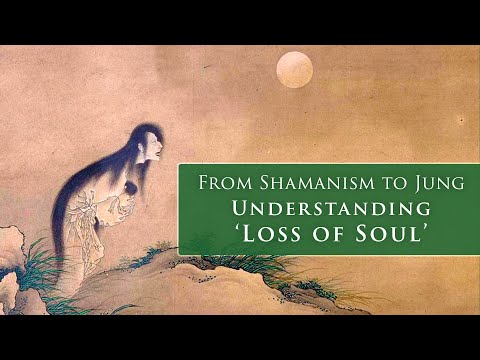
This episode from the This Jungian Life podcast traces the cross-cultural lineage of soul loss from shamanic practice into Jungian depth psychology, exploring how the structural metaphor of a departed essence translates across widely different healing traditions. Particularly useful for its treatment of how Jung drew on shamanic ethnography to describe dissociative states in clinical patients, and for its somatic precision about what “loss of soul” actually feels like from inside the experience.
This presentation covers the mechanics of soul retrieval as a healing practice, how soul loss happens, what symptoms identify it, and what the restoration process involves from both traditional and contemporary perspectives. Useful for practitioners who want a clear, accessible introduction to the framework before applying it somatically with clients.
❓ FAQ ABOUT SHAMANIC SOUL LOSS
Question: Is soul loss a real phenomenon or just a cultural metaphor?
Answer: This is the wrong question to ask first. Soul loss is a structural description of a recognizable human experience, the sense that something vital has gone missing from oneself after trauma, fright, or catastrophic rupture. Whether the mechanism is “spiritual” in the traditional sense or neurological in the contemporary sense changes nothing about the phenomenological accuracy of the description. Multiple independent cultures developed the same framework because they were observing the same pattern of human fragmentation and recovery. The model offered in this article provides a third frame: soul loss as the disconnection of belief nodes in a cognitive-emotional network. All three frames coexist and illuminate different aspects of the same territory.
Question: How do I know if I am experiencing soul loss rather than depression or grief?
Answer: The somatic signature is the most reliable guide. Depression typically produces a generalized heaviness, a quality of weight across the whole system. Grief moves in waves, with clear emotional content. Soul loss has a different quality: a specific hollowness, often locatable in the chest or belly, a sense of something specifically absent rather than generally heavy. The question “when did I last feel fully myself?” tends to produce a specific, dateable answer in soul loss, often pointing to a particular event or period, rather than a vague sense of “always like this.” If the hollow has a history, a before and an after, soul loss language may be more accurate than depression language.
Question: Can I do soul retrieval work on my own, or do I need a practitioner?
Answer: Parts of this work are accessible alone, the meditation in this article, for instance, is designed for independent practice. The deeper retrieval work, however, benefits significantly from a practitioner, for the same reason that trying to see your own blind spots is structurally difficult. The missing part, by definition, is outside your current awareness. A skilled practitioner can observe your somatic signals when you cannot, hold the frame when you lose it, and negotiate with resistant parts that are hiding precisely because they do not want to be found by you alone.
Question: Why does soul retrieval not work permanently for some people?
Answer: The model addresses this directly. A single session is one trial. If the environment that produced the soul loss, abusive relationships, ongoing social conditions, inherited trauma patterns, remains unchanged, the system will keep resampling from the fragmented region. Lasting recovery requires both internal work (belief node reconnection) and external ecology change (the behavioral shifts and relational adjustments that prevent reversion). When retrieval work does not hold, look first at what in the person’s current life is continuously reperturbing the same nodes.
Question: Is there a risk that soul retrieval work could make things worse?
Answer: Yes, and practitioners should be aware of this. Returning a soul part prematurely, before the person has sufficient nervous system capacity to tolerate what the part carries, can produce destabilization. Somatic regulation work before and during retrieval is not optional. Similarly, applying Hmong or Indigenous frameworks without proper training or cultural understanding risks both harm to the client and disrespect to the tradition. Cultural context is not decoration; it is part of the healing technology.
Question: How does the model help practically in sessions?
Answer: It changes how you measure progress. Instead of asking “has this session healed the client?” you ask “has this trial moved the system in the direction of coherence?” A trial that produces partial somatic shift and surfaces a new obstacle is a successful trial, it has sampled new territory and revealed the next required condition. This reframe prevents both practitioner discouragement (“nothing is working”) and client hopelessness (“I am beyond help”). The system is always sampling. The question is whether it is sampling with enough variety, frequency, and skill to converge on a stable configuration within a meaningful time frame.
Question: How does this relate to trauma therapy models like EMDR or somatic experiencing?
Answer: More closely than it might initially appear. EMDR uses bilateral stimulation to facilitate the processing of disconnected traumatic memory, structurally identical to the shamanic journey that accesses disconnected soul material in a non-ordinary state and facilitates re-integration. Somatic experiencing uses pendulation (moving between activation and resource) and titration (small doses of exposure) to gradually reconnect dissociated elements to the whole, which maps directly onto running many small, carefully calibrated model trials. The frameworks are compatible and mutually reinforcing rather than competing.
Question: Can soul loss work be used with children?
Answer: Yes, and some traditions specifically prioritize working with children because soul parts retrieved early are believed to be more fully integrable. With children, the work is almost entirely somatic and narrative, play-based, story-based, using natural metaphors, rather than conceptually explicit. Parental involvement is usually essential, since the child’s environment is not within their own control. The behavioral consolidation step (what the child needs to do to keep the warm part) is adapted to their developmental capacity, often as a simple daily ritual rather than a reflective commitment.
😆 JOKES ABOUT SOUL LOSS
-
“Did a soul retrieval and got three parts back. Turns out one of them is extremely opinionated about my diet choices. Debating whether to return it.” - Anonymous
-
“Soul loss explained: you know how you lose your keys but you are still you? Soul loss is when you lose the part of you that knew where you put things.” - Anonymous
-
“My shaman said I had lost a soul part in 2003. I said: I know, it took my metabolism with it.” - Anonymous
-
“According to soul loss theory, I am missing the part that found mornings acceptable. I have made my peace with this.” - Anonymous
-
“The good news: soul retrieval returned my sense of wonder. The bad news: it also returned the part that asks too many questions at work.” - Anonymous
-
“Ran a model simulation on my soul loss recovery. After ten thousand trials, the most common result was: needs more sleep.” - Anonymous
🦋 METAPHORS FOR SOUL LOSS AND RETRIEVAL
-
The electrical grid metaphor: Soul loss is like a section of a city’s power grid going dark, not because the power station has failed, but because a section of the distribution network has disconnected. The lights are off in that neighborhood, but the source is intact. Soul retrieval is the work of finding the broken connection, reestablishing the circuit, and watching the lights come back on. The warmth in the chest when re-integration succeeds is exactly what it feels like when power returns after an outage, a sudden aliveness in what had become habituated to darkness.
-
The constellation metaphor: Before soul loss, your belief nodes form a recognizable constellation, a configuration with internal coherence, a shape you navigate by. After soul loss, some stars are gone from your map. You can still move through the night, but you cannot find your bearings as reliably, and the sky no longer looks like yours. Soul retrieval is not adding new stars to the sky; it is finding the ones that fell below the horizon and restoring the original pattern. The body recognizes the familiar shape when it returns, a felt sense of “that is me” that cannot be mistaken for anything else.
-
The river and tributary metaphor: Imagine a river system where your main current of aliveness is fed by many tributaries, each soul part contributing its particular quality of water. Soul loss dams one or more tributaries. The main river narrows. Life continues, but with less force, less variety, less capacity to nourish what grows beside it. Retrieval opens the dam. The surge when the tributary rejoins is unmistakable in the body: a sudden increase in volume, warmth, the sense that the current can carry you again.
-
The model simulation metaphor: Recovery from soul loss is like running a vast simulation of possible futures. Each session, each ritual, each somatic practice is one trial, one simulation run. Individually, no single trial guarantees convergence. But enough trials, distributed across different types of intervention, progressively increase the probability of landing in the stable, integrated state. The practitioner is not a repair technician with a single correct fix; they are a skilled simulation designer, running the conditions under which the system can find its own way home.
-
The immunological metaphor: The body’s immune system does not destroy pathogens in a single decisive strike; it runs millions of simultaneous sampling processes, most of which fail, until the specific configuration that works is found and then amplified. Soul retrieval works the same way. The system is always running trials. The practitioner’s job is to increase the rate of productive trials, reduce the conditions that make failed trials more likely, and help the body amplify the successful configuration once it is found. Healing is not surgery; it is cultivation.
-
The missing instrument metaphor: Imagine an orchestra whose second violinist simply stopped coming in one day. The music continues, the other players compensate, they adjust, but something in the sound is missing, and those who listen closely know it. Soul retrieval is not replacing the missing musician with a substitute; it is finding where they went, understanding why they left, and creating the conditions in which they are genuinely willing to return and play their specific part in the whole.
🧑🦲 AXEL MAGNUS’S SESSION: PARTS INTEGRATION WITH BELIEF NODE RE-ANCHORING
Context: Client is a 41-year-old man who describes feeling “emptied out” since his company collapsed three years ago. He reports going through the motions of rebuilding but describes it as “performing recovery rather than living it.”
Axel Magnus: When you say you are performing recovery rather than living it, where in your body does “performing” live?
[Client places right hand on chest.]
Client: Right here. Like there is a shell where my chest used to be.
Axel Magnus: Good. Stay with that shell quality. And point to somewhere in your body where “living it” would feel different from “performing it.”
[Client moves hand to solar plexus.]
Client: Down here. Where there would be heat. Drive. Like caring whether it works.
Axel Magnus: So we have two locations, the shell in the chest, and the potential heat in the solar plexus. Let us work with both. First, go back to before your company collapsed. Not to find out what went wrong. Just to find a moment when “caring whether it works” was fully present. One specific moment.
Client (eyes close, pause): Presenting to the first investor. I was terrified, but I was lit. Like every cell was involved.
Axel Magnus: Stay in that body. The lit body. What did you believe, from inside that moment? Not about the company, about yourself. About what was possible.
Client: That I could build something. That my ideas were worth betting on.
Axel Magnus: “My ideas are worth betting on.” Let that land in your body. Where does it live?
[Long pause. The solar plexus area rises slightly with a fuller breath.]
Client: In my gut. Like a foundation stone.
Axel Magnus: That belief node, “I am worth betting on”, that is what went missing when the company collapsed. Not just the company. The node. And without that node in your network, the rest of the rebuilding has no foundation to connect to. You have been constructing a building on a missing floor.
Client (slow exhale): That is exactly what it feels like.
Axel Magnus: Here is what I want to do. That belief node, “my ideas are worth betting on”, I want to help your body sample the experience of having it back. Not because the company did not fail. It did. But the node does not belong to the company. It belongs to you. It was there before the company existed. Can we work with that?
Client: Yes.
Axel Magnus: When you think about that node, “my ideas are worth betting on”, where in the room does it live? Not inside your body. Out there.
[Client gestures to the left, slightly forward, without deliberating.]
Axel Magnus: Notice that. It is out there, to the left. It is accessible, not gone, not destroyed. Now, imagine your solar plexus, the place where the heat and drive would live, imagine it like an open door. Not grasping the node. Just open. Breathing toward it.
[Client breathes. A pause. Then a visible shift, a small shudder through the shoulders, a change in the quality of the chest.]
Axel Magnus: What just happened?
Client (voice slightly thicker): Something moved. The shell quality is less complete.
Axel Magnus: Good. Stay with that. You have just run one trial. The system has sampled a pathway where that node is closer to active. Now, ecology check. As that node begins to return, any part of you that resists having it back?
Client (pause): If I believe my ideas are worth betting on again, I might try again. And I might fail again.
Axel Magnus: That is the protection that has been running. The part that decided: “If I withdraw the node, I cannot be wrong.” Can you feel that part right now?
[Client nods.]
Axel Magnus: Ask that protecting part: is it willing to stay present while the node returns, not disappear, but become a careful observer rather than a blocker? Just ask. See what the body says.
[Long pause. Breathing deepens. The tension in the jaw visibly decreases.]
Client: It said… maybe.
Axel Magnus: “Maybe” is a yes in disguise. The system is sampling. The probability is shifting. Let us run this trial a few more times.
[Three more repetitions, each producing slightly stronger somatic response, warmth spreading in the solar plexus, a quality of expansion in the chest, the return of direct eye contact that had been subtly averted throughout the session.]
Axel Magnus: One last thing. To consolidate this. What will you do, starting tomorrow, that honors the returned node? Something specific. Not “I will believe in myself”, something you can do with your body, with your hands, in the world.
Client (without hesitation): Write down one idea a day. Even if it is small. Even if I never act on it. Just to practice saying to myself: this idea came from me, and that matters.
Axel Magnus: That is your daily trial. Each time you do it, you are consolidating the configuration. You are preventing the node from disconnecting again. We have not finished, this will take more sessions. But the direction is unmistakably clear. The system knows which way home is.
🕳️ THE LIMITATIONS OR UNCERTAINTIES IN SHAMANIC SOUL LOSS WORK
Cultural appropriation risk. The soul-loss frameworks described in this article belong to living traditions, Hmong, Siberian, Indigenous American, Tibetan. Borrowing their language and structure without training, context, or community relationship carries real risk of harm to clients and disrespect to traditions. The model offered here is an analytical layer added on top of these traditions, not a license to perform Hmong hu plig ceremonies without cultural grounding. Contact with traditional practitioners and community elders remains the appropriate basis for working with these specific ceremonial forms.
Not a substitute for trauma-informed clinical care. Soul loss work, as described here, is a complementary framework. It does not replace clinical assessment for dissociative disorders, PTSD, psychosis, or severe depression. When fragmentation is severe enough to impair daily function, clinical support should precede or run alongside shamanic-framework work.
The model has limits. Modeling belief-node networks as discrete, separable entities is a simplification. Real belief systems are more continuous, more embodied, and more entangled with relational and environmental factors than any network model captures. The model is useful precisely because it is a simplification, but it should not be treated as a literal description of what is happening in the brain or in the spirit.
Individual variation is significant. Some people have no access to a felt sense of pre-loss wholeness, their earliest memories are already of fragmentation. For these clients, the retrieval work must be generative rather than recuperative: building nodes that were never established rather than reconnecting nodes that once existed. This requires different techniques and different pacing.
Somatic signals can mislead. Warmth, tears, and settling can indicate genuine re-integration or emotional release that does not involve lasting change. The ecology check is essential precisely because somatic shift in session does not guarantee durability. Always verify change against the client’s actual behavior and experience in subsequent sessions before concluding that convergence has occurred.
Systemic and social factors are outside the model. A person living in ongoing oppression, poverty, or community trauma cannot fully recover through individual soul-retrieval work. The soul loss of colonization, for instance, requires collective healing, community ceremony, social justice, land restoration, alongside individual work. Individual sessions can support resilience but cannot substitute for structural change.
Research is limited. The efficacy of soul-retrieval-based interventions has not been studied in randomized controlled trials. Evidence comes primarily from ethnographic accounts, case reports, and clinical observation. The model framing is conceptually coherent but has not been empirically tested as a treatment model. Practitioners should hold this with appropriate epistemic humility while remaining open to the substantial phenomenological evidence that these frameworks produce real, observable change.
✏️ CONCLUSION
What the Hmong, the Siberian shaman, the Amazonian curandero, and the NLP practitioner working with Parts Integration share is not a common cosmology. What they share is a structural observation: that human beings can lose coherence, that specific vital capacities go missing and leave recognizable gaps, and that those capacities can be recovered through skilled, repeated, patient work.
The model lens does not reduce this to mechanism. It restores the logic of iteration, the reason why healing is rarely single-session, why the same work done repeatedly produces effects that the single attempt cannot, why the practitioner’s job is less to “fix” and more to “run better trials.” Each ritual, each somatic exercise, each session is one sample from the space of possible configurations. The system is always sampling. The question is only whether the sampling is skilled, varied, and frequent enough.
Your body already knows what wholeness feels like. It has been there before. The hollow in the chest, the shell where the warmth used to be, these are not your nature. They are the consequence of a perturbation to a network that was, at some point, coherent and alive. The path back is real. It runs through the body, through specific sensations, specific belief nodes, specific daily practices that signal to returning parts that the environment is now safe enough to re-inhabit.
Run the trial. Notice the somatic signal. Adjust. Run it again. The system is converging.
📚 REFERENCES
-
George Lakoff & Mark Johnson, 1980; Metaphors We Live By
-
Steve & Connirae Andreas, 1987; Change Your Mind and Keep the Change: Advanced NLP Submodalities Interventions
-
Julian Jaynes, 1976; The Origin of Consciousness in the Breakdown of the Bicameral Mind
-
Andreas, S. (2002). Transforming yourself: Becoming who you want to be. Real People Press.
-
Connirae Andreas & Steve Andreas, 1989; Heart of the Mind: Engaging Your Inner Power to Change with Neuro-Linguistic Programming
-
Bandler, R., & Grinder, J. (1981). Tranceformations: Neuro-linguistic programming and the structure of hypnosis. Real People Press.
-
Connirae Andreas & Tamara Andreas; 1994; Core Transformation: Reaching the Wellspring Within
-
video DVD Transforming Yourself Complete 3-day Training with Steve Andreas
-
Eliade, M. (1951). Shamanism: Archaic Techniques of Ecstasy. Princeton University Press.
-
Ingerman, S. (1991). Soul Retrieval: Mending the Fragmented Self. HarperCollins.
-
Harner, M. (1980). The Way of the Shaman. Harper & Row.
-
Winkelman, M. (2010). Shamanism: A Biopsychosocial Paradigm of Consciousness and Healing. Praeger.
-
van der Kolk, B. (2014). The Body Keeps the Score: Brain, Mind, and Body in the Healing of Trauma. Viking.
-
Levine, P. A. (1997). Waking the Tiger: Healing Trauma. North Atlantic Books.
-
Kirmayer, L. J. (2004). The cultural diversity of healing: Meaning, metaphor and mechanism. British Medical Bulletin, 69(1), 33–48.
-
Yellow Horse Brave Heart, M. (2003). The historical trauma response among Natives and its relationship with substance abuse. Journal of Psychoactive Drugs, 35(1), 7–13.
-
Shapiro, F. (2018). Eye Movement Desensitization and Reprocessing (EMDR) Therapy. Guilford Press.
-
Jung, C. G. (1933). Modern Man in Search of a Soul. Harcourt Brace.
-
Image credit - Perplexity - SHAMANIC SOUL‑LOSS AS A CROSS‑CULTURAL PHENOMENON
🎬 MOVIES ABOUT SHAMANIC SOUL LOSS
- The New World (2005), Terrence Malick’s meditation on encounter and displacement depicts what soul loss looks like through landscape and body: the moment when a person loses their coherent world and must find, or fail to find, a new configuration.
- Onoda: 10,000 Nights in the Jungle (2021), A Japanese soldier who continues fighting for decades after the war’s end; a case study in the soul loss of ideology and the difficulty of retrieval when identity has become entirely organized around a disconnected belief.
- Beasts of the Southern Wild (2012), A child’s cosmological framework for navigating catastrophic loss; the film’s somatic intelligence about how children experience and attempt to restore soul coherence is unusually precise.
- Embrace of the Serpent (2015), Two parallel journeys through the Amazon searching for a healing plant, each involving guides and seekers navigating soul loss, individual and cultural, across generations.
📺 TV SHOWS ABOUT SHAMANIC SOUL LOSS
- Severance (2022–present), The most literal dramatization of soul loss in contemporary television: the severed employee is a person whose coherent network has been surgically divided, each half unaware of the other, each running its own incomplete trials toward wholeness.
- Dark (2017–2020), A German series in which characters move through time attempting to retrieve what was lost; the structure maps cleanly onto the model of running many trials across configurations to converge on a stable state.
- The OA (2016–2019), Directly engages with near-death experience, soul departure, and the question of what returns, or fails to return, from the encounter with non-ordinary states.
🎭 DOCUMENTARIES ABOUT SHAMANIC SOUL LOSS
- Gather (2020), Documents the revival of Indigenous food sovereignty as a form of soul retrieval at the community level: reclaiming what was taken, restoring what was severed across generations.
- Icaros: A Vision (2016), Follows participants in Amazonian ayahuasca ceremonies through experiences of fragmentation, confrontation with lost parts, and the somatic and psychological process of re-integration.
- The Shaman’s Last Apprentice (2007), Documents the transmission of shamanic knowledge between generations in Siberia; shows the soul-loss framework in its original ecological context, intact and functioning.
📚 NOVELS ABOUT SHAMANIC SOUL LOSS
- Ceremony by Leslie Marmon Silko (1977), A Laguna Pueblo novel whose central character is a veteran experiencing precisely what the soul-wound tradition describes: the specific hollowness that follows both war and cultural severing, and the long ritual process of return.
- The Wind-Up Bird Chronicle by Haruki Murakami (1994), A man descending into non-ordinary states to find what has gone missing; the novel’s structure mirrors the shamanic retrieval journey more faithfully than most explicit treatments of the subject.
- Beloved by Toni Morrison (1987), In many respects a meditation on intergenerational soul loss: what is carried in the body across generations, what must be witnessed and integrated before the living can be fully inhabited.
- The Dispossessed by Ursula K. Le Guin (1974), A physicist navigating the loss of connection to his own culture and the attempt to restore coherence across two radically different worlds; the soul-loss theme runs through the entire architecture of the novel without ever being named.