BODY POSTURES AS SOMATIC SYNTAX: A NEUROPHENOMENOLOGICAL MODEL LINKING POSTURAL AXES AND PHYSIOLOGICAL MARKERS TO TRANCE EXPERIENCE ACROSS CULTURES.
HOW BODY POSTURES ENCODE ALTERED STATES OF CONSCIOUSNESS

Belief - is part of Series

Your body already knows how to change states. It has been doing it for at least 40,000 years.
Every time you slump your shoulders after disappointing news, or draw yourself upright before a difficult conversation, your nervous system reads the posture and adjusts accordingly. Anthropologist Felicitas D. Goodman and researcher Belinda Gore spent decades documenting how specific body configurations drawn from Paleolithic cave art, indigenous effigies, and cross-cultural ritual practice reliably produce distinct altered states of consciousness when held with focused intention under rhythmic stimulation. Their finding: posture is not decoration. It is instruction.
This article explores five of those postures through a practical NLP lens, situating them within the Shamanic Swish framework developed by Magnus and Klimsa (2026) as a somatic mechanism for implicit memory reconsolidation. You will find detailed how-to guidance for each posture, an anchoring state session transcript, a guided meditation, and the emerging science linking body configuration, rhythmic entrainment, and lasting psychological change.
🎯 THE BENEFITS OF BODY POSTURES AS SOMATIC STATE ACCESS
“I spent three years learning to visualize my ideal self. One afternoon standing in a strange posture with a rattle playing, I was there.” Anonymous
The primary benefit of working with ritual body postures is directness. You are not talking about a state you are entering one. The body does not metaphorize. When the chest lifts, respiratory volume increases and sympathetic tone shifts. When the spine compresses forward, baroreceptor activity changes and internal imagery pathways open. The physiological cascade is measurable and, with practice, reproducible.
State access without cognitive effort. Clients who struggle to “get into” visualization exercises often find that a precise postural configuration does the entry work automatically. The body leads; the mind follows.
Anchoring becomes structural. When a resourceful state is reached through a posture, the posture itself becomes a somatic anchor not an arbitrary touch-point, but a biomechanical configuration that reliably reproduces the neurophysiological conditions of the original state. Returning to the posture re-enters the state.
Cross-domain application. A state accessed through a grounding posture transfers to work presentations, difficult conversations, creative practice, or athletic performance. The body does not compartmentalize the way conscious effort tends to.
Implicit memory access. Magnus and Klimsa (2026) propose in their Shamanic Swish framework that posture-plus-rhythm combinations operate as somatic triggers for implicit memory reconsolidation the neurological window during which emotional learnings can be updated. The posture accesses the encoded state; new imagery introduced during that access installs new meaning.
Drug-free, equipment-free state modulation. Laboratory research at the Cuyamungue Institute confirmed that posture combined with rhythmic stimulation at around 210 beats per minute produces measurable shifts in brainwave activity, stress hormones, and endorphins without any pharmacological intervention. The technology is the body.
Cumulative skill. Unlike some NLP interventions that require practitioner facilitation, somatic posture work develops as a self-accessible skill over time. Practitioners report that sensitivity to subtle body signals the warmth gathering behind the sternum, the tingling at the crown, the pooling relaxation in the hip flexors sharpens with each session.
🏛️ ORIGINS OF RITUAL POSTURES ACROSS CULTURES AND HISTORY
The oldest posture currently documented in this research tradition appears in cave paintings estimated at around 32,000 years old. That number is worth sitting with. The posture was already there before writing, before cities, before agriculture.
Ancient and indigenous traditions
Felicitas D. Goodman began her research as a linguistic anthropologist studying glossolalia spontaneous trance speech in Apostolic churches in Mexico and the Caribbean. What caught her attention was not the speech itself but the postures accompanying it. She recognized the same configurations in pre-Columbian figurines, Paleolithic cave art, San rock art in southern Africa, Siberian shaman effigies, and Aboriginal Australian ceremony. None of these cultures had contact. Yet the postures recurred cross-legged with palms upward, chest arched with arms raised, forward-folded with gaze toward the earth.
Goodman’s conclusion was that these were not decorative gestures. They were instructions. The artifacts were records of how to hold the body during ritual in order to reach specific regions of what she called alternate reality. Each posture, she found, consistently produced a characteristic type of experience in contemporary participants not because of suggestion, but because the biomechanical configuration reliably produced the same neurophysiological conditions it always had.
The Cuyamungue Institute and modern research
Goodman founded the Cuyamungue Institute in New Mexico in 1978, which became the international center for the practice and scientific study of ritual body postures. Laboratory testing conducted at the Universities of Munich and Vienna in 1983 and 1990 documented simultaneous Beta and Theta brainwave activity during posture sessions an unusual combination associated with the waking dream state. Blood chemistry showed decreases in cortisol and adrenaline alongside sharp increases in beta-endorphins that persisted for hours after sessions. Heart rate increased paradoxically while blood pressure fell, consistent with a specific physiological profile distinct from ordinary relaxation or sleep.
Later pilot work at the Institute recorded EEG changes beginning almost immediately at the onset of rhythmic rattle stimulation, confirming that the body responds to the ritual cues before conscious intention engages.
The Shamanic Swish: NLP recontextualization
Magnus and Klimsa (2026) situate these findings within an NLP framework in their preprint Shamanic Swish: A millennial somatic-sensory mechanism for implicit memory reconsolidation. Their core argument is that the postural configurations documented by Goodman and Gore function as structured somatic access keys biomechanical entry codes into specific altered states and that when inner imagery is deliberately restructured during posture-induced state access, the conditions for implicit memory reconsolidation are met. The Swish pattern in NLP traditionally operates through rapid submodality substitution in the visual system. The Shamanic Swish extends this across all representational systems, using the body itself as the primary medium of change.
Historical induction technologies: context and caution
Traditional trance induction across cultures drew on physiological levers that deserve acknowledgment as historical and anthropological context, not as prescriptions.
Fasting for 12 to 24 hours was documented across Siberian, Plains Indigenous, and Mesoamerican traditions. The metabolic shift alters cortisol rhythms and heightens interoception the body’s sensitivity to its own signals. Repetitive movement sustained dance, swaying, rocking vestibularly primes the nervous system and depletes the high-frequency resistance of ordinary alert awareness. Cold immersion before stillness practice appears in Celtic, Norse, and San traditions; the vagal rebound from cold exposure deepens parasympathetic access. Sleep reduction to the hypnagogic threshold the edge between waking and sleep was practiced across Paleolithic and Aboriginal dream-incubation traditions, lowering the barrier to theta-dominant imagery. Tobacco use, particularly in Casas Grandes shamanism, provided nicotine-mediated limbic activation that facilitated rapid state induction. These are documented historical mechanisms, not clinical recommendations. Their modern equivalents rhythmic drumming recordings, breath pacing, cold showers before practice are accessible and considerably safer.
Modern extensions: technology and the body
Current developments in immersive technology offer new vectors for the same underlying mechanisms. Virtual reality environments can provide the darkness, sensory constancy, and spatial geometry historically achieved through cave settings or purpose-built ceremonial spaces. Haptic feedback devices can deliver rhythmic somatic stimulation directly to the skin and musculature, extending auditory entrainment into the kinesthetic system. Binaural audio at theta-range frequencies supports the same brainwave conditions historically achieved through rattle and drum. These are not replacements for direct somatic work but tools for deepening access particularly for practitioners working in urban or clinical environments where ceremonial conditions are unavailable.
📜 PRINCIPLES OF BODY POSTURES AS SOMATIC ENCODING
Principle 1: Posture is syntax, intention is semantics
A body configuration without focused intention is furniture it arranges the form but carries no direction. Intention without posture is disembodied it has semantic content but no structural channel. The power of ritual posture work comes from their combination. The specific arrangement of limbs, joints, and tension gradients functions as what might be called somatic syntax: a structured signal to the nervous system that creates the conditions for a particular class of experience. Intention provides the meaning that fills that structure. Together, they compose a complete statement in the body’s own language.
Principle 2: Rhythm synchronizes the system
External rhythmic stimulation drumming, rattling, breath pacing entrains cortical activity across brain regions that normally operate at different frequencies. At approximately 210 beats per minute, rhythmic stimulation aligns with theta-range activity in subcortical structures linked to imagery, emotional memory, and the dissolution of ordinary self-reference. The rhythm does not cause the altered state. It stabilizes the transition and holds the window open long enough for the posture and intention to do their work. This is why the timing matters: too slow, and ordinary cognitive processing dominates; too fast, and the system activates rather than deepens.
Principle 3: Stillness amplifies interoception
The paradox of sustained stillness is that it makes the body louder, not quieter. When external movement stops, the nervous system shifts attention inward. Proprioceptive signals from the joints and muscles become the primary sensory data. Subtle changes in warmth, pressure, tingling, and weight distribution move to the foreground of awareness. This heightened interoception is not incidental it is the mechanism by which the posture communicates. The body’s internal signals are the language of the altered state.
Principle 4: Each posture accesses a distinct state class
Goodman’s central empirical finding was that different postures consistently produce different experiential types. A grounded vertical posture tends to produce calm, spacious witnessing. An arched expansive posture produces ecstatic or transpersonal experience. A forward-folded posture facilitates visionary or symbolic imagery. A twisted asymmetric posture catalyzes emotional release or cognitive reorganization. A fully reclined posture produces boundary dissolution and hypnagogic imagery. These are not absolute categories individual variation is significant but the cross-cultural consistency across thousands of documented sessions suggests reliable biomechanical correlates for each experiential class.
Principle 5: The body is the anchor
In NLP terms, what Goodman documented is a naturally occurring somatic anchoring system with a 40,000-year track record. When a resourceful or transformative state is first accessed through a posture under rhythmic stimulation, the postural configuration becomes the trigger for that state. Subsequent returns to the same posture with the same focused intention and rhythmic context reliably re-enter the same state. This is why the precision of posture matters: approximate configurations produce approximate access. Exact configurations, held with practiced attention, produce reproducible entry.
Principle 6: Integration is part of the process
The altered state is not the destination what is done with it is. Every tradition that employed these postures included a structured return phase: physical grounding movement, verbal sharing of experience, journaling, or sleep. In NLP terms, this is the integration and future pacing stage. Without it, the state remains an interesting experience. With it, the new representations accessed during the trance become anchored to ordinary consciousness and available in daily life.
🗨️ GUIDING CLIENTS IN SOMATIC POSTURE WORK
Observation and presence
Position yourself at the client’s side to unobtrusively observe subtle shifts in facial expression, skin tone, breath rhythm, and postural micro-adjustments. Small signs a softening around the eyes, a slight parting of the lips, the flushing or pallor of the cheeks indicate depth of access. Avoid interrupting these transitions with commentary. Your role in this phase is to witness, not to direct.
Vocal modulation
Use a slow, even, and unhurried tone when offering verbal guidance. The pace of your speech models the pace you are inviting the client into. If you want the client in theta, your voice should already be there. Avoid rising inflections that carry implicit questions they pull the client back to ordinary conversational engagement.
Genuine engagement
Your genuine curiosity about the client’s somatic process not your knowledge of posture theory is the most useful thing you can offer. Clients sense when a practitioner is waiting for something to happen versus tracking what is actually happening. Track what is there.
Reflective communication
Match your language to the client’s reported experience. If they describe heat moving up the spine, your follow-up language uses warmth and upward movement. If they describe a deepening heaviness, your language uses weight and downward settling. Avoid substituting your preferred metaphors for theirs. Their body is the authority on their experience.
Connecting experience and inquiry
Use connective language and, as, when, while to link your observations to the client’s process without interrupting it. “And as that warmth continues moving upward, you might notice…” creates a bridge rather than an interruption. This is precisely the Ericksonian pace-and-lead structure applied to somatic guidance.
Practical session guidance
Before the posture: Establish a clear intention with the client. Not a goal in the outcome-framing sense, but a direction what territory they are entering. “Healing,” “clarity,” “release,” and “vitality” all constitute valid orientations. Without intention, the posture activates the nervous system but has no semantic direction.
During the posture: Maintain rhythmic stimulation at a consistent tempo. Invite the client to allow sensations without interpreting them during the session. Peripheral, wide attention neither narrowly focused nor drifting supports the deepest access.
Signs of state access: Watch for a slowing and deepening of breath, subtle facial relaxation, small spontaneous movements or tremors, and changes in skin tone. These are physiological indicators of shifted autonomic balance, not performance.
Transition out: Do not end the posture abruptly. Signal the close of the session with a gradual slowing of the rhythmic stimulus and a brief verbal invitation to return. Allow 2 to 3 minutes of silence after the posture ends before guiding verbal sharing. The reintegration phase is part of the session.
Integration: Invite the client to describe their experience in their own words before any practitioner interpretation. What they noticed somatically heat, pressure, imagery, emotion is data. Your interpretation comes second, if at all.
💧 SOMATIC POSTURE ANCHORING AXEL MAGNUS SESSION
“I expected to sit in a strange position for fifteen minutes and feel nothing. I did not expect to cry, laugh, and then feel the clearest I have ever felt in my body.” Anonymous
NLP technique: Anchoring State via somatic posture with Shamanic Swish integration
Axel Magnus: Before we begin, I want to make sure the intention is clear. Not an outcome you are trying to achieve more like a direction you want to move toward today. What would you like more of?
Client: (pausing, looking down) Steadiness. I keep getting swept into anxiety before presentations. I want to feel grounded when I stand up in front of people.
Axel Magnus: Steadiness. (matching the quality of her word, speaking it slowly) Good. We are going to work with that directly in your body not as a concept but as a physical state you can enter and eventually carry with you. First, I want you to remember a moment when you did feel steady. It does not have to be perfect or dramatic. A time when you stood in your own skin and felt settled.
Client: (a small smile) There was a moment at the beach last autumn. I was standing at the water’s edge, early morning. No one else was there.
Axel Magnus: Stay with that for a moment. (pause) Where in your body do you feel that memory right now?
Client: (hand moves to her lower abdomen) Here. And in my legs. Like they know where the ground is.
Axel Magnus: (quietly) Perfect. That’s the state we are going to anchor into a posture. Now I am going to guide you into a specific standing configuration. As you take the position, keep that quality of knowing where the ground is somewhere in your awareness. You do not have to hold it tightly just let it be there.
[Axel stands and demonstrates the Grounded Witness posture: feet shoulder-width apart, spine gently elongated, hands resting palms upward on the thighs, jaw soft, gaze directed at a 45-degree angle downward.]
Axel Magnus: Feet about hip-width, soft knees. Let your spine find its length not rigid, just upright. Palms face up on your thighs, thumbs resting lightly near the index fingers. Jaw relaxed, tongue resting at the roof of your mouth if that feels natural. Eyes half-open, gaze falling softly toward the floor in front of you.
Client: (adjusting into the position) It feels… stable. More than I expected just from standing like this.
Axel Magnus: (nodding) Good. Notice that. (he begins a slow rattle rhythm, approximately 210 beats per minute)
[Two minutes of rhythmic stimulation. Client’s breath deepens noticeably. Axel observes: shoulders have dropped about two centimeters, jaw is visibly relaxed, a faint flush has appeared across the upper chest.]
Axel Magnus: (speaking softly under the rattle) And as that rhythm continues, you might notice sensations arriving warmth, tingling, a sense of settling into the floor through your feet. Whatever is there, you do not need to name it yet. Just let the body do what it already knows how to do.
[Three more minutes. Client’s eyes have closed fully. There is a subtle swaying, less than a centimeter, that she appears unaware of.]
Axel Magnus: (even softer) And staying with whatever is present in the body right now… there is something I want to invite. That image from the beach the water, the early light, the steadiness in your legs. Let it appear somewhere in your awareness. Not forced. Just allowed.
Client: (a barely audible exhale) It’s here.
Axel Magnus: (continuing the rhythm) And that feeling knowing where the ground is let it deepen into the body, into the feet and legs, into the hands. The posture is holding it. You are just allowing.
[Two minutes.]
Axel Magnus: (gradually slowing the rattle) And now, very slowly, beginning to let the rhythm settle… letting your breath come back to its ordinary pace… staying in the posture for just another moment while the body finds its way back to ordinary awareness.
[Silence. 90 seconds.]
Axel Magnus: When you are ready, you can let the posture soften. Take your time.
[Client slowly releases the position, opens her eyes. She looks slightly surprised.]
Client: That was… I did not expect it to feel that complete. My legs still feel like they did at the beach.
Axel Magnus: That feeling is now associated with this posture. The body has encoded it. If you practice this posture even for two or three minutes with that same intention, you will find the state is there waiting for you. Before your next presentation, five minutes in this position with a slow rhythm or even just counted breath. Let’s talk about what you noticed in your body during the session.
Client: The warmth surprised me. It started in my hands and spread up. And there was a moment where the anxiety I usually carry just… wasn’t present. Not because I pushed it out it just had nowhere to stand in that posture.
Axel Magnus: (writing briefly) That’s an important observation. We will build on that. For now, I want you to stay with the physical memory of that state the warmth in the hands, the weight in the feet and we will map it further in our next session.
💪 MEDITATION FOR ENTERING THE GROUNDED WITNESS
You might find it comfortable to allow yourself to settle now allowing the weight of your body to find its natural distribution, however you are positioned.
And before anything else is asked of you, you might simply notice the surface beneath you. The pressure of it. The temperature of it. The way it holds you without effort on your part. The floor, the chair, the ground already doing what they do.
And as you continue to notice that support… you might find your breath beginning to slow. Not because you have decided to slow it, but because the body, when it feels held, tends to breathe in a particular way. A little deeper. A little more slowly. As if there is time.
You might bring your attention, gently, to your feet. And I wonder if you could notice the sensations there perhaps a subtle warmth, or a quiet pressure, or simply the awareness that your feet exist in this moment, connected to the earth through whatever layers of floor and foundation lie between.
And perhaps you could allow that awareness to travel slowly upward through the ankles… the shins and calves… the soft heaviness of the thighs… arriving at the pelvis, which is the foundation of the spine, the root of the upright posture that makes you human.
You might find it interesting to allow the spine to find its own length from the inside not by effort, but by a kind of releasing upward that happens when you stop asking it to do anything else.
And in this position sitting or standing, it does not matter you might begin to sense a quality that lives below ordinary thought. A steadiness. Not the steadiness of being rigid, but the steadiness of something deeply rooted, which can move and still return. Like a tree that bends in the wind and is still a tree.
You might notice where in your body that quality of steadiness already exists. Perhaps as a warmth in the lower belly. Perhaps as a sense of weight in the heels and sit bones. Perhaps as a quiet knowing behind the breastbone that you are here, that you are present, that the ground is real.
And you might stay with that knowing for a moment… allowing it to become familiar… allowing the body to memorize this particular configuration of sensations as home.
And when you are ready, perhaps you could invite into your awareness an image. Not one you have to construct more one that arrives. An image of yourself in a moment of steadiness. It might be from memory. It might be from possibility. Let it be whatever presents itself, and simply allow it to settle into the body that is already steadied.
Perhaps you notice how the image feels from the inside. The temperature of it. The weight of it. Whether there is color or movement or stillness. The body knows what to do with this it has been recognizing states through imagery since before language.
And you can stay here as long as it serves you… allowing the steadiness to deepen at whatever pace is right… knowing that this configuration, this posture, this quality of attention, is available to you any time you find your way back to it.
When you are ready to return fully to ordinary awareness, you might take one deeper breath, allow some movement to return to the hands and feet, and bring your attention back to the room at whatever pace feels right.
🗣️ ANECDOTE ABOUT SOMATIC POSTURE WORK
Marta was a 34-year-old software engineer who came for one session. She did not have a grand presenting issue she described herself as “functional but flat.” Her emotional range had narrowed in the years since her father died, and while she was performing well professionally and maintaining relationships, something she called “the feeling of being in my life” had gone quiet.
She was skeptical, which she said immediately and directly, and which I appreciated. She had tried talk therapy, journaling, and a meditation app, all of which had helped somewhat with anxiety but had not touched the flatness. She asked what made posture work different.
I told her it was different in the same way that reading about swimming is different from entering the water.
She laughed. We began.
I guided her into the Ecstatic Expansion posture: standing, feet shoulder-width, fists pressed lightly to the upper chest with the little fingers forming a V, chest gently lifted, chin barely raised, deep rhythmic breath. I introduced the rattle. She stood still, skeptical expression in place.
For the first two minutes, nothing visible changed. Her breath was controlled, her expression guarded. Then something shifted in her face not dramatically, but her forehead smoothed, and the muscles around her eyes softened. Her breath deepened without any instruction. Her fists, which had been held with white-knuckle correctness, settled into the position more naturally.
At the four-minute mark she made a sound not a word, not a cry more like a recognition. A short exhale with a quality of surprise.
When I brought the session to a close and she opened her eyes, she stood still for a long moment.
“There it is,” she said, finally.
She could not locate “it” in an abstract sense, but she could locate it in her body precisely. A fullness behind the sternum. A buzzing along the forearms. A quality of aliveness in the chest and throat that she said felt like the moment before laughter. She had not felt it in two years.
We spent twenty minutes in integration she drew it in her notebook, described it in language, and talked about what the sensation reminded her of (her father’s laugh, Sunday mornings before he was sick). The integration mattered as much as the posture. The posture had opened the door; the conversation walked through it.
She returned twice more, working with the Grounded Witness to anchor steadiness into the pre-work state she had been using the Expansion to access. By the third session she was reporting “flickers of it” in daily life a warmth behind the sternum during a moment with a friend, a return of color to ordinary experience.
She did not need dramatic intervention. Her body needed to be reminded, in a language it could recognize, that those states were still accessible. The posture was the reminder.
👣 THE BASIC PROCESS OF WORKING WITH RITUAL POSTURES
Step 1: Set a clear intention
Before assuming any posture, identify the direction you want to move. Steadiness, clarity, release, vitality, grief, joy any of these constitute a valid orientation. Write it down or state it aloud. Intention functions as the semantic content that gives the posture’s somatic syntax a direction to move. Without it, you are opening a door to an unaddressed room.
Somatic checkpoint: As you hold your intention, notice where in your body you feel its absence most clearly. This is your starting point, not a problem to fix.
Step 2: Prepare the environment
Minimize sensory disruption: a quiet room, a consistent light level, no interruptions for at least 20 minutes. If possible, dim the lighting the reduction of external visual input amplifies internal imagery. Have a drum recording, rattle track, or binaural audio at approximately 210 beats per minute ready to play. Alternatively, breath-pacing at four to five seconds per inhale and exhale provides a biological rhythm that supports similar access.
Step 3: Enter the posture with precision
Select one of the five core postures below and take the position precisely. Small deviations in hand placement, jaw tension, or gaze angle change the proprioceptive signal significantly. The precision is not perfectionism it is the specificity of the access code.
Somatic checkpoint: Once in position, scan the body for areas of unnecessary holding. The shoulders, jaw, and hands are common sites of habitual tension. Soften without collapsing the structural alignment.
Step 4: Begin rhythmic stimulation
Start the rhythmic audio or begin counted breath. Allow the rhythm to settle before introducing any active attention to it. The first 90 seconds are calibration let the nervous system orient to the new input before directing attention anywhere specific.
Step 5: Distribute attention peripherally
Rather than concentrating attention at a single point, allow it to spread wide, soft, receiving. This peripheral attentional mode is associated with right-hemisphere processing and supports the dissolution of ordinary analytical engagement. You are not trying to think your way into a state; you are allowing the conditions you have created to do the work.
Somatic checkpoint: Notice whether you are waiting for something to happen versus noticing what is already happening. Ordinary sensations warmth, weight, tingling, the rhythm of breath are the experience, not the waiting room before it.
Step 6: Hold the posture for the minimum threshold
Each posture has a practical minimum: approximately 10 to 15 minutes for the grounded, expansive, and inward postures; 15 to 20 minutes for the dissolving supine posture. Depth of access tends to increase between the 7 and 15 minute marks, corresponding to the phase during which beta-endorphins are measurably rising and cortisol is falling.
Step 7: Introduce the Shamanic Swish imagery
Once a clear shift in state has occurred marked by deepened breath, warmth or tingling in the hands and chest, or a quality of widened attention invite an inner image. If working with a resourceful state (steadiness, joy, clarity), allow an image of yourself in that state to appear and settle into the body. If working with transformation, allow the image to shift from contracted to expanded, from obscured to luminous. The Swish operates through the body, not only through visual submodality change.
Step 8: Close the posture gradually
Do not exit abruptly. Allow the rhythmic stimulus to slow over 30 to 60 seconds, then release the posture and remain still for 2 to 3 minutes. This transition period allows the neurophysiological shift to begin integrating before ordinary movement and language resume.
Step 9: Ground physically before verbal integration
Before journaling or discussing the session, take three to five minutes of slow physical movement walk, stretch, or simply shake the hands and feet. Hydration supports somatic reintegration. Physical grounding stabilizes the shift before the analytical mind re-engages.
Step 10: Integrate through language and reflection
Describe what you noticed somatically sensations, imagery, emotional tone, any moments of shift before interpreting it. Write in concrete sensory terms first, then allow meaning to emerge. Wait 24 hours before ascribing fixed symbolic significance to imagery. Let the experience settle before it becomes a story about itself.
Cross-Cultural Trance Postures: Master Catalog
This synthesis draws from Paleolithic cave evidence, San rock art, Aboriginal Dreamtime practices, Casas Grandes shamanism, Celtic/Norse trancework, Siberian shamanism, and published scientific studies on physiological correlates of trance states. ancient-origins
Core Posture 1 Grounded Witness
Sources: Paleolithic caves (France, Lascaux, Trois Frères), sitting Siberian shaman figures. news.harvard
How-to:
- Sit cross-legged on the ground, spine upright, pelvis neutral
- Hands resting palms-upward on knees, fingers loosely positioned
- Eyes half-closed, gaze soft and downward at approximately 45°
- Jaw released, tongue resting lightly at roof of mouth
- Sustain for a minimum of 15 minutes
Enhancement Stack:
| Layer | Element | Mechanism |
|---|---|---|
| Auditory | Rattle or drum at sustained rhythmic tempo (~210 bpm) | Theta-band entrainment, interrupts habitual CNS gating felicitas-goodman-institut |
| Visual | Total darkness or enclosed space | Amplifies endogenous phosphene imagery cuyamungueinstitute |
| Kinesthetic | Fasting 12–24h prior | Shifts cortisol baseline, heightens interoceptive sensitivity reddit |
| Olfactory | Natural resin or plant smoke | Olfactory limbic activation via chemosensory pathways academia |
| Cognitive | Single focused intention held before and during posture | Semantic priming aligns trance content to intended state academia |
Core Posture 2 Ecstatic Expansion
Sources: Global shamanic standing figures in ethnographic art, corroboree movement patterns in Aboriginal ceremony, upward-gesturing figures in rock art globally. theconversation
How-to:
- Stand with feet approximately shoulder-width apart, knees slightly unlocked
- Both hands brought to the upper chest region, creating bilateral symmetry and mild thoracic compression
- Chest lifted and expanded outward, chin marginally elevated
- Breath sustained in deep, slow, rhythmic cycles
- Eyes closed with soft upward inner gaze; maintain through sustained stillness
Enhancement Stack:
| Layer | Element | Mechanism |
|---|---|---|
| Auditory | Group drumming combined with percussive body decoration | Full-body vibrational resonance amplifying entrainment theconversation |
| Kinesthetic | Prolonged dance or movement to exhaustion before stillness | Depletion of cortical beta resistance; opens trance threshold cuyamungueinstitute |
| Movement | Repetitive swaying or rocking as preparatory warm-up | Vestibular priming recalibrates proprioceptive reference frame frontiersin |
| Vocal | Sustained monotone chant or open-vowel toning | Vagal nerve stimulation through phonatory vibration druidwaysdotorg.wordpress |
| Social | Circle formation with community witnesses | San healing circle structure; social resonance deepens entrainment ancient-origins |
Core Posture 3 Visionary Inversion
Sources: San rock art depicting forward-bent figures with inversion motifs and nosebleed imagery; Paleolithic cave figures with concealed faces and downward orientation. bradshawfoundation
How-to:
- Stand or kneel, then fold the torso forward over the thighs
- Head lowered, neck fully released; the visual horizon is fully eliminated
- Arms hanging loosely or palms resting on the ground
- Breathe in a slow, shallow pattern throughout
- Sustain complete stillness for 10–20 minutes
Enhancement Stack:
| Layer | Element | Mechanism |
|---|---|---|
| Visual | Darkness or eyes firmly closed | Suppresses external input; generates phosphene imagery scirp |
| Auditory | Rhythmic clapping by others nearby | Auditory entrainment paired with social safety signal ancient-origins |
| Kinesthetic | Cold water contact before session | Vagal nerve activation; sensitizes baroreceptor pathways reddit |
| Respiratory | Periodic breath holds of 5–10 seconds | Shifts CO₂/O₂ balance, altering sensory gating thresholds cuyamungueinstitute |
| Mudra | Palms turned downward or concealed | Proprioceptive cue encoding somatic surrender and inner orientation bradshawfoundation |
Core Posture 4 Transformative Twist
Sources: Asymmetric healer figures in Casas Grandes (Chihuahua) ceramic tradition; healing and metamorphosis poses in North American rock art. academia
How-to:
- Stand or sit with the torso deliberately rotated to one side
- One shoulder drawn forward, with the opposite arm extended upward or outward
- Body weight distributed asymmetrically to create sustained embodied tension
- Gaze fixed on a single stable point or eyes closed
- Hold conscious postural tension for 10–15 minutes without releasing
Enhancement Stack:
| Layer | Element | Mechanism |
|---|---|---|
| Auditory | Rapid percussive drumming | Temporal disorientation; accelerates trance onset academia |
| Kinesthetic | Physical exhaustion through prior sustained movement | Adrenal normalization; somatic receptivity increases cuyamungueinstitute |
| Vocal | Repeated rhythmic vocalization sustained to altered state | Equivalent to Celtic Tenm Laida practice; chant-induced illumination druidwaysdotorg.wordpress |
| Olfactory | Plant-derived smoke inhalation | Chemosensory activation of nicotinic receptors in limbic system academia |
| Cognitive | Contextual expectation and clear framing | Predictive coding alignment orientates trance content academia |
Core Posture 5 Dissolution Supine
Sources: Documented trance endpoints across multiple independent pilot studies; dream incubation traditions in Aboriginal Dreamtime practice; historical death-and-rebirth motifs in supine ceremonial figures. shamanicpractice
How-to:
- Lie fully supine with arms slightly separated from the body, palms open and upward
- Allow complete progressive muscular release from feet through jaw
- Eyes closed with softened, unfocused gaze behind the lids
- No voluntary movement is initiated or maintained
- Sustain for a minimum of 20–30 minutes
Enhancement Stack:
| Layer | Element | Mechanism |
|---|---|---|
| Environmental | Cold exposure immediately before reclining | Hypothermic rebound triggers strong parasympathetic activation reddit |
| Auditory | Sub-4 Hz ambient drone or near-total silence | Facilitates delta/theta emergence without cortical alerting response felicitas-goodman-institut |
| Kinesthetic | Partial sleep deprivation (24–36h prior) | Dramatically lowers hypnagogic threshold reddit |
| Visual | Complete sensory deprivation: cave, sealed room, blindfold | Eliminates competing external stimuli for endogenous imagery cuyamungueinstitute |
| Mudra | Palms fully open, fingers uncurled and passive | Minimal proprioceptive load signals cortical release cuyamungueinstitute |
Universal Enhancement Matrix
Adversarially filtered from all traditions: artafricamagazine
Kinesthetic
- Exhaustion through prolonged movement before stillness
- Cold immersion or cold ambient exposure
- Fasting 12–24h (not exceeding without professional supervision)
- Preparatory repetitive micro-movements (rocking, swaying)
Auditory
- Rhythmic percussion at sustained tempo (~210 bpm)
- Monotone chanting or toning held until noticeable state shift
- Body percussion or worn rattles creating vibrational resonance
- Group rhythmic clapping in circle formation
Visual
- Complete darkness via cave, dark room, or blindfold
- Pre-closure fixed gaze on a single point
- Geometric or fractal patterns in natural firelight
Cognitive / Intentional
- Clear single-focus pre-session intention (semantic priming)
- Contextual expectation framing
- Post-session journaling within 10 minutes of return
Olfactory
- Natural plant resins or smoke as sensory boundary markers
- Historically: tobacco smoke in specific Mesoamerican traditions
▶️ VIDEO ABOUT RITUAL BODY POSTURES
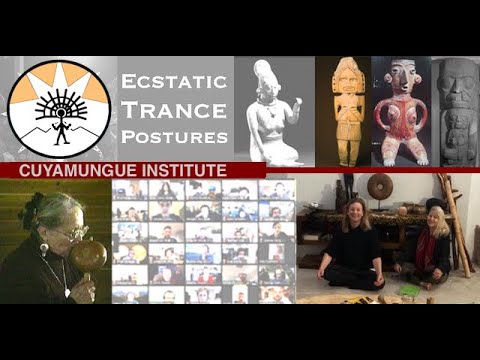
This six-minute introduction from Laura Lee at the Cuyamungue Institute provides a clear overview of ecstatic trance postures for newcomers covering the historical basis of the practice, the role of rhythmic stimulation, and the physiological shifts documented in laboratory testing. Watch for the explanation of how the simultaneous Beta and Theta brainwave state distinguishes this trance from ordinary meditation or relaxation.
❓ FAQ ABOUT BODY POSTURES AND SOMATIC ENCODING
Question: Isn’t this just meditation with unusual hand positions?
Answer: The postures share some territory with meditation stillness, inward attention, breath modulation but the mechanisms and outcomes are distinct. Meditation generally cultivates a stable, neutral witnessing state regardless of posture. Ritual body posture work uses specific configurations to access particular state classes: one posture for visionary experience, another for ecstatic expansion, another for dissolution. The posture is not decoration around the stillness; it is the primary variable that shapes which neurophysiological conditions emerge.
Question: I tried the posture and felt nothing. Did I do something wrong?
Answer: This is one of the most common experiences for first-time practitioners, particularly those with strong analytical habits. The instruction to not try and feel something runs counter to how most adults approach learning. Several adjustments help: ensure the posture is precise rather than approximate; ensure rhythmic stimulation is at the right tempo (too slow produces a dreamier, less distinct state); lower your expectation from “altered state” to “ordinary sensation noticed more carefully.” Warmth, weight, subtle tingling, and a slight deepening of breath are the experience, not the waiting room before it. Depth tends to develop with repetition.
Question: Is this safe for people with anxiety or trauma history?
Answer: The most activating posture the Ecstatic Expansion can amplify sympathetic arousal and is not the appropriate starting point for those with unresolved trauma or active anxiety disorders. The Grounded Witness posture, by contrast, consistently promotes parasympathetic regulation and is generally well tolerated. Anyone with a trauma history, dissociative tendencies, cardiovascular concerns, or active mental health conditions should approach this work with a qualified practitioner and, where appropriate, the support of their mental health provider. The technology is powerful precisely because it bypasses ordinary cognitive defenses which means it requires care proportional to that power.
Question: How is this connected to the NLP Swish pattern?
Answer: The classical Swish replaces an unwanted internal image with a desired one through rapid submodality contrast. The Shamanic Swish, as proposed by Magnus and Klimsa (2026), extends this principle into the somatic domain. Rather than operating only in the visual system, it uses posture-induced altered states to access the affective and implicit memory systems that standard submodality work may not reach. The altered state opens a window of neurological plasticity; the Swish imagery installs new representations during that window.
Question: How long does the change last?
Answer: Duration varies significantly with the depth of state access, the clarity of intention, and the quality of integration. Superficial sessions brief, without clear intention, without grounding tend to produce temporary state shifts that fade within hours. Sessions with deep access, clear intention, and thorough integration including the 24-hour reflection period tend to produce changes that clients describe as structural rather than temporary. Repeated practice compounds the effect: the posture becomes a more reliable anchor, and the state becomes more accessible in daily life without the full ritual context.
Question: Can I do this alone or does it require a practitioner?
Answer: The basic practice is self-accessible once the postures and process are understood. Many experienced practitioners work with postures as a daily solo practice. That said, first-time access to deeper states particularly the Dissolution Supine and Transformative Twist is more easily navigated with an experienced practitioner present who can support the integration phase. The risk of solo practice is not the trance itself but the tendency to exit prematurely when something unfamiliar arises, or to not allow sufficient time for grounding.
Question: Does the specific posture matter or will any pose work?
Answer: The precision matters considerably more than most newcomers expect. Minor variations in hand placement, head position, and tension distribution produce measurably different proprioceptive inputs, which alter the somatic signal the nervous system receives. This is the core finding of Goodman’s research that postures documented independently across cultures produced consistent experiential types, while improvised or modified positions did not. The exact configurations appear to function as precise access codes rather than rough approximations.
Question: How does VR or haptic technology fit into this practice?
Answer: Immersive technology can replicate several of the environmental variables historically associated with deep trance access complete darkness, spatial enclosure, consistent auditory environment, rhythmic somatic stimulation. VR environments can provide the cave-like perceptual conditions that amplify endogenous imagery without geographical access to actual cave or ceremonial spaces. Haptic devices can deliver tactile rhythmic stimulation synchronized with auditory rhythm, extending entrainment across multiple sensory channels simultaneously. These tools do not replace the body’s role the posture and intention remain the core mechanism but they can expand access for practitioners who lack traditional ceremonial infrastructure.
😆 JOKES ABOUT BODY POSTURES AND TRANCE STATES
-
“I asked my body to enter an altered state. It said it had been in one since my third coffee.” Anonymous
-
“Fifteen minutes of standing perfectly still and I had a profound visionary experience which turned out to be my knee falling asleep.” Anonymous
-
“The ancient shamans used sleep deprivation, fasting, and cold exposure to access altered states. I use a particularly boring conference call.” Anonymous
-
“My therapist asked if I was open to trying somatic work. I said yes. She did not specify that I would be standing with my fists on my chest making an expression my colleagues would find deeply concerning.” Anonymous
-
“I finally achieved the dissolution of ordinary ego consciousness. Then the rattle stopped and I had to find somewhere to park.” Anonymous
-
“Forty thousand years of ancestral wisdom encoded in a body posture. And I still cannot hold it for fifteen minutes without checking whether my phone buzzed.” Anonymous
🦋 METAPHORS FOR SOMATIC POSTURE AS STATE ACCESS
-
The tuning fork: A tuning fork does not create frequency it vibrates at the frequency it was made for when struck. The ritual posture is similar: it does not manufacture an altered state from nothing. It configures the body so that the frequency of a particular state is the one the nervous system resonates with when the rhythmic stimulus arrives. You are not building the state. You are tuning the instrument.
-
The key and the lock: The five posture axes are less like techniques and more like keys. Each key fits one kind of lock one class of inner territory. An ecstatic expansion posture does not open the same room as a forward-folded visionary posture. The body already contains all of these rooms; the posture is simply the configuration that makes entry possible. What you find inside each room is yours alone, but the door is the same for everyone.
-
Sedimentary rock: The resourceful states accessed through posture do not vanish between sessions. They layer. The first session leaves a thin deposit a faint trace of warmth and steadiness that was there for twenty minutes and then faded. The second session adds another layer. Over months and years, the accumulation becomes geological a deep stratum of somatic knowledge that underlies ordinary consciousness and can be accessed by returning to the same configuration. The body remembers what the mind forgets.
-
Changing the channel: The ordinary waking state is one channel the nervous system can run. Anxiety, grief, focused problem-solving, creative flow each is another channel. The postures are not about escaping the television; they are about learning that the remote exists. Most adults do not know they have been stuck on one channel because no one showed them the other ones.
-
The river and its banks: The rhythmic stimulation in posture work functions like the banks of a river it does not contain the water, but it gives the water a direction to move. Without rhythm, the altered state tends to meander or simply dissipate into ordinary daydream. With rhythm, the state has a current, a consistency, a place to deepen. You are not controlling the experience; you are giving it structure to move within.
-
The cast and the set: An actor preparing for a role does not simply decide to feel something they prepare the conditions: they learn the lines until they cease to require attention, they know the set, they trust the other performers. The ritual posture works similarly. Setting up the conditions precisely posture, rhythm, intention, environment allows the state to emerge without effort, the way a performance emerges from prepared conditions. The preparation is rigorous; the emergence is effortless.
🧑🦲 AXEL MAGNUS’S EXPERIENCE WITH RITUAL POSTURES
The first time I stood in the Ecstatic Expansion posture with a rattle playing, I was in a basement room in Vienna with twelve other people who looked equally unsure about what they were doing. My fists were on my chest. My chin was slightly raised. A woman across the room was playing a gourd rattle at a pace that I initially found irritating.
I was thirty-one years old and I knew a great deal about NLP. I could run a Swish Pattern in my sleep and had anchored more resource states than I could count. I had read the Goodman literature and understood the theoretical argument. I was there because someone I respected had told me that understanding it and experiencing it were not the same thing.
The first seven minutes produced nothing I would describe as altered. I was standing in an uncomfortable position with a sore lower back, counting down the time. My internal monologue was running a full commentary: this is fine, this is not much, I wonder if I am doing it correctly, the rattle is annoying, my back hurts.
Then the commentary stopped. Not because I stopped it. It stopped the way a conversation stops when something in the room commands attention.
What arrived was a quality of expansion that I can only describe physically. A warmth that began in my fists and traveled up the forearms to the chest, where it pooled and then spread outward not metaphorically outward but spatially, as if the skin had stopped being the boundary of the body. A simultaneous buzzing along the outside of both arms. And something I had not expected: a completely ordinary thought about my father, who died when I was twenty-four, arriving not as a memory or a grief spike but as a presence, briefly, with the quality of warmth he used to carry.
I stood there and I cried for approximately ninety seconds. Not from sadness. From recognition. The word that came to me afterward was there as in: there it is. The same word Marta would use years later, which is why I wrote it down when she said it.
Since then I have used posture work in three ways: as a daily brief practice (the Grounded Witness, five to seven minutes before any demanding engagement), as a preparation for deep NLP session work with clients, and as a research practice for understanding state classes I want to be able to guide others into. You cannot guide someone somewhere you have not been. The Shamanic Swish framework I developed with my colleague Viktor Klimsa grew directly from that realization: that the postures were not anthropological curiosities but reproducible mechanisms, and that understanding them neurophysiologically was the bridge between traditional practice and clinical application.
What I return to, consistently, is the humility of the body’s knowledge. My cognitive apparatus can articulate state change with considerable precision. My body just does it. The postures are one of the few practices I have found where the doing and the understanding arrive in the same moment, through the same channel.
🕳️ THE LIMITATIONS OR UNCERTAINTIES IN SOMATIC POSTURE WORK
Not a replacement for clinical treatment. Posture work operates as a somatic state access and conditioning method, not as psychotherapy. For individuals experiencing clinical depression, active trauma responses, psychosis, dissociative disorders, or severe anxiety, this practice should be integrated within, not substituted for, appropriate clinical care. The depth of access the postures provide can amplify unresolved material, which requires a qualified practitioner context.
Individual variability is significant. The cross-cultural consistency of Goodman’s findings describes population-level tendencies, not guaranteed individual outcomes. Some people access states readily; others require many sessions before significant shifts occur. Trauma history, interoceptive sensitivity, medication, and psychological flexibility all affect access. Practitioners should avoid framing sessions in ways that generate failure when the expected experience does not arrive.
Research limitations. The most rigorous physiological data on posture-induced trance comes from laboratory testing conducted in the 1980s and 1990s. While the findings are internally consistent and the Cuyamungue Institute’s EEG and blood chemistry data are frequently cited, the sample sizes were small by contemporary standards and not replicated under modern experimental controls. The 2026 Frontiers in Psychology study on movement-based trance confirmed EEG changes consistent with hypnotic depth, lending convergent support, but independent replication of the specific posture effects remains limited. The Shamanic Swish framework proposed by Magnus and Klimsa (2026) is a preprint and has not yet been subject to peer review.
Cultural context matters. The postures were developed and practiced within specific cultural and ceremonial frameworks. Goodman’s contribution was to isolate the biomechanical mechanism from the cultural overlay, but this also means that something is inevitably absent in contemporary secular practice. Cultural and ceremonial context provides meaning structures, community resonance, and integration frameworks that solo practice does not automatically supply. Practitioners and participants benefit from intellectual honesty about this difference.
Contraindications for specific postures. The Dissolution Supine posture is not appropriate for those prone to dissociation without prior grounding stability. The Ecstatic Expansion posture is not appropriate for those with active cardiovascular conditions, severe unmanaged anxiety, or a history of manic episodes. The Transformative Twist requires tolerance for intentional somatic tension and is not appropriate for practitioners with musculoskeletal vulnerabilities. All postures require cardiovascular and respiratory screening for participants with relevant health history.
Risk of inflation. As with any practice that provides access to states significantly beyond ordinary experience, there is a risk of what might be called spiritual inflation attributing permanent or universal significance to experiences that are physiologically induced states. The standard for this framework is phenomenological: the experience happened, it was real, and its meaning is yours to integrate over time. The 24-hour rule before ascribing symbolic meaning to imagery is a practical safeguard against premature closure.
Children and minors. No evidence supports the use of these practices with individuals under eighteen years of age, and the altered state depths involved warrant explicit exclusion of minors from this work.
✏️ CONCLUSION
The postures in this article have been documented for tens of thousands of years because they work. Not because they carry mystical significance though they may but because the human nervous system is built in a way that specific body configurations, held with focused intention under rhythmic stimulation, reliably produce reliable states. This is not belief. It is biomechanics.
What the Shamanic Swish framework adds to this ancient technology is the NLP practitioner’s question: and then what? The altered state is not the destination. It is the neurological window through which new representations can be installed, old implicit learnings can be updated, and the body’s somatic vocabulary can be expanded. The posture opens the door. What you do in the room is the work.
Begin with the Grounded Witness. Five minutes, a slow rhythm, clear intention. Notice what is already there before you try to find something new. The warmth in the palms, the settling weight of the heels, the quality of breath that arrives when the body is given permission to stop bracing these are not signs that something is about to happen. They are the thing itself.
The body has been speaking a language older than words. Posture work is one of the few practices that listens to it in the language it already uses.
📚 REFERENCES
-
Goodman, F. D. (1990). Where the spirits ride the wind: Trance journeys and other ecstatic experiences. Indiana University Press.
-
Goodman, F. D., & Nauwald, N. (2003). Ecstatic trance: New ritual body postures. Binkey Kok Publications.
-
Gore, B., & Goodman, F. D. (1995). Ecstatic body postures: An alternate reality workbook. Bear & Company.
-
Magnus, A., & Klimsa, V. (2026). Shamanic swish: A millennial somatic-sensory mechanism for implicit memory reconsolidation Theoretical framework, neurophysiological basis, and clinical implications [Preprint]. Zenodo. https://doi.org/10.5281/zenodo.19338497
-
Cuyamungue Institute. (2020). Introduction to ecstatic trance postures [Video]. YouTube. https://youtu.be/tXCOXJSiue0
-
Cuyamungue Institute. (2014, April). EEG and physiological data from posture trance research. Monthly Newsletter. https://www.cuyamungueinstitute.com/monthly-newsletter/april-2014/
-
Cuyamungue Institute. Physiological changes induced by ecstatic body posture trance state. https://www.cuyamungueinstitute.com/articles-and-news/physiological-changes-induced-by-ecstatic-body-posture-trance-state/
-
Cuyamungue Institute. Ritual postures and ecstatic trance. https://www.cuyamungueinstitute.com/the-experience/ritual-postures-and-ecstatic-trance/
-
Felicitas Goodman Institut. Ritual body postures. https://felicitas-goodman-institut.de/ritual-body-postures/
-
Frontiers in Psychology. (2026). Movement-based trance states and EEG changes. https://www.frontiersin.org/journals/psychology/articles/10.3389/fpsyg.2026.1728381/full
-
Bhatt, M., et al. (2018). Trance posture and tobacco in the Casas Grandes shamanic tradition: Altered states of consciousness and the interaction effects of behavioral variables. Academia.edu. https://www.academia.edu/109019014/Trance_posture_and_tobacco_in_the_Casas_Grandes_shamanic_tradition_Altered_states_of_consciousness_and_the_interaction_effects_of_behavioral_variables
-
Lewis-Williams, D. (2006). Dance scenes in South African rock art: Ritual music and movement. The Conversation. https://theconversation.com/dance-scenes-in-south-african-rock-art-a-closer-look-at-ritual-music-and-movement-275489
-
Bradshaw Foundation. Shamans of prehistory. https://www.bradshawfoundation.com/books/shamans_of_prehistory.php
-
Lakoff, G., & Johnson, M. (1980). Metaphors we live by. University of Chicago Press.
-
Andreas, S., & Andreas, C. (1987). Change your mind and keep the change: Advanced NLP submodalities interventions. Real People Press.
-
Andreas, C., & Andreas, S. (1989). Heart of the mind: Engaging your inner power to change with neuro-linguistic programming. Real People Press.
-
Andreas, C., & Andreas, T. (1994). Core transformation: Reaching the wellspring within. Real People Press.
-
Andreas, S. (2002). Transforming yourself: Becoming who you want to be. Real People Press.
-
Jaynes, J. (1976). The origin of consciousness in the breakdown of the bicameral mind. Houghton Mifflin.
-
Castaneda, C., & Cleargreen, Inc. (2004). Carlos Castaneda’s magical passes: Unbending intent [DVD; English, Spanish, German, Italian]. Cleargreen, Inc.; Terra Entertainment. (Original release 1999) https://www.worldcat.org/title/carlos-castanedas-magical-passes-unbending-intent/oclc/55125947
-
Image Credit Perplexity - HOW BODY POSTURES ENCODE ALTERED STATES OF CONSCIOUSNESS
🎬 MOVIES ABOUT BODY POSTURES AND ECSTATIC STATES
- Embrace of the Serpent (2015) Colombian film following two expeditions into the Amazon, depicting indigenous ritual, trance states, and the relationship between posture, rhythm, and altered consciousness.
- Kumiko, the Treasure Hunter (2014) A quietly hypnotic film about dissociation and obsessive pursuit that offers oblique resonance with trance and altered states of embodied attention.
- Carlos Castaneda’s Tensegrity: Magical passes (1994) A foundational introduction to Tensegrity, presenting twelve movement sequences drawn from ancient Mesoamerican seer traditions. Castaneda and associates demonstrate postures and passes designed to activate awareness of the energy body, redistribute personal energy, and establish a somatic baseline for altered-state navigation.
📺 TV SHOWS ABOUT RITUAL, TRANCE, AND EMBODIED CONSCIOUSNESS
- Cosmos: Possible Worlds (2020) Includes episodes on the deep history of human consciousness and how early humans understood the relationship between body, mind, and cosmos.
- Connected (Netflix, 2020) Explores scientific interconnection across systems; the episode on fungi and collective consciousness touches on how biology encodes information non-cognitively.
🎭 DOCUMENTARIES ABOUT ECSTATIC TRANCE AND SHAMANIC PRACTICE
- The Last Shaman (2016) Documents an extended healing journey using traditional Amazonian practice, including the role of posture, breath, and rhythm in state induction.
- Fantastic Fungi (2019) While centered on mycology, includes substantive discussion of consciousness alteration, embodied states, and the history of humans intentionally modifying their neural experience.
📚 NOVELS ABOUT ALTERED STATES, THE BODY, AND TRANSFORMATION
- Aldous Huxley, The Doors of Perception (1954) A first-person account of a chemically induced altered state that remains one of the most precise phenomenological descriptions of expanded consciousness in English prose.
- Ursula K. Le Guin, The Left Hand of Darkness (1969) Weaves the relationship between body, identity, and consciousness into its central narrative in ways that resonate with somatic state change.
- Carlos Castaneda, The Teachings of Don Juan (1968) Controversial but culturally significant documentation of indigenous altered-state practice, including the role of posture, movement, and attention in accessing non-ordinary experience.