EXTENDING SOMATIC MARKER HYPOTHESIS: HOW PERSISTENT WHOLE-BODY SENSATIONS GUIDE CONTEXTUALLY OPTIMAL DECISIONS THROUGH INTEROCEPTIVE TRAINING PROTOCOLS.
PERSISTENT WHOLE BODY SOMATIC SENSATIONS AND CONTEXTUALLY OPTIMAL DECISION MAKING: AN EXTENSION OF THE SOMATIC MARKER HYPOTHESIS
 AXEL MAGNUS
publication - is part of Series
Type
Key Contributions
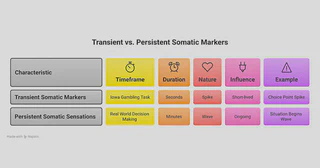
✓ Extends classical theory - Moves beyond transient lab-based markers to persistent real-world somatic sensations
✓ Four contextual dimensions - Maps temporal, spatial, social, and personal appropriateness encoding
✓ Trainable discrimination - Teaches distinction between authentic intuition and anxiety/processing noise
✓ Ecological validity - Tests decision outcomes in actual life contexts (career, relationships, major commitments)
✓ Integrated methodology - Combines training protocols + EMA + wearable sensors + outcome tracking
✓ Practical applications - Informs clinical interventions, vocational counseling, and leadership development
The somatic marker hypothesis (SMH) proposes that bodily feedback guides decision making through emotion linked physiological signals. However, existing research has primarily focused on transient, anticipatory somatic markers in laboratory gambling tasks, neglecting persistent, whole body somatic sensations that resist cognitive dismissal and may encode contextual information about temporal and spatial appropriateness. This theoretical and methodological framework develops an integrated model for understanding how persistent whole body somatic sensations those visceral feelings pervading consciousness across varying situations inform contextually appropriate decision making in specific temporal and spatial circumstances. We propose that through deliberate training, individuals can develop recognizable somatic patterns that predict contextually optimal outcomes while distinguishing genuine intuitive signals from information processing inadequacies. A study design is presented, combining interoceptive training protocols with ecological momentary assessment, psychophysiological measurement, and decision outcome tracking across varying contexts. This research extends the SMH by examining persistent rather than transient somatic states, contextual rather than abstract decision optimality, and trainable discrimination between authentic intuition and processing inadequacy. Findings could inform embodied decision making practices, vocational guidance, and clinical interventions for anxiety and stress related disorders.