LEARN WHY EVERY SHAMANIC TRADITION ENTERS TRANCE THROUGH THE BODY FIRST, AND HOW NEUROGENIC TREMOR, SHAKING, AND RHYTHMIC MOVEMENT UNLOCK FULL VISUAL AUDITORY KINESTHETIC INTEGRATION.
THE KINESTHETIC GATEWAY: WHY YOUR BODY LEADS EVERY ALTERED STATE

Belief - is part of Series

The body knows how to enter altered states. Long before modern psychology named the mind’s representational systems, shamanic cultures on every continent had already mapped the route: through the body first. Movement, posture, shaking, and rhythmic dance are not preparations for trance they are the induction itself. This article explores why the kinesthetic channel functions as the universal gateway to full sensory alignment, tracing the evidence from Paleolithic cave art through contemporary neuroscience and clinical somatic therapy.
The convergence across traditions is striking. From the Kalahari San healing dance to Siberian frame drumming to Tibetan Chöd practice, every major shamanic tradition arrives at the same architectural principle: a specific, sustained body signal whether held posture, rhythmic movement, or spontaneous tremor reliably shifts the nervous system into a lower frequency, higher coherence state. Neuroscience now has a name for this: the ventral vagal state, characterized by theta wave dominance and cross modal sensory binding. Within NLP, we recognize it as the condition in which all three representational systems operate simultaneously rather than sequentially.
By the end of this article, you will understand the neurological mechanism behind this body first architecture, have practical exercises for using your own posture and movement as entry points into aligned multi sensory experience, and see how anthropologist Felicitas Goodman’s research on ritual body postures maps directly onto the NLP lead system model.
🎯 THE BENEFITS OF THE KINESTHETIC GATEWAY
“I spent three years trying to visualize my goals. Then someone told me to shake. That worked.” Anonymous
The kinesthetic gateway offers something that purely cognitive or visual approaches to altered states rarely provide: reliability. When you engage the body directly, through sustained posture, rhythmic movement, or spontaneous tremor, the state change follows the physical input rather than depending on the quality of mental construction. You can misplace your visualization. You cannot misplace your legs.
It bypasses analytical interference. When the cognitive mind is generating counterproductive internal dialogue, engaging the body kinesthetically interrupts the loop at source. The nervous system’s sensorimotor processing takes priority over the narrative brain when the physical signal is strong enough and sustained enough.
It cascades into all representational systems. This is the central discovery that connects shamanic induction to NLP lead system theory. Once a sustained kinesthetic signal is established a held posture, rhythmic movement, or neurogenic tremor visual imagery and inner sound arise spontaneously without effortful construction. You do not need to work to produce the vision. The body creates the conditions and the vision arrives.
It is cross culturally validated. Anthropologist Erika Bourguignon’s comparative survey of 488 societies found that 437 of them roughly ninety percent used at least one culturally institutionalized method to enter an altered state of consciousness. The body first entry pattern appears in nearly every one. This is not cultural similarity. It is neurological universality.
It is self regulating. Neurogenic tremor, in particular, is inherently self limiting. The body tremors until it reaches homeostasis and then naturally stops, making it safer as a self practice than many induction methods that require external monitoring.
It builds a trainable skill. Unlike passive induction methods, kinesthetic gateway practices condition the nervous system over time. Regular practitioners find that the threshold for entering aligned multi sensory states drops substantially not because they get better at relaxing but because the body learns to recognize the signal and respond more efficiently.
It does not require substances. The body’s own nervous system architecture contains the full induction capacity when given appropriate somatic input. As Felicitas Goodman’s work at the Cuyamungue Institute demonstrated, a specific body posture held for fifteen minutes with rhythmic rattling at approximately 210 beats per minute reliably produces a distinct altered state experience reproducible across different individuals, cultures, and decades of research.
🏛️ ORIGINS OF THE KINESTHETIC GATEWAY ACROSS CULTURES AND HISTORY
Paleolithic roots
Shamanic States of Consciousness appear to date to the Middle Paleolithic cognitive revolution roughly 70,000 years ago, predating organized religion by tens of thousands of years. Cave art from southern Africa contains imagery consistent with the entoptic visual phenomena phosphene patterns, tunnel visions, therianthropic figures that emerge when the kinesthetic and auditory channels are simultaneously saturated. These are not artistic conventions. They are records of perceptual experience, and the body postures depicted alongside them suggest that specific physical positions were already understood as doorways into particular kinds of inner experience.
The fact that Australian Aboriginal cultures, isolated for 50,000 to 65,000 years following continental separation, independently developed body first trance induction methods that parallel those found in Siberia, Africa, and the Americas is one of the strongest pieces of evidence for a universal neurological mechanism rather than a shared cultural lineage.
Siberian origin: the word “shaman” itself
The word shaman derives from the Tungus Evenki term saman, making Siberia the cultural source of Western conceptual vocabulary for this entire domain. Siberian shamans combine frame drum beats in the theta frequency range with elaborate ritual costumes bells, mirrors, animal attachments that provide simultaneous sonic, visual, and proprioceptive stimulation with every movement of the body. The costume itself is a multi sensory induction device. The shaman’s stamping, swaying movement couples with this auditory and tactile environment to create a tightly scripted kinesthetic entry, after which visual journeys and auditory encounters with spirit beings follow as emergent phenomena.
Amazonian icaros: when sound becomes body
The Amazonian tradition offers perhaps the most sophisticated example of deliberate cross channel transduction in shamanic history. The icaros sung by Shipibo and mestizo curanderos during ayahuasca ceremonies are not simply beautiful music. They are engineering tools designed to induce, modulate, and steer the content of inner experience. Practitioners consistently report that difficult somatic states tight, anxious, contracted body sensations physically dissolve when the right song arrives, replaced by expansive warmth. The auditory input translates directly into a kinesthetic shift, which then opens or closes visual access. This is a complete representational cascade, just running in the opposite sequence to the Siberian model.
African traditions: kinesthetic first architecture
African traditions tend to invert the Siberian sequence, entering through the kinesthetic channel first via vigorous rhythmic dance, then allowing auditory community participation to sustain and deepen the state, with visual experience emerging last.
The Kalahari San healing dance is the most thoroughly documented example. Healers use all night sustained shaking to activate n/um a quality of somatic energy described as rising heat in the lower spine as the primary vehicle of altered state entry. Modern osteopathic analysis describes this as a neurophysiological body unlocking mechanism nearly identical to the neurogenic tremor evoked by TRE. The visual and auditory dimensions of the San healer’s experience spirit journeys, therianthropy arise after and because of the kinesthetic foundation, not before it.
The Tumbuka Vimbuza healing tradition of Malawi, recognized by UNESCO as intangible cultural heritage, uses circular movement as the patient’s entry point, with spirit specific drum rhythms providing auditory entrainment and the diagnostic vision arriving as the product of that K plus A alignment.
Tibetan Chöd: structured VAK sequencing
The Tibetan Buddhist Chöd practice represents a highly codified form of kinesthetic gateway work that directly inherits shamanic structures predating Buddhist influence in Central Asia. Practitioners combine ritual shaking dance movements with simultaneous bell and drum instrumentation, producing a compound kinesthetic and auditory entry. Remarkably, the Tsoknyi Nuns of Nepal have incorporated modern TRE style tremor practices into their contemplative training a living bridge between ancestral shamanic induction and contemporary somatic therapy, and a demonstration that these two lineages are describing the same physiological mechanism from different cultural positions.
Felicitas Goodman’s discovery: posture as tuning fork
The single most directly relevant body of modern research comes from anthropologist Felicitas Goodman, who over decades identified more than fifty ecstatic body postures encoded in indigenous artifacts worldwide postures that, when held for fifteen minutes with rhythmic rattling at approximately 210 beats per minute, reliably produce specific altered state experiences unique to each posture.
What made Goodman’s findings remarkable was not that the postures produced altered states numerous techniques can do that but that the content of the experience was shaped by the specific geometry of the posture. The Bear Spirit posture produced healing and somatic repair imagery. The Olmec Prince posture produced prophetic visual reception. Metamorphosis postures produced the full kinesthetic experience of becoming an animal. And critically, these results were reproducible across participants with no shared cultural background in Ohio, Berlin, Vienna, and New Mexico.
Physiological measurements during the Bear Spirit posture documented decreased respiration depth, increased heart rate, measurable changes in galvanic skin response, and shifts in EEG activity from beta wave dominance into simultaneous theta and delta ranges. This is the neurological signature of what Winkelman called “integrative slow wave discharge” the theta dominant state in which the limbic system and frontal cortex begin to fire synchronously and cross modal sensory binding occurs.
Goodman’s most radical finding was that the geometry of the posture acts like a tuning fork, not just inducing altered awareness generically but selecting which terrain of the inner world is entered. Within NLP terms, this means posture is a submodality distinction not a broad analog dial but a specific digital switch that determines which representational content emerges.
📜 PRINCIPLES OF THE KINESTHETIC GATEWAY
Principle 1: The kinesthetic channel is the lead system into altered states
In NLP, the lead system is the representational system that initiates the search for a memory or experience the first ripple in the pond before the primary system takes over. Across virtually every shamanic tradition documented, the kinesthetic channel performs this lead function. The body moves first. The images and sounds follow. This is not a cultural preference; it is a consistent neurological pattern. The posterior somatosensory cortex, which processes body surface information, activates before the areas governing visual imagery when rhythmic movement begins. The body is genuinely first.
You can feel this right now. If you stand up and begin slowly swaying, you will notice that within thirty seconds or so your internal visual field begins to change becoming more fluid, more receptive. The swaying did not produce the vision. It created the neurological conditions for visual access by shifting from beta wave analytical processing toward the more open alpha theta boundary state.
Principle 2: Sustained input overrides analytical channel switching
The analytical mind has a strong tendency to interrupt altered states by switching representational channels jumping from body sensation to internal commentary to memory image and back, never sustaining any single channel long enough for the trance threshold to be crossed. The kinesthetic solution to this is duration and specificity. A held body posture maintained for fifteen minutes, or a rhythmic movement sustained for the same period, is too persistent and too structurally specific for the analytical mind to redirect with its usual rapid switching. The body’s signal dominates.
Notice what happens in your own experience when you hold a single, unusual body position for more than two minutes. The cognitive mind initially generates commentary this is uncomfortable, I look ridiculous, what is the point and then, if you hold, the commentary quiets and the body’s signal begins to fill awareness. That quieting is the kinesthetic channel establishing dominance.
Principle 3: The specific geometry of posture shapes experiential content
Goodman’s cross cultural research established that the relationship between body configuration and inner experience is not random. Different postures consistently produce different categories of inner experience, even across participants with no cultural exposure to the tradition the posture comes from. This suggests that the human nervous system contains a kind of spatial map in which different body configurations resonate with different functional states an anatomically encoded representational system selector.
From a practical standpoint, this means that when you want access to a specific quality of inner experience, the most direct route may be to find the body configuration that corresponds to it. Expansive, open postures open the internal representational space and increase vividness across all three channels. Contracted, closed postures narrow and dim them. The specific angle of a hand, the degree of spinal extension, the distribution of weight each is a submodality of the kinesthetic channel with a specific effect on inner access.
Principle 4: Tremor is a portal, not a pathology
Every mammal tremors after stress or intense activation. Deer shake violently after escaping a predator and then continue grazing as if nothing happened. The tremor discharges the accumulated sympathetic activation, completes the nervous system’s response cycle, and returns the organism to homeostasis. Humans have the same mechanism. We are socialized to suppress it.
What David Berceli’s TRE research demonstrates clinically, and what the San healing dance demonstrates anthropologically, is that when tremor is allowed rather than suppressed, it does not simply discharge stress. It shifts the nervous system from sympathetic fight or flight activation into the ventral vagal state the neurological condition of social safety, open awareness, and full multi sensory access. The tremor is not a sign of dysfunction. It is the body’s own version of a parasympathetic reset, and it reliably opens the kinesthetic channel to visual and auditory co activation.
Principle 5: Rhythm is an external nervous system
The brain’s theta oscillation pattern the four to seven Hz range associated with hypnagogic imagery, deep relaxation, and cross modal sensory binding can be driven from outside the nervous system through rhythmic auditory input. This is entrainment: the tendency of oscillating systems to synchronize when exposed to a nearby periodic rhythm. Siberian frame drums beat in precisely the theta frequency range. So does the heart at rest. So, interestingly, does the psoas muscle when it tremors spontaneously during TRE.
When your nervous system begins to track a four to seven Hz rhythm externally, the brain’s own oscillation pattern shifts to match it, and the physiological conditions for full VAK alignment are created without any effortful mental induction. The rhythm carries you. You do not need to pursue the state; you simply need to allow the rhythm to be the lead.
Principle 6: Kinesthetic alignment is a skill that compounds over time
The first time you attempt a sustained ecstatic posture practice, you may notice primarily the discomfort of holding still, the fidgeting of the analytical mind, and occasional brief flickers of altered experience. The hundredth time, you may find yourself in full visual auditory kinesthetic alignment within three minutes of assuming the posture. The nervous system learns the route. Each practice session lowers the threshold, deepens the channel, and reduces the lag time between kinesthetic entry and full multi sensory opening. This is not mystical. It is a trainable neural pathway, and like all trained pathways it strengthens with use.
🗨️ GUIDING CLIENTS IN THE KINESTHETIC GATEWAY
Observation and presence
Position yourself at the client’s side to unobtrusively observe subtle shifts in facial expressions, gestures, and skin tone while ensuring you do not interfere with their imaginative process or metaphor creation. When working with kinesthetic gateway induction, you are watching for the specific physiological signs that signal a shift from beta wave waking state toward theta access: slowed respiration, subtle muscle twitching or tremoring in the legs or hands, slight reddening of the skin, micro expressions of surprise or wonder, and spontaneous eye movements beneath closed lids. These are your indicators that the body has begun to lead.
Vocal modulation
Use a gentle, melodic, and unhurried tone when speaking, allowing your voice to foster calm and receptivity. The pacing of your speech is particularly important in kinesthetic work slower speech naturally entrains the client’s breathing and heart rate downward, supporting the physiological shift the posture or movement is already initiating. Allow longer pauses than you think necessary. The silence carries the induction.
Genuine engagement
Demonstrate active interest in the client’s process by listening attentively and supporting their exploratory journey. In kinesthetic gateway work, this means genuine curiosity about the body’s experience not asking “what do you see?” prematurely, but staying with “what’s happening in your body right now?” until the client reports that the kinesthetic channel has fully opened. Rushing toward visual or auditory content before the body has established its lead will interrupt rather than deepen the state.
Reflective communication
Echo the client’s words and delivery style. If a client describes sensations with slow, grounded language “a heaviness… spreading… warm” match that pace and weight in your response. If they describe energy and movement with quickened breath and animated expression, gently mirror that aliveness. The goal is to communicate that you are fully present with their somatic experience, not managing it from outside.
Connecting experience and inquiry
Seamlessly link questions and reflections to the client’s experiences using coordination (and, as, when), ensuring a smooth and empathetic flow throughout the interaction. For example: “And as that warmth continues to spread through your chest… you might notice whether an image or a sound wants to form…” This type of linking respects the kinesthetic process already underway rather than interrupting it with a new directive.
Practitioner guidance for kinesthetic sessions:
Begin by asking the client to notice their natural resting posture and their current body state warm or cool, heavy or light, tense or soft without trying to change anything. This establishes a baseline and begins cultivating kinesthetic awareness before any formal induction starts.
Introduce the posture or movement slowly, framing it as an exploration rather than a technique: “I’d like to invite you to try a particular way of holding your body, and I’m curious what you notice.” This permissive framing reduces performance anxiety, which is the primary inhibitor of kinesthetic access.
Watch for the first signs of tremor or spontaneous micro movement. These are not problems to manage; they are the process beginning. Your role at that moment is to name them neutrally and permissively: “You might notice some movement beginning in the legs… that’s the body doing exactly what it needs to do.”
As the kinesthetic channel deepens, invite do not demand the client’s awareness toward visual and auditory experience: “And while the body continues that process on its own… you might notice whether any images or sounds are forming in the background…” If nothing comes, return to the body. The visual and auditory will arrive when the kinesthetic foundation is ready for them.
Signs of completion include spontaneous sighing or deep exhale, a visible softening of facial musculature, and the client’s breath returning to a natural diaphragmatic rhythm. The integration window after this point is crucial: do not rush to debrief. Allow two to three minutes of quiet presence before inviting the client to slowly return to ordinary awareness.
💧 KINESTHETIC LEAD SYSTEM ANCHORING: AN AXEL MAGNUS SESSION
NLP technique: Kinesthetic Lead System Activation with Submodality Integration
“My client asked me afterward if we’d done hypnosis. I said we’d done something older.” Anonymous
Emma, thirty four years old, is a UX designer who describes her experience of creativity as “stuck in her head.” She can generate ideas cognitively and she can visualize them at a surface level, but the felt sense of creative certainty the body knowing “this is right” is absent. Her decisions feel arbitrary, her confidence is brittle, and she has noticed that her best creative work always happened in a physical state she cannot consciously recreate.
Axel: Speaking in a calm, unhurried tone, sitting at a slight angle rather than directly opposite. So before we do anything at all, I’d like you to just notice your body right now. Not to change it. Just to notice what it’s like to be in your body in this chair, in this room, at this moment.
Emma: After a pause. It’s… a bit tight. Like I’m braced for something. My jaw especially.
Axel: Yes. And below the jaw? If you let your awareness move down through your throat, your chest, your belly… what’s there?
Emma: Long pause, eyes moving downward. Hollow. I don’t know. Not much.
Axel: Not much. That’s honest. Pause. And I’m curious when you said “braced for something”… where exactly does that bracing live? If you could point to it.
Emma: Places hand over sternum. Here. Like a held breath.
Axel: Like a held breath. Good. Keep your hand there and just let it rest. You don’t need to breathe differently. Just let the hand be there. Pause. Now, you mentioned those moments of creative certainty that used to come. The times when you just knew something was right. Even if you can’t get there right now, do you have any memory of what that felt like in your body?
Emma: Her face shifts, a brief expression of recognition. Yes. Yes, I do. It was like… warmth. And a kind of opening. In my chest and lower.
Axel: Warmth and opening. In the chest and lower. Mirrors her words very quietly. Good. Now I want to invite you to try something physical. There’s a particular way of standing that some traditions have used for thousands of years as a way of opening exactly that kind of access. I’d like you to stand up if that’s comfortable. Take your time.
Emma stands. Axel invites her to take a wide stance, feet somewhat beyond hip width, toes turned slightly outward, knees soft. Arms hang loosely at the sides, palms facing slightly forward. Chin is level, mouth soft and slightly open. This approximates a number of Goodman’s standing healing and divination postures without prescribing an exact historical posture.
Axel: Just find your weight evenly through both feet. Pause. Notice what the floor feels like from here. How solid it is. Pause. Now, without forcing anything, I’d like you to allow the knees to soften just a little more. Not to bend. Just to unlock.
Emma: She shifts. Almost immediately, a slight trembling begins in her quadriceps.
Axel: Very quietly. There. You might notice a kind of aliveness in the legs. Some people describe it as trembling. Let it be exactly as strong or as gentle as it wants to be. Pause. What are you noticing?
Emma: My legs are… shaking a little. Is that okay?
Axel: That is your nervous system beginning to complete something. Pause. Keep noticing it. And as you notice the trembling in the legs… let your attention also be with that space in the chest you showed me earlier. The place behind your hand.
Emma: Pause. Her breath noticeably deepens. It’s… less tight there.
Axel: Less tight. Good. Keep your feet on the floor. Keep your arms loose. Long pause perhaps ninety seconds of silence. The trembling in Emma’s legs is visible and moving up into the hips. And while your body continues to do what it’s doing on its own… I’d like to ask you to notice, very softly, whether there’s any image that wants to form in the background. Not to construct one. Just to notice if anything is already there.
Emma: Eyes still loosely closed, her breath slow. There’s… light. Just light. It doesn’t have a shape yet.
Axel: Light without a shape yet. Pause. And the warmth you described earlier the opening feeling is there any trace of that now?
Emma: Her face changes. A softening around the eyes, a brief swallow. Yes. It’s… yes. Actually yes. It’s in my belly now.
Axel: In your belly. Very quietly. And the light… does it have any color?
Emma: Gold. Warm gold.
Axel: Warm gold. Pause. And right now, in this moment, with the trembling in your legs and the warmth in your belly and the gold light… what does your body tell you about whether something is right?
Emma: Long silence. A single tear tracks from the corner of one eye. It… it just knows. I don’t have to think about it. It just knows.
Axel: Gently, after a pause. Yes. That’s the signal you’ve been looking for. It was never gone. It just needed the body to go first. Pause. Stay there for a moment. Let yourself know this.
Three minutes of silence. The trembling gradually settles. Emma’s breath becomes fuller and more natural.
Axel: When you’re ready, very slowly come back. Take your time. Feel the floor. Notice what’s changed.
Emma: Opens her eyes slowly. A long pause. I feel like myself. I don’t know how else to say it. Like myself, but more than I usually am.
Axel: And your chest?
Emma: Places hand there. A surprised smile. Open. It’s actually open.
Axel: Good. Before we talk about what happened, I want to give you something you can use on your own. Any time you’re in that creative place where the head is generating but the body isn’t confirming the wide stance, soft knees, loose arms. Let the trembling come if it wants to. You don’t need me here for the body to know how to do this. It already does.
Emma: How long does it take to get there again?
Axel: With practice, less and less time. The first time was the hardest. Now your nervous system has the memory of the route. Pause. How does that land?
Emma: Quietly. Like a door that was always there and I just found the handle.
[The session continues with integration and future pacing, anchoring the somatic state to a specific breath and hand placement that Emma can use independently as a resource anchor.]
💪 Meditation for the kinesthetic gateway
Find a position that allows your body to be supported sitting with your spine upright but not rigid, or standing with your feet hip width apart and your weight evenly distributed. You might allow your eyes to close, or to soften their gaze downward, whichever feels more natural right now.
And you don’t need to do anything at first. You might simply allow yourself to notice that your body is already here, already breathing, already alive in a way that requires no effort from you at all. The heart is beating. The lungs are filling and releasing. Somewhere in the legs and the belly and the chest, there is aliveness a particular quality of sensation that has been there all along, quiet and continuous, like a low note held beneath everything else.
Before you do anything at all… you might simply allow that aliveness to become a little more present in your awareness.
And as you continue noticing, you might find that your attention begins to settle more fully into the body not thinking about the body, but actually in it. Feeling the weight of the thighs or the feet on whatever surface supports you. Feeling the temperature of the air as it enters the nostrils. Feeling the subtle movement of breathing as it shifts the belly and ribs in their gentle, continuous rhythm.
You might notice that as your attention moves deeper into the body, the internal chatter becomes a little quieter on its own. Not because you’ve made it stop simply because the body’s signal, when you attend to it fully, tends to be more interesting than the thoughts that were running before.
Now, if you are sitting, you might allow the spine to very gently lengthen upward. Not forcefully. More as if you were growing a centimeter taller, from the sitting bones up through the crown of the head. And let the shoulders soften down and slightly back. Let the jaw relax completely mouth slightly open if that feels comfortable. And let the hands rest palm upward on the thighs, as if you were receiving something.
This open, receptive position is one that human beings across many cultures have discovered, across thousands of years, as a configuration that allows the nervous system to settle into a particular quality of awareness wider, softer, more permeable to inner experience.
And now, if you would allow the knees to soften very slightly even if you are sitting, just releasing the grip in the thigh muscles… you might notice something beginning. A kind of trembling or aliveness or vibration that starts in the legs. Perhaps just warmth at first. Perhaps a subtle movement.
This is not something you are doing. This is something your nervous system already knows how to do. Like a tuning fork that has been struck, the body, in this open position, with this quality of attention, begins to find its own natural resonance.
Allow a long pause here, simply breathing.
Whatever is happening in the body right now whether it is trembling or warmth or stillness or a quiet pulsing you might simply stay with it. Let it do what it needs to do. The body has been waiting, perhaps for some time, to complete this particular movement, to release this particular quality of held tension. You don’t need to name it or understand it. You only need to let it happen.
And as the body continues its process, you might notice softly, without reaching for it that the internal visual field begins to change. The darkness behind the closed eyes might become more luminous, more alive. Colors or shapes might begin to form at the periphery of awareness. Or a quality of light. Or simply an aliveness in the visual field that was not there before.
You might hear sounds in the inner ear a tone, a rhythm, a whisper of something. Or you might simply notice that the sounds of the room have changed quality, becoming both more distant and somehow more vivid at once.
And in the body itself, the warmth or the trembling or the particular quality of sensation that was already there might now be spreading from the legs into the belly, from the belly up through the chest, from the chest through the throat and the face and the crown of the head. Not as something you are pushing or directing. As something that is moving because that is the direction it was always going to move.
Allow another long, generous pause.
You might find, in this place where the body is alive and the inner eye is soft and the inner ear is open, that something wants to be known. Not a thought produced by the analytical mind, but a knowing that comes from below thought from somewhere in the belly or the chest or the crown where the three channels meet. A quality of recognition. A sense of something being true or right or complete.
Whatever that knowing is, you might allow it to be here, without needing to capture it or explain it yet. It will still be available when you return to ordinary awareness. The body will remember.
And now, very gently, beginning to let your awareness return to the room… noticing the weight of the body on the chair or the floor… noticing the breath, which has been here all along… noticing that something is perhaps different than when you began a quality of openness, or warmth, or availability and that this quality belongs to you and will be here whenever you return to this posture, this quality of attention, this willingness to let the body go first.
When you are ready, you might allow the eyes to open gently, taking in the room slowly, bringing this quality of somatic availability with you into your ordinary awareness.
🗣️ ANECDOTE ABOUT THE KINESTHETIC GATEWAY
Marco had spent four years in weekly therapy working on anxiety. He was an articulate man a management consultant in his late thirties, precise and thorough, the kind of person who could describe his own psychological patterns with the clarity of a radiologist reading a scan. He knew his attachment style, his developmental history, his cognitive distortions. He could identify the exact moment his chest tightened in a difficult conversation and describe in accurate detail the childhood memory that the pattern was linked to. None of this understanding had moved the anxiety by so much as a notch.
He came to see me after his therapist suggested he try something body based. He arrived slightly skeptical and very politely cooperative, which I recognized as his habitual mode of managing uncertainty.
In our first session I asked him to do something simple: stand up and shake his hands for thirty seconds. He looked at me the way a senior partner looks at an intern’s slide deck patiently, waiting for this to make sense.
He shook his hands. He felt nothing except slightly foolish.
I asked him to shake his whole arms next, then his shoulders, then to let his knees bounce gently. Each time he reported with good natured precision that he felt nothing out of the ordinary. Then I asked him to hold a wide stance, soften his knees, and let his spine settle into a very slight forward incline weight through the heels, arms loose, jaw soft.
Within forty five seconds, something in his upper thighs began to tremble.
He looked down at his legs with an expression I can only describe as genuinely surprised the look of a person who has just watched a card trick done with their own deck.
“I’m not doing that,” he said.
“No,” I agreed. “You’re not.”
We stayed there for about ten minutes. The trembling moved upward in waves, settling into the hips, the lower back, the diaphragm. At some point he couldn’t tell me exactly when his breathing changed from the careful, controlled pattern I’d been observing for an hour to something much deeper and more involuntary. His chest expanded fully on the inhale for what he told me later felt like the first time in years.
When the trembling settled, he sat down and was quiet for a long time. The calculated articulateness was simply absent. He looked, for the first time since he’d walked in, like a person inhabiting his own body.
He said eventually: “The anxiety is still there. But it’s like… I can see it from further away. There’s more room.”
I asked him where he felt “more room.”
He pointed to his chest, then his belly.
“Is that new?” I asked.
He thought about it. “The last time I felt that was when I was twelve, swimming in a lake in summer. I wasn’t thinking about anything.”
We worked together for three months. The formal therapy continued in parallel I was not trying to replace what was already working. But something shifted in that first session that the four years of insight work had not shifted, and the difference was elementary: we had started from the body rather than trying to work down to it. The analytical mind, which had been the problem and simultaneously the only tool being offered to solve the problem, was bypassed entirely by starting where the nervous system actually lives in the legs, the diaphragm, the swaying, involuntary knowing of the body.
Marco still shakes his legs at his desk when a difficult meeting approaches. He told me it looks odd, but he doesn’t care. His assistant thinks he’s listening to music.
👣 THE BASIC PROCESS OF THE KINESTHETIC GATEWAY
Step 1: Establish a somatic baseline
Before anything else, take sixty seconds to notice your current physical state without trying to change it. Is the body warm or cool? Tight or loose? Where does your weight sit? What is your breathing like? You are not fixing anything. You are simply making contact with where the body is right now, so you have a reference point for what changes.
A useful marker: notice where in your body there is aliveness and where there is numbness or absence. The aliveness is where the process will begin. The numb areas are what the process is working toward.
Step 2: Choose a posture of entry
Stand or sit in a position that is slightly different from your ordinary resting posture. The key qualities are: feet at least hip width apart, knees soft rather than locked, spine long rather than collapsed, jaw and hands released. If you are standing, allow the arms to hang freely with palms facing slightly forward. This open, receptive configuration reduces the body’s habitual defensive armor and creates the conditions for the kinesthetic channel to open.
If you have access to Belinda Gore’s work on Goodman’s ecstatic postures, you may choose a specific posture appropriate to your intention. If not, the standing open posture above is a reliable starting point.
Step 3: Sustain the posture without fidgeting
Hold the position for at least five minutes before evaluating whether anything is happening. The analytical mind will want to abandon it within ninety seconds, because nothing dramatic is occurring yet. The threshold for most people is somewhere between two and five minutes of sustained holding before the body’s own signal begins to dominate over the mind’s restlessness. Do not mistake restlessness for absence of effect.
Notice the quality of sensation in the legs, hips, and lower belly specifically. These are typically the first areas to begin tremoring or warming.
Step 4: Allow tremor if it arises
If you notice a vibration or trembling beginning in the thighs, hips, or lower back, allow it completely without trying to stop it or amplify it. The natural response for most people is to tighten the legs to make it stop. This is the nervous system completing its protective response. Instead, breathe into the area that is trembling and let it do what it needs to do.
The tremor will feel unlike voluntary movement. It is oscillating rather than directed, and it carries a quality of release rather than effort. Some people describe it as “the body letting go of something.” That is an accurate description.
Step 5: Deepen through breath
Let your breath slow naturally without forcing it. Nasal breathing, into the low belly rather than the chest, maintains and deepens the tremor by increasing vagal tone. Each exhale is an opportunity to release another layer of holding in the musculature. You do not need to breathe dramatically simply fully, and without restriction.
If the tremor is absent, try slowing your exhale to twice the length of your inhale. This alone can initiate the parasympathetic shift that allows kinesthetic channel access.
Step 6: Open toward visual and auditory access
Once the kinesthetic channel is established the body warm or tremoring, the breath deep and natural, the analytical commentary quiet you can gently widen your attention to include the inner visual and auditory fields. You are not constructing imagery. You are noticing whether imagery is already forming.
The instruction to yourself is permissive rather than directive: “I wonder what wants to appear in the visual field right now…” rather than “I will visualize X.” The distinction matters. Forced visualization overrides the kinesthetic foundation. Invited visualization rides it.
Step 7: Stay with whatever arises
Whether what arises is a strong visual experience, a purely somatic one, or something that is difficult to categorize, stay with it without immediately analyzing or narrating it. The analytical mind will rush to name and explain the experience, which tends to end it. Simply be with it, as if you were watching weather rather than directing it.
Step 8: Integrate before returning
When the process naturally settles the tremoring easing, the depth of the state reducing on its own give yourself at least two minutes before reorienting fully to ordinary awareness. During this integration window, the experience is consolidating in the nervous system. Rushing to stand up, check your phone, or start debriefing tends to dissipate what has been established. A slow, sensory return noticing the weight of the body, the sounds of the room, the temperature of the air anchors the somatic experience in ordinary state memory.
▶️ VIDEO ABOUT THE KINESTHETIC GATEWAY
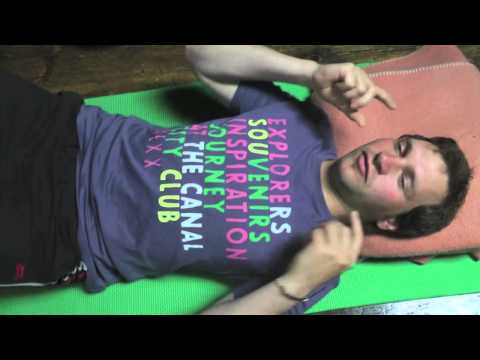
The first video features Dr. David Berceli, creator of TRE, as he observes and discusses a participant undergoing spontaneous neurogenic tremor and myofascial release. This is one of the clearest available demonstrations of what the kinesthetic gateway looks like in practice the involuntary, self organizing quality of the body’s response once the tremor mechanism activates. Watching this before trying TRE yourself is worth doing.
The second video is a longer interview with Berceli in which he explains the mechanism of neurogenic tremoring, its relationship to the polyvagal system, and why the suppression of this natural response underlies much of what modern humans carry as chronic stress and tension. He covers the history of his discovery in war zones, the cross cultural parallels with shamanic shaking practices, and the practical steps for learning to use the tremor mechanism deliberately.
❓ FAQ ABOUT THE KINESTHETIC GATEWAY
Question: I tried standing in the posture you described and nothing happened. Does this mean I can’t access the kinesthetic gateway?
Answer: Almost certainly not. The nervous system has typically spent decades learning to suppress spontaneous movement and tremor in response to cultural conditioning that equates shaking with anxiety or loss of control. The suppression reflex can be quite strong initially. Most people need multiple sessions before the tremor arises reliably and for some, it begins with subtle warmth or tingling rather than visible movement. If nothing is happening, try lengthening the hold time to ten or fifteen minutes, adding slow nasal breathing into the lower belly, and reducing expectations about what the experience should look like. The body’s response to this work is highly individual and unfolds at its own pace.
Question: What is the difference between kinesthetic gateway work and simply relaxing?
Answer: Relaxation typically reduces activation across all systems, producing a more passive, receptive state. Kinesthetic gateway work is more specific: it uses a particular type of somatic input held posture, rhythmic movement, or neurogenic tremor to shift the nervous system into a ventral vagal, theta dominant state in which all three representational channels open simultaneously. The felt quality is quite different. Relaxation is typically quiet and tends toward sleep. The kinesthetic gateway produces what many practitioners describe as “awake dreaming” alert, open, and inwardly rich rather than quiet or drowsy. You are not less present in this state; you are present in a different way.
Question: I’m skeptical that a body posture can actually shape the content of inner experience. Isn’t that too simple?
Answer: It is simple. That is exactly what makes it strange. Goodman’s research is worth sitting with precisely because of how direct the mechanism appears to be. The same posture, regardless of the participant’s belief system or cultural background, tends to produce the same category of inner experience. The most parsimonious explanation is neurological: different body configurations create different patterns of proprioceptive and interoceptive input to the brain, which in a theta dominant state shape the content of what the visual and auditory systems produce. This is the same mechanism by which actors “find” an emotion through physical positioning before cognitive effort, and by which the research on posture and psychological state shows that physical configuration reliably precedes and shapes emotional experience.
Question: Is kinesthetic gateway work safe for everyone?
Answer: For most people with no specific contraindications, carefully paced kinesthetic work involving posture and gentle movement is safe. However, neurogenic tremoring in particular can be strongly activating for people carrying unprocessed developmental or shock trauma. If you have a history of trauma, severe anxiety disorders, or dissociation, working with a certified TRE provider or a trained somatic practitioner is strongly advisable before attempting extended tremor practice on your own. The process is self regulating by nature, but that self regulation works most reliably when the nervous system has enough support around it to stay within the window of tolerance.
Question: How is this different from standard progressive muscle relaxation?
Answer: Progressive muscle relaxation is a top down technique you deliberately contract and then release muscle groups in a sequence, using the cognitive mind to direct the process. The kinesthetic gateway approaches take a bottom up route: they use specific body configurations, rhythmic input, or muscle fatigue to trigger a response that the nervous system itself then runs. The difference is that bottom up approaches bypass the analytical mind’s tendency to monitor and correct, producing a more complete nervous system shift. Progressive relaxation reliably produces physical relaxation. Kinesthetic gateway practices aim for the specific theta dominant, cross modal binding state that produces full VAK alignment.
Question: I noticed that when the tremor started, I felt afraid of it. What should I do with that?
Answer: That fear response is extremely common and completely understandable. The body is doing something it normally suppresses, and the analytical mind interprets uncontrolled movement as a threat signal. The most useful thing to do is name it internally “the mind thinks this is dangerous, but the body says it’s fine” and then continue breathing slowly into the lower belly while allowing the tremor to continue at whatever pace it chooses. Most people find that the fear response dissolves within thirty to sixty seconds once the tremor continues past it, and what remains is often the opposite of fear: a sense of release, warmth, and unexpected ease. If the fear is overwhelming rather than merely present, stop the session and rest in a comfortable position. You can return to the practice when the nervous system has had time to settle.
Question: How often should I practice to see results?
Answer: Two to three sessions per week of fifteen to twenty minutes produces consistent results for most people. Daily practice is fine once the nervous system has acclimated meaning once you can begin the process, move through the tremor or movement phase, and return to ordinary awareness without prolonged residual activation. Starting with shorter sessions and building gradually is always better than trying to force depth by extending session time before the system is ready. The goal is to train the pathway, not to exhaust it.
😆 JOKES ABOUT THE KINESTHETIC GATEWAY
-
“My therapist told me the trauma lives in the body. I said, can you be more specific? She said, the psoas. I said, how do I get there? She said, lie on the floor and shake. I said, for how long? She said, until you stop.” Anonymous
-
“I’ve been meditating for twenty years trying to quiet the mind. Turned out I just needed to shake for ten minutes. The mind got bored and left.” Anonymous
-
“The body has a wisdom that goes back seventy thousand years. My body’s wisdom told me to pace around the kitchen at eleven PM. I’m counting it.” Anonymous
-
“I asked the shaman what the difference was between his practice and therapy. He thought about it and said: in therapy, you talk until the body hears. Here, the body talks until the mind hears. I’m not sure that’s a joke, but it’s cheaper.” Anonymous
-
“They said hold the posture for fifteen minutes without fidgeting. I held it for four minutes and invented twelve reasons it wasn’t working. Then minute five happened and I understood everything.” Anonymous
-
“My nervous system is apparently not a modern invention. Apparently it’s been doing this since before agriculture. It’s deeply unimpressed by my to-do list.” Anonymous
🦋 METAPHORS FOR THE KINESTHETIC GATEWAY
-
The tuning fork: Strike a tuning fork and bring it close to another of the same frequency. The second fork begins to vibrate without being touched. The body, in a specific posture with rhythmic auditory input at the right frequency, works the same way the nervous system’s own oscillation begins to synchronize with the external rhythm, not because it is commanded to but because resonance is a physical law. You do not make a tuning fork ring. You simply give it the conditions in which its own frequency can express itself.
-
The antenna and the signal: An antenna does not generate the signal it receives. It configures itself to receive the signal that is already present. Different body configurations are different antenna geometries each one tuned to a different channel of inner experience. When Goodman found that the Bear Spirit posture produced healing imagery and the Olmec Prince posture produced prophetic vision, she was not discovering that posture creates experience from nothing. She was discovering that posture is a receiver configuration, and that different configurations make different channels available.
-
The keyhole: Most altered state work tries to break down the door between ordinary and non ordinary awareness. Kinesthetic gateway work finds the keyhole. The specific body configuration the particular angle of the spine, the softness of the knees, the openness of the hands is a key shape. When the right key meets the right lock, the door opens without force. The trance does not need to be achieved; it needs to be admitted.
-
The river and the channel: Visual and auditory experience in an aligned state are like water: they naturally seek the path of least resistance. The body, in its kinesthetic opening, cuts the channel. The water does not need to be pumped; it flows when the channel exists. Trying to construct visual or auditory experience without first establishing the kinesthetic foundation is like trying to direct water uphill effortful, leaky, and exhausting. Cut the channel first and the water finds its own way.
-
The dam and the spring: Chronic muscular tension held in the psoas, diaphragm, and hip flexors is not simply a structural problem. It is a dam across a spring. The spring the body’s natural tremoring and regulatory capacity has been flowing since birth and simply accumulated behind the barrier of social conditioning. The kinesthetic gateway practices do not create the spring. They remove what was blocking it. When the dam releases, the water that flows first is not new water. It is very old water that has been waiting.
-
The instrument and the musician: An unplayed violin has all the music built into it the tension of the strings, the geometry of the body, the resonance chamber. But without being played, it is silent. The body in ordinary daily use is this violin all the capacity present, nothing activated. The kinesthetic gateway practice is learning to be both instrument and musician simultaneously: the specific posture or movement is the bow on the string, and the music that emerges is not added from outside but drawn out from what was always structurally present.
🧑🦲 AXEL MAGNUS’S EXPERIENCE WITH THE KINESTHETIC GATEWAY
I came to the kinesthetic gateway through embarrassment.
Not through intention, not through a well planned professional development arc, and certainly not because I thought shaking around in strange postures was what was missing from my NLP practice. I came to it because a colleague invited me to a weekend workshop and I was too polite to say no, and then I was too proud to leave halfway through.
The workshop was with a facilitator who had trained in Goodman’s ecstatic posture method. There were about twenty of us in a room that smelled of pine and old carpet. We were going to hold unusual body positions for fifteen minutes while someone shook a rattle at an uncomfortable volume. I was thirty six years old and I had, at that point, a fairly sophisticated understanding of altered states from my NLP training. I knew about representational systems, about the lead system, about how auditory and visual experience could be used as induction vectors. I thought I knew roughly what was going to happen.
We were given the Lame Deer posture standing, feet hip width apart, slight forward inclination, one hand placed flat against the sternum. The rattle started. I stood there.
For the first three minutes I thought about what I needed to do the following week. I also thought the rattle was too loud, that the room was warm, and that I was unclear whether I was holding my weight correctly. This is the kinesthetic practitioner’s version of monkey mind: not visual distraction, but proprioceptive commentary.
Then something changed.
It started in my left thigh a trembling that I would have described as muscle fatigue if I hadn’t been standing in a relatively relaxed position. It was involuntary in a way that I found genuinely unsettling. Not frightening, exactly, but strange in the way that a familiar room looks strange in the wrong light. I recognized my own leg and I recognized trembling, but I did not recognize what was trembling, or who was doing it.
The trembling moved upward. Into the hips. Into the lower back, where I had carried a chronic tightness for years that I had decided was just my spine aging. The tightness did not so much release as simply stop being a project it became movement instead of held tension, and the difference between those two things, as I stood there in that warm room with the rattle going, was enormous.
What came next I would not have predicted from my understanding of NLP at the time. The visual field behind my closed eyes began to shift. Not in a vague, drifty way in a specific, luminous, directional way. Something that was both deep blue and somehow warm. A kind of inner darkness that was also, strangely, radiant. I was aware of the room, the rattle, my own body trembling I was not in any sense unconscious but I was also somewhere else, and the somewhere else was organized and purposeful in a way that felt ancient rather than imagined.
I did not understand what I had experienced in the way I typically understood things. I understood it the way you understand warmth when you step from cold into sunlight not as a proposition but as an undeniable fact of the body.
What changed in my practice afterward was not dramatic. I did not throw out my NLP methodology or become a shamanic practitioner. But I began systematically asking clients to begin from the body from the posture, the tremor, the felt quality of the state before asking them to access any representational content. I stopped treating kinesthetic as one of three equal channels and started treating it as the structural foundation that the others build on.
Several clients have cried when the body finally opened, not because what they found was painful but because it had been closed for so long. One man, a highly defended executive in his fifties, said after his first tremor session: “I thought the body was just the thing that carries the brain around.”
The body is not the thing that carries the brain around. If my experience in that pine scented room taught me anything, it is that the relationship runs in the opposite direction. The brain is what the body grows, when it is given a long enough time and the right conditions. And the body knows things the brain has not caught up with yet.
🕳️ THE LIMITATIONS OR UNCERTAINTIES IN THE KINESTHETIC GATEWAY
Not appropriate for all nervous systems. The kinesthetic gateway, particularly when it involves neurogenic tremor, is a powerful activating process. For people with a history of developmental trauma, complex PTSD, severe dissociation, or psychosis, unguided tremor work can exceed the nervous system’s capacity to stay within a manageable range of activation. This is not a hypothetical risk it is a practical clinical reality. The same capacity that makes the kinesthetic channel such a reliable gateway also makes it unsuitable as a solo practice for anyone whose window of tolerance is significantly narrowed by trauma history.
Results vary substantially across individuals. Goodman’s research found that the same posture reliably produced the same category of experience across different participants. But the specific content within that category, the depth of the altered state, and the time needed to reach it vary considerably. Some people enter full theta wave states within five minutes. Others work for months before experiencing clear altered state access. This variation does not indicate that the approach is not working it may indicate that the nervous system requires more preparatory work, or that the person is unconsciously resisting the loss of cognitive control that kinesthetic induction requires.
The cultural translation problem. The postures and movement practices documented across shamanic traditions were developed within specific cultural containers cosmologies, community structures, ritual protocols, and accumulated lineage knowledge that provided the context in which kinesthetic induction made sense and was safe. Extracting these techniques from their containers and applying them individually or in decontextualized workshop settings removes much of that protective structure. The nervous system can still respond to the somatic input, but the integration of what arises is a different proposition when there is no community, no cosmology, and no practitioner relationship of sufficient depth to hold what emerges.
The Goodman posture research needs replication. While Goodman’s methodology was rigorous for its era and her findings are consistent across decades of workshop practice, the research was conducted largely without randomized controlled trial design, blind evaluation of participant reports, or independent replication by researchers without vested interest in the findings. The neurophysiological measurements that were taken are genuine and interesting, but the specific claim that particular postures produce specific experiential categories requires more robust confirmation than the existing literature currently provides.
The tremor mechanism is not yet fully understood. TRE’s clinical outcomes are supported by an increasing body of research, but the exact neurological mechanism by which neurogenic tremor produces its observed effects on the autonomic nervous system remains a matter of ongoing investigation. The polyvagal model that TRE practitioners typically use to explain the process is influential and heuristically useful but is itself not without critics in the neuroscience literature.
Kinesthetic work is not a replacement for relational support. The body can open through posture, movement, and tremor in solitude. But the integration of what arises particularly if it includes unresolved emotional material is substantially supported by a relational container. Working alone with strong kinesthetic activation and no one to witness or support the process carries the risk of retraumatization rather than resolution, particularly for people who carry relational trauma.
This approach is not for everyone, and that is fine. Some people’s lead system is genuinely auditory or visual, and forcing a kinesthetic first approach may be both ineffective and uncomfortable. The principle that the kinesthetic channel is the most reliable universal gateway does not mean it is the only one, or that every individual’s optimal induction route begins from the body. Reading the client’s system and following what is actually available is always more important than applying a theoretical model as if it were a rule.
✏️ CONCLUSION
The body went first. That is the oldest piece of knowledge about altered states, encoded in cave paintings before writing existed and in drum rhythms before notation was possible. Seventy thousand years of human beings independently discovering and rediscovering the same route into full multi sensory experience, because it was the only route that worked reliably not for the gifted or the trained or the believing, but for anyone with a healthy nervous system and a willingness to stand still in an unusual position for long enough.
What modern neuroscience adds to this ancient architecture is not a correction. It is a translation. Theta wave dominance, ventral vagal state, cross modal sensory binding these are different names for something human beings have been doing since before they had names for anything. The body’s tremoring is not a modern discovery; it is an ancient mechanism given a contemporary description. Felicitas Goodman’s ritual body postures are not a new technology; they are a rediscovery of the access codes that were always present in the human nervous system and that, for much of modern history, have simply gone unused.
For practitioners working with NLP, the implication is specific: the lead system is not merely a diagnostic category to note and accommodate. It is an active tool. Establishing kinesthetic access first, before visual or auditory induction, does not merely match the client’s preferred processing style it activates the representational foundation on which the other two channels naturally rest. When the body goes first, V and A follow. When V and A are pushed first without kinesthetic grounding, the resulting state tends to be vivid but brittle, impressive but not rooted, gone by morning.
Put your feet on the floor. Soften your knees. Let your arms release. And wait. The rest has been coming since before you were born.
📚 REFERENCES
- George Lakoff & Mark Johnson, 1980; Metaphors We Live By
- Steve & Connirae Andreas, 1987; Change Your Mind and Keep the Change: Advanced NLP Submodalities Interventions
- Julian Jaynes, 1976; The Origin of Consciousness in the Breakdown of the Bicameral Mind
- Andreas, S. (2002). Transforming yourself: Becoming who you want to be. Real People Press.
- Connirae Andreas & Steve Andreas, 1989; Heart of the Mind: Engaging Your Inner Power to Change with Neuro-Linguistic Programming
- Connirae Andreas & Tamara Andreas; 1994; Core Transformation: Reaching the Wellspring Within
- Video DVD Transforming Yourself Complete 3-day Training with Steve Andreas
- The Wholeness Work
- Core Transformation
- Felicitas D. Goodman & Nana Nauwald, 2003; Ecstatic Trance: New Ritual Body Postures
- Felicitas D. Goodman, 1990; Where the Spirits Ride the Wind: Trance Journeys and Other Ecstatic Experiences
- Belinda Gore, 1995; Ecstatic Body Postures: An Alternate Reality Workbook
- David Berceli, 2008; The Revolutionary Trauma Release Process
- Peter Levine, 1997; Waking the Tiger: Healing Trauma
- Cuyamungue Institute Physiological changes induced by ecstatic body posture trance state. cuyamungueinstitute.com
- Flor-Henry, P., et al. (2017). Brain changes during a shamanic trance: Altered modes of consciousness, hemispheric laterality, and systemic psychobiology. Cogent Psychology, 4(1). tandfonline.com
- Pubmed: Yoga and EEG alpha wave research. pubmed.ncbi.nlm.nih.gov/25824030
- Osteopathy For All: TRE overview. osteopathyforall.co.uk
- UNESCO: Vimbuza healing dance. ich.unesco.org
- Takiwasi Center: Role of icaros. takiwasi.com
- Human Relations Area Files: Altered states of consciousness cross cultural summary. hraf.yale.edu
Image credit Perplexity: THE KINESTHETIC GATEWAY: WHY YOUR BODY LEADS EVERY ALTERED STATE
🎬 MOVIES ABOUT THE KINESTHETIC GATEWAY AND SHAMANIC TRANCE
- Cave of Forgotten Dreams (2010) Werner Herzog’s documentary on Chauvet Cave is the closest available visual record of the Paleolithic context in which ecstatic body practices were first encoded
- Bliss (2021) oblique but relevant treatment of reality shifting and altered perception
- Embrace of the Serpent (2015) explores Amazonian plant medicine and icaro traditions in a cinematic form that prioritizes sensory experience over explanation
📺 TV SHOWS ABOUT THE KINESTHETIC GATEWAY AND SHAMANIC TRANCE
- Sacred Science (various streaming platforms) documentary series on indigenous healing traditions with particular attention to somatic and plant medicine approaches
- Explained: Mind (Netflix) the meditation episode covers relevant neuroscience on altered states and contemplative practice
🎭 DOCUMENTARIES ABOUT THE KINESTHETIC GATEWAY AND SHAMANIC TRANCE
- Heal (2017, Netflix) covers somatic and consciousness based approaches to health and wellbeing, including nervous system regulation
- The Last Shaman (2016) portrait of Amazonian healing traditions; useful context for the icaro and kinesthetic dimensions of Shipibo practice
- Neurons to Nirvana (2013) neuroscience of altered states; directly relevant to the theta wave and cross modal binding material in this article
📚 NOVELS ABOUT THE KINESTHETIC GATEWAY AND SHAMANIC TRANCE
- Carlos Castaneda, The Teachings of Don Juan (1968) foundational Western encounter with indigenous body based knowledge; read critically but worth reading
- Peter Kingsley, In the Dark Places of Wisdom (1999) traces the somatic and incubation practices of pre-Socratic Greek philosophy; an unexpected kinesthetic gateway history from the Western tradition
- Olga Tokarczuk, Drive Your Plow Over the Bones of the Dead (2009) not directly about shamanism but contains a quality of body first knowing that resonates with the material in this article