HOW MOVEMENT WITHIN METAPHORICAL MAPS TRANSFORMS PSYCHOLOGICAL STUCKNESS
NAVIGATING INNER LANDSCAPES: SPATIAL METAPHORS IN THERAPEUTIC CHANGE

Belief - is part of Series

When you say you feel stuck, trapped, or at a crossroads, you are not speaking poetically. Your brain has literally encoded your difficulty as a spatial relationship, complete with actual positions, obstacles, and potential pathways. This article explores how therapeutic work with naturally occurring spatial metaphors can facilitate profound change by treating these expressions as accurate maps rather than symbols requiring interpretation. By exploring the landscape clients describe through their spontaneous language, practitioners help reveal structural patterns maintaining problems and discover movements that generate new possibilities. Grounded in embodied cognition research and linguistic analysis, this somatic approach works directly with how consciousness organizes experience spatially, creating transformation through awareness and exploration rather than forced reframing.
🎯 THE BENEFITS OF SPATIAL METAPHOR WORK
“I spent six months trying to overcome my obstacles. Then someone asked me to describe where they actually were. Turns out I had been trying to climb over them when I could have just walked around.” - Anonymous
Working with spatial metaphors creates changes that register throughout your entire nervous system simultaneously. When you discover through careful attention that your metaphorical position differs from what you assumed, your body responds with measurable physiological shifts: breath deepens, muscles release, posture reorganizes, energy returns to areas that had gone numb.
Immediate somatic relief emerges when internal pressure finds external form. That crushing sensation in your chest might reveal itself as a weight positioned specifically on your sternum in your inner landscape. Once externalized spatially, you can examine its dimensions, texture, and how it attaches to you. Your nervous system processes what had been compressed inside, often releasing through tears, sighs, tingling in extremities, or warmth spreading through your core.
Cognitive clarity arrives naturally when confusion resolves into navigable terrain. The overwhelm that seemed impossible to address becomes a landscape you can map. You notice you have been facing one direction exclusively when other orientations were always available. Your mind stops spinning because it now has actual coordinates and relationships to work with rather than abstract emotional states.
Enhanced self awareness develops as you recognize patterns in how you position yourself. Discovering you consistently place yourself beneath others reveals inherited status arrangements. Noticing you habitually back away from desired experiences explains years of unfulfilled longing. These spatial discoveries create instant recognition accompanied by goosebumps, sudden laughter, or tears that validate truth.
Relationship transformation occurs when you map where you stand relative to others in your inner landscape. Finding yourself positioned behind someone for decades explains why leadership felt impossible. Recognizing you have been turned away from connection while wondering why you feel lonely resolves the paradox immediately. Your body registers these realizations with palpable shifts in how you hold yourself.
Integration of conflicting impulses becomes possible when inner contradictions occupy distinct positions. The part wanting to move forward and the part holding back can be located spatially, each with valid concerns viewable from their particular position. This spatial separation allows dialogue between impulses without internal warfare, often revealing how both serve important functions.
Lasting behavioral change emerges because spatial reorganization updates multiple related schemas simultaneously. Research in embodied cognition demonstrates that abstract concepts are systematically understood through concrete spatial source domains. When your position in inner space shifts, your brain automatically updates all behaviors organized relative to that arrangement. The change feels organic because it arises from correcting actual structure rather than imposing prescribed outcomes.
Benefits accumulate as your nervous system integrates new spatial possibilities. Imagining movement through your inner landscape while tracking somatic responses feeds your motor cortex real data about alternative positions. This embodied learning bypasses intellectual resistance and inscribes new patterns directly into procedural memory.
🏛️ ORIGINS OF SPATIAL METAPHORS ACROSS CULTURES AND HISTORY
The recognition that humans structure abstract thought through spatial relationships spans millennia and cultures worldwide. Ancient wisdom traditions understood intuitively what modern neuroscience now confirms: our brains organize experience spatially before adding linguistic labels.
Eastern Philosophical Roots
Traditional Chinese medicine has operated for thousands of years on principles treating internal states as having literal locations and directional qualities. The flow of qi through meridians conceptualizes consciousness as navigable terrain with blockages, pressures, and movements. Taoist practices guide practitioners through internal spatial journeys, visiting different energy centers as actual territories of awareness.
Buddhist meditation instructions employ spatial language not as poetic device but as precise technical direction. “Sit with” difficult emotions, “expand” awareness, “rest in” the present moment—these phrases direct attention through spatial relationships. Tibetan Dream Yoga explicitly maps consciousness as landscape with geographic features and directional coordinates that practitioners learn to navigate.
Indigenous Wisdom Traditions
Aboriginal Australian Songlines encode knowledge into geographical features, treating internal and external geography as continuous. Walking the landscape activates memory and understanding, demonstrating humanity’s deep capacity to organize information spatially. The dreaming tracks recognize that consciousness itself has topography.
Native American Medicine Wheels create spatial frameworks for understanding life stages and qualities. Standing in different positions activates connection to different aspects of experience, making abstract concepts physically accessible through embodied positioning. Vision quests send seekers into physical landscape to discover internal terrain.
Western Historical Development
Greek philosophers structured thought through spatial metaphors extensively. Plato’s Cave presents knowledge as movement from darkness into light, from lower to higher ground. Classical rhetoric organized ideas through memory palaces—imaginary spatial arrangements demonstrating ancient recognition that memory operates spatially.
Medieval mystics described spiritual development as journeys through interior castles, ascending mountains, or crossing deserts. Teresa of Avila’s Interior Castle maps seven mansion like spaces, each requiring different movements and orientations. These were careful observations of how consciousness structures itself, not mere poetic invention.
Modern Scientific Discovery
The late 20th century brought empirical validation of what traditions knew intuitively. Cognitive linguists George Lakoff and Mark Johnson demonstrated in “Metaphors We Live By” that conceptual metaphors are fundamental cognitive mechanisms, not literary devices. Their research revealed abstract concepts are systematically understood through concrete spatial source domains.
Neuroscience research illuminated neural substrates of this process. Brain imaging studies showed that comprehending metaphors like “grasping a concept” activates motor cortex regions involved in actual grasping. Spatial metaphors engage brain areas associated with physical navigation and orientation, confirming these are actual modes of neural processing rather than figures of speech.
Development of Therapeutic Applications
The 1980s and 1990s saw emergence of therapeutic approaches working directly with client generated metaphors. David Grove developed Clean Language while working with trauma survivors, discovering that carefully structured questions allowed clients to explore their symbolic landscapes without therapist contamination. His work demonstrated that spontaneous metaphors contain extraordinary information about problem structure.
NLP practitioners including Steve Andreas, Connirae Andreas, and Charles Faulkner explored how metaphors encode submodality distinctions and can be worked with therapeutically. Their research showed that changing spatial relationships within metaphors creates generative transformation across contexts.
James Lawley and Penny Tompkins systematized Grove’s work into Symbolic Modeling, providing rigorous methodology for exploring client generated metaphor landscapes. Their approach treats metaphors as having their own internal logic and wisdom, requiring facilitation rather than interpretation.
Contemporary neuroscience research on embodied cognition by researchers like George Lakoff, Mark Johnson, Raymond Gibbs, and others has continued validating that spatial metaphors are not decorative language but fundamental to how humans think, feel, and organize experience.
The Emergence of Metaphors of Movement
In the 1980s, Andrew T. Austin began developing what would become Metaphors of Movement while working with chronic therapy clients. Influenced by communications trainer Charles Faulkner, psychiatrist R.D. Laing, and anthropologist Gregory Bateson, Austin observed that clients naturally described problems using spatial metaphors outside their conscious awareness.
Traditional therapy focused on four elements: examples of problems, emotional responses, consequences, and diagnoses. None consistently produced lasting change. Austin noticed that exploring clients’ spontaneous idioms and metaphors revealed highly systematic information structures that, when mapped spatially, allowed for rapid, profound transformation.
Drawing on Clean Language developed by David Grove for working with trauma survivors, Austin created a forensic approach to linguistic investigation. Rather than interpreting metaphors symbolically, he treated them as literal descriptions of navigable territories. This shift from symbolic interpretation to spatial exploration marked a revolutionary development in therapeutic methodology.
The work incorporated insights from multiple traditions: NLP’s attention to subjective structure, hypnotherapy’s utilization of client resources, neurolinguistics’ focus on how language shapes cognition, and improvisational theater’s understanding of status and positioning. Over decades of clinical practice and international teaching, Metaphors of Movement evolved into a comprehensive system now recognized in academic literature and taught worldwide.
📜 PRINCIPLES OF SPATIAL METAPHOR WORK
Principle 1: Spontaneous Metaphors Reveal Organizing Structure
The metaphors that arise naturally in conversation without prompting carry extraordinary structural information. When someone says “I feel like I’m hitting my head against a brick wall,” they have not chosen this description randomly. This spontaneous expression reveals their strategy (using head rather than hands), the obstacle type (impenetrable rather than movable), the action pattern (repetitive hitting), and the implicit belief (the wall will eventually give way).
Your body recognizes authentic metaphors with felt validation. When you land on the metaphor truly capturing your experience, something shifts in your chest, belly, or throat—a visceral yes, this is exactly it. Your nervous system signals recognition through goosebumps, tears, breath catching, or sudden clarity. This somatic marker distinguishes genuine spontaneous metaphors from socially acceptable descriptions or imposed interpretations.
These metaphors function as compressed files containing layered meaning. The brick wall is not merely obstruction but reveals assumptions about appropriate methods, beliefs about eventual outcomes, and possibly inherited patterns. A single spontaneous metaphor can unpack into an entire family system, belief structure, and behavioral strategy.
Principle 2: Spatial Relationships Are Literal Encodings
This principle marks a revolutionary shift in therapeutic thinking. When someone describes experience metaphorically, this is accurate reportage of their actual subjective structure, not symbolic representation requiring interpretation. If you say you are “stuck in a pit,” the work does not interpret what the pit symbolizes. Instead, it explores: How deep is this pit? What are you standing on? What is around you?
Your body responds to this literal treatment with surprising specificity. When asked what is at the bottom of your metaphorical pit, you might suddenly notice sensations in your feet, qualities of ground, temperature or texture. These are not imaginative additions but revelations of information your nervous system has been encoding spatially all along.
This literal approach honors client experience completely. No one needs to tell you what your metaphor “really means.” The metaphor itself contains everything needed. Your unconscious mind, which generated this spatial encoding, possesses far more wisdom about your situation than any external interpretation could provide.
Principle 3: Thorough Exploration Before Intervention
The impulse to immediately fix or change metaphors must be resisted. When someone discovers they are trapped in a box, the temptation is to suggest making the box bigger, breaking through it, or imagining it disappears. These interventions, however well intentioned, collapse crucial information about why the person is in that particular configuration at this particular time.
Systematic exploration reveals internal logic maintaining the problem. That box might be the only thing protecting you from danger outside. Those walls might be supporting a ceiling that would otherwise crush you. The trapped feeling might actually represent safety from an overwhelming external world. Only through mapping complete territory can you discover what role each element serves.
Your body provides feedback during exploration. Moving attention toward certain areas might bring chest tightness, shallow breathing, or muscle bracing. These somatic responses signal important information about boundaries, dangers, or forbidden territories. Conversely, other directions might bring opening, easier breathing, or curious interest. The exploration itself becomes diagnostic.
Principle 4: Position Determines Experience
Where you stand in relation to other elements in your inner landscape fundamentally determines your experience. Being above someone creates looking down upon them. Being below requires looking up. Standing behind means following. Standing in front implies leading or blocking. These positional relationships encode status, obligation, permission, and identity.
Your body knows these positions intimately from a lifetime of spatial learning. Social hierarchies, family roles, power dynamics all get encoded through actual physical positioning throughout development. When you stood behind a parent as a child, below a teacher, beside a friend, these spatial arrangements inscribed themselves into your nervous system as templates for understanding relationships.
Exploring position in metaphorical space activates these embodied schemas. Standing where you always stand in your family landscape, you feel the familiar sensations: smallness, hypervigilance, weight of expectations. Moving to a different position even hypothetically, your entire physiology shifts. You breathe differently. Your posture changes. Your voice alters. Position literally reorganizes your nervous system.
Principle 5: Movement Reveals Possibility
Asking clients to actually take steps in different directions within their metaphor while noticing what happens provides direct experiential feedback about available options. This embodied exploration bypasses intellectual theorizing and generates real neurological responses.
When you imagine taking a step left in your metaphorical landscape, your body responds with actual sensations. Perhaps your chest opens slightly. Perhaps anxiety spikes. Perhaps something previously hidden comes into view. These are not imaginary responses but actual neurological events as your brain simulates movement through represented space.
Each direction corresponds to meanings encoded in language and culture, yet each person uses these directions in uniquely personal ways. Taking steps backward often reveals what you have been trying to leave behind. Forward steps test aspirational paths. Exploring all directions accumulates information about what movements are possible, blocked, dangerous, or enticing.
Principle 6: Questions Shape Discovery
The quality and phrasing of questions profoundly influences what clients can discover. Clean Language pioneered a specific question syntax that avoids contaminating client metaphors with therapist assumptions. Questions like “And what kind of [client’s words]?” or “And is there anything else about [client’s words]?” or “And where is [client’s words]?” maintain the client’s language and frame of reference.
Your nervous system relaxes when questions honor your own words and frame. Questions that introduce new content or interpretations create subtle disconnection, as part of you monitors whether the therapist understands rather than purely exploring your experience. Clean questions create space for your own discoveries to emerge.
The timing and pacing of questions matters equally. Rushing prevents somatic integration. Excessive silence can create anxiety. Skilled facilitation matches the client’s processing speed, asking the next question just as the previous answer completes itself in their awareness.
Principle 7: Change Emerges From Structure, Not Content
Traditional therapy focuses on content: what happened, how you feel about it, why it occurred, what it means. Spatial metaphor work addresses structure: how experience is organized spatially, what relationships elements hold to each other, what movements are possible or blocked, where you stand in the configuration.
Your body carries structural information even when your mind cannot articulate it. The tightness between your shoulder blades encodes a specific spatial relationship. The heaviness in your chest represents actual weight in metaphorical space. The fog in your thinking has literal density and location. Working with these structural elements directly rather than their interpretations creates changes that generalize automatically.
When structure shifts, content transforms spontaneously without being addressed. Resolving your position relative to a metaphorical wall eliminates the obstacle without analyzing what the wall “represents.” The structure of being positioned against a wall generated certain thoughts, feelings, and behaviors. Change the structure, and these automatically reorganize.
🗨️ GUIDING CLIENTS IN SPATIAL METAPHOR EXPLORATION
Observation and Presence
Position yourself at the client’s side to unobtrusively observe subtle shifts in facial expressions, gestures, and skin tone while ensuring you do not interfere with their imaginative process or metaphor creation.
Vocal Modulation
Use a gentle, melodic, and unhurried tone when speaking, allowing your voice to foster calm and receptivity.
Genuine Engagement
Demonstrate active interest in the client’s process by listening attentively and supporting their exploratory journey.
Reflective Communication
Echo the client’s words and delivery style. For example, if the client describes an exciting moment with a bright expression, quicker speech, and a higher tone, mirror these qualities in your response. As a practitioner, strive to match their affective cues, or consider formal training in expressive techniques to enhance these skills.
Connecting Experience and Inquiry
Seamlessly link questions and reflections to the client’s experiences using coordination such as and, as, when, ensuring a smooth and empathetic flow throughout the interaction.
Establishing Safety and Curiosity
Begin by creating safety through your calm presence and genuine curiosity. The client needs to feel this is exploratory rather than evaluative. Your body language communicates volumes: open posture, relaxed shoulders, soft gaze. Avoid excessive note taking during initial exploration as this shifts attention to documentation rather than discovery.
Frame the work simply: “I’m curious about your experience, what it’s actually like for you.” This establishes expectations without overwhelming with theory. Watch the client’s face for micro expressions of curiosity, confusion, or resistance. Your somatic awareness of their state guides pacing and intervention.
Listening for Spatial Language
People spontaneously use spatial metaphors constantly in everyday speech. “I feel stuck.” “I’m at a crossroads.” “I’m up against a wall.” “I feel down.” “Things are looking up.” “I’m going in circles.” “I need to move forward.” These are not mere figures of speech but actual descriptions of internal spatial organization.
Listen for these spontaneous spatial expressions without pointing them out initially. When you hear one that seems to carry weight (notice your own somatic response—do you feel something shift in you when they say it?), you can begin gently exploring that specific metaphor.
Initiating Metaphor Exploration
Once you hear a spatial metaphor that seems significant, you can ask: “When you say you feel stuck, if you were to notice where you are when you feel stuck, what would you notice?” This invites them to access the spatial dimension of their experience without imposing structure.
Watch for the moment their eyes shift, usually slightly upward or to the side, signaling access to internal imagery. Notice changes in breathing pattern, often becoming slower and deeper. Skin tone may change subtly. These physiological markers indicate transition from talking about the problem to accessing its metaphorical structure.
If they struggle to access metaphorical space, you can invite: “If there were some sense of where you are, or what’s around you, what might you notice?” The permissive language (“if there were,” “might”) reduces performance pressure and allows organic emergence.
Exploring the Spatial Landscape
Once they have accessed a sense of spatial position, you can systematically explore using clean questions:
- “And when [repeat their exact words], where are you?”
- “And when you’re pushing this huge boulder up a hill, what kind of boulder is that?”
💧 SPATIAL METAPHOR SESSION: AXEL & MARIA
“My therapist said we were making progress. I said, ‘What do you mean WE? You’re sitting in the chair while I’m the one sinking in the mud.’” – Anonymous
This fictional session illustrates one way a practitioner might explore a client’s spontaneous spatial metaphor using general NLP and embodied-cognition principles.
Axel sits slightly to the side of Maria rather than directly opposite her. Both are in simple chairs. Axel’s posture is relaxed and attentive, his notebook closed on a small table nearby.
Axel: Maria, before we talk about details, I’d like to get a sense of the whole thing. If you think about what brought you here—this whole situation in your life lately—if you had to say what it’s like, as if it were a scene or a situation, how would you describe it?
Maria shifts in her seat, glances away, then looks down at her hands.
Maria: Mostly I just feel anxious. I wake up worrying about everything that might go wrong at work, and—
Axel: gently raising a hand That’s really important, and we’ll come back to how it feels. For a moment, though, I’m curious about something slightly different: if the entire situation were like something—a picture, a place, a situation—what is the whole thing like?
Maria’s brow furrows; she sits quietly for a moment.
Maria: I’m not sure I understand.
Axel: Think of how people sometimes say, “It’s like I’m stuck in a rut,” or “It’s like I’m drowning,” or “It’s like I’m on a treadmill that never stops.” Those are just examples. When you think of your situation, what is it like?
Maria’s gaze drifts upward and to the side. Her breathing slows slightly.
Maria: It’s like… I’m carrying this huge bag on my back. I can barely stand up straight.
Axel: leaning forward a little Good. As you say that, notice your body. Do you have a sense of that bag right now?
Maria’s hand moves toward her shoulder.
Maria: Yes. It feels like it’s always there.
Axel: If you’re willing, close your eyes for a moment and imagine you’re right there in that scene—standing with that heavy bag on your back. Let yourself be in that place as clearly as you can.
Maria closes her eyes; her shoulders tense and lift.
Axel: voice softer, slower As you find yourself there, carrying that bag, just notice your surroundings. If you were to become aware of what’s around you, what do you notice on one side of you?
There is a long pause; tension gathers around Maria’s eyes.
Maria: I’m not sure.
Axel: That’s okay. Take your time. If some part of you did know what’s there, what might you find on that side?
Maria’s head tilts slightly.
Maria: There’s a path. A narrow path off to my left.
Axel: A narrow path to one side. And on the other side?
Maria: There’s a wall. It feels really close, like it’s pressed up against me.
Axel: So: heavy bag on your back, a wall pressed close on one side, a narrow path on the other. When you look ahead from there, what do you see?
Maria’s breathing becomes shallower.
Maria: Just more of the same path. It keeps going. I can’t see the end.
Axel: And if you were to become aware of what’s behind you?
Her jaw tightens slightly.
Maria: There are people behind me. A lot of them. Waiting for me.
Axel: People waiting. And beneath your feet—what’s the ground like?
Maria: Rough dirt. Uneven.
Axel: And above you?
Maria: Open sky.
Axel: All right, when you’re ready, you can open your eyes.
Maria opens her eyes and blinks. Her hand is still near her shoulder.
Axel: So here’s the picture I’m hearing: you’ve been carrying a very heavy load on your back. There’s a crowd of people behind you who seem to be depending on you. One side of you is pressed right up against a wall, and the only other visible option is a narrow side path, which you haven’t taken. Instead, you’ve been walking forward on an endless road under that weight. How long have you been doing some version of this?
Maria’s eyes widen slightly.
Maria: Years. Oh my god—years.
Axel: If we saw someone out on a road like that—bent under a huge load, people pushing from behind, no room on one side, a narrow path on the other—what advice would we give them? “Keep going, don’t stop, don’t put the bag down, don’t disappoint anyone”?
Maria lets out a brief, surprised laugh.
Maria: That would be horrible advice.
Axel: And yet it sounds like that’s been your inner instruction: keep going, don’t let anyone down.
Maria’s expression softens; tears begin to form.
Maria: Yes. That’s exactly it.
Axel: If you’re willing, close your eyes again and step back into that scene: heavy bag, people behind you, wall on one side, narrow path on the other, long road ahead. Really be there for a moment.
Maria closes her eyes; tears trace down her cheeks.
Axel: Now imagine that, just for a moment, you shift your weight and take a single step onto that narrow side path. Notice what changes—if anything.
Maria’s body shifts subtly in the chair; her breathing deepens.
Maria: The bag feels lighter.
Axel: The bag feels lighter. What else do you notice?
Maria: The people behind me aren’t coming with me. They’re staying where they were.
Axel: They stay on the main road. And as you notice that, what happens in your body?
Maria: I can straighten up more. I can breathe.
Her hand drops from her shoulder. Her face looks softer, though tears are still present.
Axel: If you look along that side path now, what kind of place does it lead into?
Maria: I see trees. The light is softer. It actually looks… beautiful.
Axel: Good. In your imagination, step back temporarily onto the old road and notice how that feels again.
Maria’s shoulders rise; her jaw tightens.
Maria: Heavy again. Tight. I don’t want to stay there.
Axel: So now that you’ve experienced both, what do you want to choose in this inner landscape?
Maria opens her eyes and meets Axel’s gaze.
Maria: I want to take the side path. Leave the bag. Let the others stay where they are.
Axel: Say that once more, and pay attention to what happens in your body as you do.
Maria: hand on her chest I’m taking the path. I’m putting the bag down. They can wait if they need to.
It feels like something unlocks… my chest can expand. My shoulders feel lighter.
Axel: Notice that. Your body is already responding to that decision. One last question for today: that bag you’ve been carrying for so long—do you have any sense of what’s inside it?
Maria’s eyes widen a little.
Maria: No. I never really looked.
Axel: You’ve carried it for years without looking. At some point, when it feels right, you may be curious to gently explore what you’ve been hauling around. For today, it’s enough to know that there is a path besides the one you’ve been on—and that, inside yourself, you’ve already started to step toward it.
The session closes with Maria sitting more upright, breathing more freely, her hands resting more loosely in her lap.
Technique Note (Generic NLP/Embodied Metaphor Use)
This example shows one way to:
- Elicit a client’s own spontaneous metaphor for a problem state.
- Map basic spatial features (load, directions, obstacles, others’ positions) without interpreting symbols for them.
- Invite small, reversible experiential shifts (imagined steps) and track somatic feedback as the client experiments with alternative positions and choices.
Practitioners could, if they wish, later blend this with standard NLP tools (e.g., submodality shifts, Swish, Timeline) in a way that respects the client’s metaphor and avoids claiming or reproducing any proprietary system.
💪 MEDITATION FOR SPATIAL METAPHOR EXPLORATION
Close your eyes now, or if you prefer, let your gaze rest softly downward, and you might begin to notice your breathing, how it finds its own rhythm without any effort from you. And as you settle into this chair, this moment, this particular point in time and space, you might become curious about what wants to be discovered today.
Perhaps you have been carrying something, or perhaps you have been standing somewhere, or maybe you have been trying to move in a direction that keeps not quite working out the way you had hoped. And you might find it interesting how your body already knows exactly what this is like, even before your mind catches up with words to describe it.
So I wonder if you might allow yourself to notice, just for a moment, what the whole thing is like. Not how you feel about it, not why it happened, not what you wish were different, but simply what the entire experience is like, as if you could see it or sense it or somehow know its shape and form.
And as you rest here, breathing in this easy way, you might discover that an image begins to form, or a sense of where you are standing, or a feeling of what surrounds you. There is no need to force anything or make anything happen. Your unconscious mind already has this mapped perfectly, and it can begin to let you know, in its own time and its own way, exactly where you are in this inner landscape.
Perhaps you find yourself noticing what is to your left, as if you could sense or see or somehow know what territory lies in that direction. And you can let that information arrive however it wants to arrive, whether as picture or feeling or simply as knowledge. What has been left unexplored, what remains to the left of your current position?
And as you breathe, you might become aware of what is to your right, in that direction that holds rules and rightness and the way you have been told things should be done. What lies there, pressing close or distant, supportive or demanding? You can let your awareness drift that way, just noticing, just allowing.
And you might find yourself curious about what is in front of you, what you face, what you look forward to or perhaps what blocks your view forward. No need to change anything, just noticing what is there, how close or far, how it appears or feels or makes itself known to you.
Behind you, what rests there? What have you put behind you or what follows you or what you have been trying to leave? Just notice, in this gentle way, what your awareness discovers when you sense what lies behind.
And beneath your feet, what supports you or fails to support you, what you stand upon in this inner place? Is it solid or shifting, reliable or uncertain? Let your attention drop down through your feet and notice what holds you up or what you sink into.
Above you, what opens or closes, what allows you space or presses down, what sky or ceiling or vastness or limitation rests overhead? You might notice how it is to have that above you, how your body responds to what lies in that upward direction.
And now, as you have this sense of where you are standing in this inner landscape, with awareness of what surrounds you in all six directions, you might become curious about what would happen if you were to take just one small step. Not committing to anything, not making permanent changes, just an exploration, just a gentle experiment.
You might imagine stepping to the left, just one small step into that unexplored territory, and notice what shifts, what changes, what becomes possible or impossible, lighter or heavier, open or closed. And notice what your body tells you about this movement, how your chest might expand or contract, how your breathing might ease or tighten, what sensations arrive to give you information about this direction.
And you can step back now to where you were, just noticing what it is like to return, whether something feels different even in returning to the familiar position, whether the landscape itself has shifted somehow in your brief absence.
Perhaps you might explore stepping to the right now, into that territory of rules and rightness, and notice what happens when you move that direction. What becomes available, what closes down, what your body wisdom tells you about this path? And what happens as you take this step? And how does that change things, even slightly, even subtly?
And stepping back again to center, to that place where you began, breathing easily, noticing how it is now to be in this starting place with all this new information accumulating.
You might become curious about taking a step forward, into whatever lies ahead, and notice what that is like, what emerges, what becomes clear or unclear, what your body registers about moving this direction. And what happens? And how does that change things?
Stepping back once more to center, breathing, integrating, allowing your nervous system to catalog each of these movements and what they revealed.
And perhaps taking a step backward now, into what lies behind, and noticing what that uncovers, what becomes visible or audible or knowable, how your body responds to this direction of movement. What does it tell you about what rests in your past or what follows you or what you have been moving away from?
And returning to center one final time, breathing fully now, your body having explored all four directions, your nervous system having gathered extraordinary amounts of information about what surrounds you, what possibilities exist, what movements are available.
And you might find, in this moment of stillness, that something has already begun to shift, that the landscape itself has started to reorganize around your new awareness, that choices are becoming visible that were hidden before, that the stuck place is revealing itself to have been something else entirely all along.
Perhaps it was not that you were stuck but that you were standing still, waiting, watching, holding a position for reasons that made perfect sense at the time and perhaps still do or perhaps no longer serve you in the same way. And you can trust your own wisdom about what to do with this information, what movements to make or not make, what timing feels right for any changes that want to emerge.
As you prepare to return fully to the room, to this time and place, you can know that your unconscious mind will continue processing this exploration, will continue revealing insights and understandings in dreams or sudden recognitions or moments of clarity that arrive when you least expect them.
And you might notice your breathing returning to its normal rhythm, your awareness expanding to include the sounds in the room, the sensation of your body in the chair, the temperature of the air on your skin. When you are ready, at your own pace, in your own time, you can let your eyes open, bringing back with you everything you discovered and everything that wants to continue unfolding.
🗣️ ANECDOTE: THOMAS DISCOVERS HIS SPATIAL METAPHOR
Thomas entered my office moving like someone caught mid juggle shoulders locked, steps careful, as if one wrong motion would send everything tumbling. He sat on the edge of the chair, barely settling, tension radiating from him.
“My wife says I’m impossible to live with,” he said flatly. “No joy. Like a robot following rules.”
I asked what his whole situation felt like—not the story or feelings, but the experience itself, as if it were a scene. After redirecting from explanations, he paused, then said: “It’s like balancing spinning plates. Dozens of them on poles. If they stop, everything crashes.”
We explored this image spatially. The plates stood for life areas—work, marriage, parenting, money, health, family duties—each needing constant motion. The poles varied in height, forcing him to shift endlessly, never resting.
“What happens if even one stops?”
His body stiffened completely. “Disaster. Everyone suffers. My fault.”
“And where are you standing while keeping all this going?”
Long silence. Emotions flashed across his face. “On a tightrope. Stretched tight between two tall buildings.”
His breath shallowed; hands gripped the chair. Beneath: hard concrete far below. “One slip and it’s over,” he whispered—not figuratively, but as lived reality.
“What’s to either side as you balance?” “Empty air. No safety net. Just me, the plates, the rope, the drop.”
I reflected it back conversationally: “So you’re expected to perform this endless high wire act alone perfectly spinning everything, no support, on something designed for falling forever? And failure means catastrophe? Does that sound sustainable?”
Thomas’s expression cracked. “It sounds crazy.”
“What does your body notice now?” “Exhaustion. Deep exhaustion everywhere.”
We tested small shifts. Forward on the rope: more of the same. Backward: returning to where it began. Sides: impossible, only linear motion.
Then: “Notice those plates. Are they actually spinning, or are you just keeping them that way?”
Eyes fluttered behind closed lids. “They’re not moving. Just sitting there. More like… demands. Expectations I think I must meet.”
“And the tightrope—is it swaying, or are you?”
Breath caught. “I’m frozen rigid. The rope’s steady. I’ve been holding myself unnaturally still.”
Suddenly, his shoulders dropped. Breathing eased. Eyes opened wide.
“I just imagined setting the poles down. Nothing fell. They weren’t spinning. And the rope? Six inches off the ground. I’ve dreaded a six inch drop.”
He leaned back fully for the first time. Color returned. “How did I miss this for twenty years?”
The “buildings” were his father’s standards versus his self-image of success. The rope: the thin line trying to satisfy both. Plates: perfection proving worthiness.
“What feels possible now?” “Step off. Sit on solid ground. Rest without performing.”
His body relaxed as he spoke—jaw softening, hands unclenching.
“Notice being grounded.” “Safe. Open. I can move freely, not trapped on a line.” Tears welled. “I’ve been terrified without knowing it. Thought this was normal.”
Three months later: Thomas returned transformed—relaxed, smiling, present. “My wife says she finally has me back, not the juggler.”
The old image? Gone. “Sometimes the tension starts—I step off mentally. My body remembers: ground’s always been there, six inches down, holding me.”
👣 THE BASIC PROCESS OF SPATIAL METAPHOR EXPLORATION
Step 1: Listen for spontaneous spatial language
People use spatial metaphors constantly in everyday conversation without realizing it. “I feel stuck.” “I’m at a crossroads.” “I’m up against a wall.” “Things are looking up.” “I’m going in circles.” “I need space.” “I’m in over my head.” “I’m on top of things.” Listen with your whole body for the metaphors that carry weight, that seem to land with particular significance.
Your own somatic response provides valuable feedback. When you feel something shift in your chest, when goosebumps arise on your arms, when you feel moved or curious, these often signal that a metaphor carries emotional weight for the client. Notice which phrases they repeat, which ones they emphasize, which ones come with visible body responses.
Not every spatial metaphor needs exploring. Some are habitual linguistic patterns without much underneath. Others are surface expressions of deeper structural metaphors. Trust your developing intuition about which ones to inquire into further. The ones that matter typically come with somatic markers in both you and the client.
Step 2: Invite exploration with clean questions
Once you hear a metaphor that seems significant, you can begin exploring it using questions that maintain the client’s language and frame of reference. Clean Language offers a powerful framework for this:
- “And when [their exact words], what kind of [element they mentioned]?”
- “And is there anything else about [their metaphor]?”
- “And where is [thing they described]?”
- “And when [their situation], that’s [their metaphor] like what?”
These questions use their precise words, avoiding introducing your content or interpretations. The “and” at the beginning creates a sense of addition rather than interrogation. The questions invite development of their metaphor from within its own structure rather than imposing external frameworks.
Watch their response to your questions. If their body relaxes and they go inward, you are on track. If they tense up or become confused, you may have inadvertently introduced new content or moved too quickly. Adjust by returning to their exact words and slowing down.
Step 3: Map the spatial landscape systematically
Once the client has accessed a metaphorical position, you can explore the surrounding territory. Spatial landscapes typically have six primary directions that can be explored:
- What’s in front (what they face)
- What’s behind (what’s back there)
- What’s to the left (often unexplored territory)
- What’s to the right (often rules, rightness, duty)
- What’s beneath/ground (what supports or fails to support)
- What’s above (what’s overhead, what allows or limits)
Ask about each area using their language: “And when you’re [their position], what’s in front of you?” Not every direction will have content, and that’s fine. Empty space is information too. Notice which directions they can easily access and which bring confusion, blankness, or resistance.
Feed back what they tell you using their exact words: “So there’s a wall in front of you, and nothing behind you, and the ground beneath you is unstable.” This reflection confirms you have heard accurately and helps them build a more complete sense of the whole landscape.
Step 4: Track somatic responses throughout
While mapping the metaphorical landscape, pay continuous attention to the client’s body:
- Breathing changes (rhythm, depth, location)
- Muscle tension and release
- Skin color shifts
- Facial micro expressions
- Eye movements and pupil changes
- Voice quality (pitch, volume, tempo, timbre)
- Posture and weight distribution
- Hand and arm movements
These somatic markers often reveal emotional valence of landscape features before the client consciously recognizes it. When they mention something and their breathing becomes shallow, that element carries threat or discomfort. When their shoulders drop and face softens, that direction or element brings relief or possibility.
You can gently bring awareness to these body responses: “And as you notice that wall in front of you, what happens in your body?” This helps clients develop embodied awareness and adds richness to the exploration.
Step 5: Explore movement and its effects
Once the basic landscape has form, you can invite experiential exploration of movement. This provides direct feedback about what different positions offer:
“And if you could take a step forward, what would you notice?” “And what happens when you take that step?” “And how does that change things?”
After each exploratory movement, invite them to return to their starting position before exploring another direction. This accumulates information without forcing premature change. Some movements will feel possible and opening. Others will bring increased discomfort or anxiety, revealing that direction is genuinely blocked or dangerous in their current structure.
Watch their body during these imaginal movements. Often they will physically shift in their chair, lean in a direction, or gesture. These are not conscious performances but automatic motor responses as their brain simulates movement through represented space. Allow silence for processing what emerges.
Step 6: Honor what emerges without interpretation
Your role is facilitating exploration, not providing interpretation or analysis. When clients discover something significant in their metaphorical landscape, resist the urge to explain what it means or connect it to their life circumstances. Let them make their own connections if and when those emerge.
If they ask “What does this mean?” you can gently redirect: “And when [what they just discovered], what do you know now?” This keeps authority for meaning making with them rather than positioning you as expert interpreter of their inner world.
Sometimes profound change happens without any conscious understanding of what the metaphor “means.” The structural shift occurs at a level deeper than linguistic explanation. Trust the process even when you do not fully understand what happened or why.
Step 7: Recognize organic resolution
Change typically arrives in one of several ways:
- Sudden insight with visible shift in face and body
- Tears or laughter signaling release
- Long silence with quality of fullness rather than emptiness
- Statement of recognition: “Oh!” or “I see it now” or “That’s what I’ve been doing”
- Spontaneous body reorganization (shoulders dropping, breathing deepening, posture opening)
When resolution emerges, the client typically reports somatic changes: “I feel lighter,” “I can breathe,” “That pressure is gone,” “My body feels different.” These are not merely subjective reports but measurable physiological changes as their nervous system reorganizes around new structural information.
Ask simply: “What do you notice now?” or “What’s different?” Let them articulate their own discoveries. The insights that emerge from direct exploration carry transformative power that interpretations you could offer cannot match.
▶️ VIDEOS ABOUT SPATIAL METAPHORS IN THERAPY
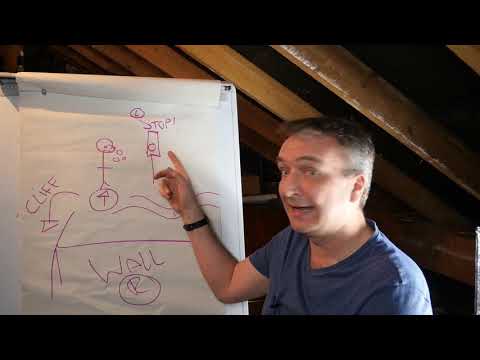
Andrew T. Austin analyzes a client generated metaphor of a person balancing on a large ball while juggling near a cliff, wall, and stop sign, interpreting it as a high‑probability work and status metaphor about precarious over responsibility and lack of real progress. He highlights elements such as elevation (status), juggling (busyness without productivity), the cliff (danger of “going over the edge”), the wall (rules/injunctions), and the ignored stop sign (warnings left unattended), suggesting the person maintains a risky elevated position out of perceived importance. As an intervention, he proposes inviting the person to “step down” or sit, stand on their own feet, and explore what happens to their sense of status and options when they no longer try to balance and juggle in this exaggerated, unsustainable way.
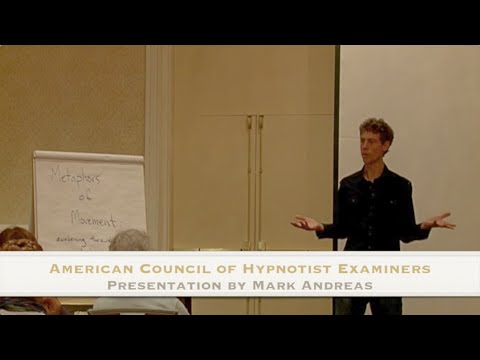
Mark Andreas introduces Andrew T. Austin’s Metaphors of Movement by showing how everyday phrases like “stuck in a rut,” “going in circles,” or “running on a treadmill” reveal detailed unconscious maps of a person’s problem state. He demonstrates eliciting these metaphors, drawing them out spatially, and then responding in the same metaphorical “channel” (e.g., island, river, hamster wheel) to generate surprising insight and shifts without focusing on life story or emotions directly. A key example is a woman in a hamster wheel like metaphor who realizes that her own feet are driving the exhausting cycle, and by “taking fewer steps” in the metaphor her internal experience and even physical tension change, illustrating the method’s power for gentle yet deep reorganization of experience.
❓ FAQ ABOUT SPATIAL METAPHOR WORK
Question: How is spatial metaphor work different from traditional talk therapy or other NLP techniques?
Answer: Traditional therapy often focuses on why problems exist, analyzing causes, processing emotions, and providing insight. Spatial metaphor work treats the spontaneous metaphors people use as literal maps of their subjective structure that can be explored directly. Rather than talking about the problem or analyzing it, you explore its actual spatial organization. This reveals structural patterns and possibilities that analyzing content alone cannot access. The approach can work beautifully alongside other NLP techniques like Timeline Work or Submodality Mapping once the metaphorical structure is revealed, or it can stand alone as a complete approach.
Question: What if I’m not a visual person? Can I still work with spatial metaphors?
Answer: Absolutely. Spatial metaphors do not require visualization. You might experience them kinesthetically as felt sensations, proprioceptively as awareness of position, auditorily as directional sound, or simply as knowledge without imagery. When someone says “I feel stuck,” they are already using a spatial metaphor regardless of their preferred representational system. Your nervous system knows where stuck is, what surrounds it, and what movements are possible without any visual imagery required. The spatial relationships exist in your experience whether or not you see pictures of them.
Question: Is this approach safe for trauma? What if exploring a metaphor brings up overwhelming emotions?
Answer: Spatial metaphor work offers unusual safety for trauma because clients explore structure without needing to disclose traumatic content. The metaphorical distance provides natural buffering. However, practitioners should have trauma informed training and recognize when to slow down or stop. If someone becomes overwhelmed, have them open their eyes, ground in present reality through sensory awareness, and regulate before proceeding if appropriate. Sometimes intense emotion signals approach to material needing more specialized support. While the methodology is content free, what it reveals may require additional therapeutic containment.
Question: How do I know if I’ve accessed a real metaphor versus something I’m just making up?
Answer: Real spontaneous metaphors come with somatic validation. You feel something shift in your body—a sense of rightness, tears, goosebumps, sudden clarity, or relief. They often surprise you with their accuracy or with details you did not consciously know. Fabricated metaphors feel flat, require mental effort to maintain, and do not produce physiological responses. Also recognize that everything emerging from your system reveals something true about how you organize experience. There is no “making it up” that is not actually information from your nervous system about your subjective structure.
Question: What if nothing changes during the exploration? Does that mean it failed?
Answer: Change happens on multiple timelines. Sometimes shifts are immediate and dramatic. Other times, your nervous system needs days or weeks to integrate new information before behavioral changes manifest. Some people leave sessions feeling confused or even frustrated, only to report profound changes days later. The exploration plants seeds that continue developing outside conscious awareness. Also, sometimes the discovery IS that your current position actually works for you despite complaints. Recognizing you are choosing your situation rather than being trapped in it represents significant change even when external behavior remains constant.
Question: Can I explore my own metaphors, or do I need a trained facilitator?
Answer: You can absolutely explore your own metaphors through journaling or voice recording. Write or speak the questions to yourself and notice what emerges. The challenge is that your defenses may operate outside awareness without someone else to notice them. You might unconsciously avoid certain areas or accept vague answers that a facilitator would gently probe. However, even incomplete self exploration often yields valuable insights. For deeply rooted patterns or longstanding difficulties, working with a trained practitioner who can track your process and ask clean questions provides significant advantages.
Question: How long does spatial metaphor exploration typically take?
Answer: Sessions range from 20 minutes to 2 hours, with most falling around 45 to 90 minutes. Simple metaphors with straightforward structure resolve quickly. Complex, multilayered metaphors require more thorough mapping. The work values thoroughness over speed; rushing defeats the purpose of careful exploration. Some practitioners offer intensive half day sessions for deeply entrenched patterns. The metaphor itself often signals when exploration is complete through organic resolution or natural stopping points where more time is needed for integration before proceeding.
Question: What happens after I explore my metaphor? Do I need to keep working with it?
Answer: Often, thorough mapping and exploration creates permanent structural shifts because your nervous system has updated its organizing framework. The problem was maintained by the spatial configuration; once you recognize alternative positions or movements, your system spontaneously reorganizes related behaviors. However, some people benefit from occasional check ins to notice if old patterns are reasserting or new metaphors are forming around different issues. Your body tells you if more work is needed through return of familiar stuck sensations or emergence of new spatial metaphors in your language.
😆 JOKES ABOUT SPATIAL METAPHORS
-
“I told my therapist I was going in circles. She asked me to describe the circle. I said ‘It’s about three feet wide, I’ve been walking it for 12 years, and there’s a door I pass every lap that I’ve never tried opening.’ This was embarrassing.” - Anonymous
-
“Turns out when I said I felt trapped in a box, I was actually standing in a doorframe. Not even a box. Just standing in a doorframe refusing to walk through. My therapist did not say ‘I told you so’ but I could tell she wanted to.” - Anonymous
-
“I spent three sessions describing my wall before someone asked what was on the other side. I’d never looked. Turns out it was three feet tall and made of cardboard. I have been defeated by kindergarten crafts.” - Anonymous
-
“My stuck place was a crossroads. Four directions, infinite possibilities. I’d been standing in the exact center for six years trying to decide. Someone finally asked ‘Do you need to choose just one direction?’ My life has been a geometry problem this entire time.” - Anonymous
-
“I felt like I was drowning. Therapist asked ‘How deep is the water?’ I checked. Eighteen inches. I am 5'9. This is why I drink.” - Anonymous
-
“I carried a heavy burden on my shoulders for decades. Turned out to be a backpack full of rocks I had put there myself. At least it was good for posture?” - Anonymous
🦋 METAPHORS FOR SPATIAL METAPHOR WORK
-
Developing photographs in a darkroom: Like watching a blank sheet slowly reveal its hidden image as you agitate it in solution, spatial metaphor exploration makes visible what was always there but invisible. The information existed in the negative all along, encoded in silver halide crystals waiting for the right chemical process to reveal it. Each clean question is like another moment in the developer solution, bringing latent structure into focus until suddenly the complete picture stands clear and unmistakable.
-
Tuning in a radio signal: Your problem broadcasts constantly but you have been slightly off frequency, receiving only static and interference. Spatial metaphor exploration acts like slowly turning the tuning dial, making micro adjustments until suddenly the signal comes through crystal clear. The information was always transmitting; you just needed the precise frequency to receive it distinctly. Once tuned in, the message becomes obvious, and you wonder how you ever missed it.
-
Cleaning dusty glasses: You have been looking through lenses so covered with accumulated dust and grime that everything appears blurry and indistinct. Spatial metaphor work carefully wipes each lens clean, removing layer after layer of obscuring film until suddenly you can see with startling clarity. The landscape did not change; your ability to perceive its actual structure did. Objects you bumped into repeatedly were always visible, just waiting for clear lenses to reveal them.
-
Assembling a puzzle from scattered pieces: Your experience has been like puzzle pieces dumped randomly on a table, all jumbled together with no sense of how they fit. Spatial metaphor exploration is like slowly turning each piece right side up, sorting edges from middles, connecting shapes by color and pattern until the complete picture emerges. The image was always inherent in the pieces; it just needed proper arrangement to become visible.
-
Excavating buried structures: Like an archaeologist carefully brushing away centuries of accumulated sediment, spatial metaphor work uncovers the organizing architecture of experience hidden under layers of adaptive thinking. Each clean question removes another layer of obscuring debris. Each direction explored reveals another wall or passage. Eventually the complete temple of your subjective reality stands visible, waiting for you to navigate its corridors with new awareness.
-
Defragmenting scattered data: Your psychological experience has become fragmented across consciousness like files scattered randomly on a hard drive, causing slow access times and frequent crashes. Spatial metaphor exploration acts like defragmentation software, reorganizing scattered bits into contiguous, efficiently accessible storage. The information was always there but poorly organized; now it streams smoothly, available when needed, no longer causing system errors.
-
Pulling focus on a camera lens: Your problem has been like looking at a photograph with the focus completely wrong, all elements mushed together into indistinct confusion. Spatial metaphor work is like slowly turning the focus ring, bringing the image into sharp clarity. Suddenly you can distinguish foreground from background, see exactly what each element is and where it sits in relation to others. The scene did not change; your ability to perceive its structure with clarity did.
🧑🦲 AXEL MAGNUS’S EXPERIENCE WITH SPATIAL METAPHOR WORK
I discovered this work through my own desperation, not through elegant theoretical interest.
For three years, I had been building my practice while feeling like I was running through chest deep water. Every step required enormous effort. Sessions exhausted me. Client work drained me. I told myself this was normal—new business, building momentum, paying dues in the field.
My partner finally said one evening, “You look like someone trying to breathe underwater.”
The metaphor landed in my body like a physical blow. I felt it: the pressure in my chest, the strain in my throat, the sense of never quite getting enough air despite being surrounded by it.
I called a colleague trained in David Grove’s Clean Language work. “I need help,” I told her. “I feel like I’m drowning even though I’m on dry land.”
She agreed to work with me, no questions about causes or history. Just: “Let’s see what’s there.”
She guided me through exploration. “And when you feel like you’re drowning even though you’re on dry land, where are you?”
I closed my eyes. Immediately I found myself standing in water. “I’m in the ocean. The water is up to my chest. Waves keep coming.”
“And when waves keep coming, and water is up to your chest, what kind of ocean is that?”
“Dark. Cold. The water is cold and I can’t see the bottom.”
“And when the water is cold and dark and you can’t see the bottom, is there anything else about that ocean?”
Long pause. I noticed my feet. “I’m… I’m standing on something. Something solid under my feet.”
“And what kind of something solid under your feet?”
“A platform. A flat platform. I’m standing on a platform in this ocean.”
As soon as I said it, my breathing eased. The panic receded slightly. I was not drowning. I was standing on something solid.
“And when you’re standing on this platform in this dark cold ocean, how big is that platform?”
I looked down in my mind’s eye. “About six feet across. Maybe seven. Definitely big enough to stand on. It’s stable.”
“And when it’s stable and big enough to stand on, is there anything else about that platform?”
“I’m…” I paused, feeling confused. “I’m standing right in the middle of it. I haven’t moved from the center.”
“And when you haven’t moved from the center of that platform, what stops you from moving?”
The answer came immediately, from my body rather than my mind. “If I step toward the edge, I’ll fall into deep water.”
“And if you were to step toward the edge now, just in imagination, what would you notice?”
I imagined taking a step toward the edge. Immediately: vertigo, fear, need to back into center where it felt safer.
“I can’t,” I said. “It’s too dangerous.”
“And when it’s too dangerous to step toward the edge, if you could look over the edge without stepping, what would you see?”
Resistance rose in my chest like a hand grabbing my throat. I did not want to look. But I forced my attention downward, over the edge of the platform, into the water.
Below the platform, maybe two feet down: sand. Beautiful sandy bottom. Clear water, no more than waist deep.
I started laughing. Then crying. Then laughing again while tears ran down my face.
“The water is shallow,” I said to my colleague. “This whole time, I’ve been terrified of drowning in water that’s waist deep.”
The metaphor had been encoding decades of inherited belief. My father struggled financially his entire life, warning me constantly about business dangers, how people drowned in debt, how most ventures failed. I had internalized this as literal drowning danger, standing frozen on my safe platform, exhausting myself staying perfectly balanced on something I did not need, in water I could simply walk through.
“And now that you know the water is waist deep, what would you like to have happen?”
“Step off this platform. Walk to shore. Stop exhausting myself staying in one place.”
The sensation when I imagined stepping off was extraordinary. My shoulders dropped what felt like six inches. My chest expanded. I could breathe fully for the first time in months. Heat and tingling spread through my arms and legs as circulation returned to areas I had been unconsciously clenching.
Over the following weeks, everything changed. I stopped the desperate controlling and pushing. Clients came easily. Sessions flowed naturally instead of draining me. My partner said I looked like someone who had just been released from prison.
But the deeper gift was experiential understanding of what clients go through. That moment when the platform reveals itself, when the water turns out to be shallow, when what seemed terrifying dissolves into something navigable—I carry that in my body now. When a client resists looking in a certain direction, I know that resistance from inside, have compassion for it, but also trust it signals what most needs exploring.
The experience taught me that metaphors are not decorative language but actual encoding of how consciousness organizes itself spatially. My stuck feeling was not “like” standing on a platform in the ocean—I was literally standing on a platform in the ocean in my subjective experience. That spatial structure organized everything: my behavior, my emotions, my energy level, my business decisions.
Change that structure, change everything.
🕳️ THE LIMITATIONS OR UNCERTAINTIES IN SPATIAL METAPHOR WORK
Not everyone accesses metaphors easily
Some people have difficulty accessing metaphorical representation of experience. Highly analytical individuals, those trained to suppress imaginative thinking, or people whose problems are primarily physiological rather than psychologically constructed may struggle to generate spatial metaphors. Forcing the process rarely helps. Alternative approaches may be more suitable, or metaphor work might become accessible after other foundational work.
Your body tells you when metaphor work is not fitting. Persistent difficulty accessing any imagery or felt sense despite patient exploration, flat affect throughout, absence of any somatic markers—these suggest this approach may not be right for this person at this time. Honor this rather than insisting everyone must work metaphorically.
Cultural considerations shape meaning
Directions, elevations, and spatial relationships carry different meanings across cultures. What represents progress in one culture might indicate avoidance in another. Practitioners must remain alert to avoid imposing their cultural assumptions onto clients’ metaphors. What seems obviously positive or negative through your cultural lens may hold completely different valence in the client’s cultural framework.
Additionally, some cultures have prohibitions against certain types of imaginative work, associating it with practices their traditions forbid. Respect these boundaries. Spatial metaphor work can adapt to work within culturally appropriate constraints, but this requires education about the client’s cultural context and flexibility in application.
Not all presenting problems respond to this approach
This work excels with certain difficulties: chronic stuck states, identity conflicts, patterns where people “know” what to do but cannot do it, situations maintained by hidden organizing principles. It works less reliably with acute crisis, active psychosis, severe cognitive impairments, or situations requiring immediate practical intervention.
Someone in acute suicidal crisis needs safety planning and possibly hospitalization, not metaphor exploration. Someone experiencing active delusions needs medical support, not spatial mapping. While metaphors can be incorporated later in treatment for these conditions, they should not be the primary intervention during acute phases.
Physical limitations can affect the work
Certain neurological conditions, cognitive impairments, or medication effects can interfere with the cognitive processes required for metaphor work. Traumatic brain injury, severe cognitive decline, or medications that suppress imaginative thinking may make this approach less accessible or effective.
Additionally, people experiencing significant physical pain may have difficulty sustaining the internal focus required. Their attention naturally draws to body sensations demanding immediate awareness. The work can sometimes proceed anyway but requires adaptation and may need to be briefer or broken into multiple shorter sessions.
Changes do not always generalize
While structural changes often ripple through multiple contexts automatically, sometimes metaphor resolution creates change in the mapped domain without transferring to related areas. Someone might resolve their work related stuck metaphor while their relationship stuckness remains unchanged, requiring separate exploration.
Generalization depends partly on how fundamentally the metaphor organized experience. Surface metaphors describing specific situations change that situation. Deep structural metaphors organizing large swaths of identity transform broadly. Practitioners cannot always predict which type they are working with until observing post session changes.
Timing significantly affects outcomes
Metaphors evolve through people’s lives. Working with a metaphor already shifting naturally can accelerate change beautifully. Working with one not yet ready to shift creates frustration and resistance. Sometimes clients need to live in their current metaphor longer before they are developmentally ready to reorganize it.
Intuition about timing develops through experience but remains imperfect. Sometimes what seems too early proves exactly right; sometimes obvious readiness turns out to be false. The client’s nervous system provides feedback through somatic responses during exploration. Trust productive confusion differently than confusion signaling wrong timing.
Not all changes persist
Some people return to old metaphorical positions after initial transformation, especially if their environment reinforces the original pattern. Family systems, relationship dynamics, or workplace cultures can pull people back into positions they had reorganized. This does not mean the work failed but rather that environmental factors need addressing.
Additionally, new stressors can reactivate old metaphors or generate similar new ones. The nervous system tends to return to familiar organizing patterns under sufficient pressure. This is normal human functioning, not failure of methodology. Follow up work often proceeds more quickly as the person recognizes the pattern earlier.
Research base has gaps
While this work draws on established principles from cognitive linguistics, neuroscience, and embodied cognition research, formal outcome studies specifically on therapeutic applications of spatial metaphor remain limited. Large scale controlled trials comparing this approach to other interventions are sparse.
This does not invalidate clinical observations and client reports of effectiveness, but it means we cannot quantify precisely what types of problems respond best, what lasting change rates look like across populations, or how it compares statistically to other modalities. Practitioners should represent the evidence base honestly when describing the work.
Practitioners need training and supervision
While the basic principles seem simple, skillful application requires training in Clean Language question syntax, somatic tracking, recognizing when clients avoid certain territories, and knowing when to stop or adjust. Self taught practitioners may miss important subtleties or inadvertently contaminate client metaphors with their own content.
Working with metaphors can access deeply rooted patterns and intense emotions. Practitioners need training in trauma informed care, ethical boundaries, and knowing when clients need referral to other specialists. The simplicity of the questions should not be confused with simplicity of the process.
✏️ CONCLUSION
Your problems speak themselves spatially before words arrive to describe them. The tightness in your chest, the sensation of being pressed against a wall, the feeling of going in circles—these are not metaphors for something else but accurate reports of how your nervous system has mapped your difficulty.
Spatial metaphor work invites you to take these expressions seriously as literal descriptions of navigable territory. When you explore what lies to your left, behind you, beneath your feet, you often discover that stuckness has unexpected pathways hidden just outside your habitual field of awareness. The wall that seemed solid proves to have doors. The pit that trapped you measures only three feet deep. The burden weighing you down can be examined, perhaps set aside.
This work requires courage to see what you have been avoiding and patience to map thoroughly before changing. But the recognition that arrives through direct exploration carries transformative power intellectual understanding cannot match. Your body knows immediately when you have found truth; the shifts register as breath deepening, muscles releasing, energy returning.
The metaphors emerging spontaneously from your experience contain extraordinary wisdom about how you have been organizing yourself, what you have been protecting, where inherited patterns have constrained chosen possibilities. Learning to navigate these inner landscapes offers a path to change that feels organic rather than imposed, emerging from your own structure rather than applied from outside.
Whether you work with a trained practitioner or begin exploring your own metaphors through journaling and self inquiry, trust what your body tells you about direction, movement, and possibility. The map has been inside you all along, waiting for someone to ask the right questions and listen closely enough to hear where you actually stand and what directions might carry you toward more ease, freedom, and authentic alignment with who you are becoming.
📚 REFERENCES
- George Lakoff & Mark Johnson, 1980; Metaphors We Live By
- Steve & Connirae Andreas, 1987; Change Your Mind and Keep the Change: Advanced NLP Submodalities Interventions
- Julian Jaynes, 1976; The Origin of Consciousness in the Breakdown of the Bicameral Mind
- Andreas, S. (2002). Transforming yourself: Becoming who you want to be. Real People Press.
- Connirae Andreas & Steve Andreas, 1989; Heart of the Mind: Engaging Your Inner Power to Change with Neuro-Linguistic Programming
- Connirae Andreas & Tamara Andreas; 1994; Core Transformation: Reaching the Wellspring Within
- video DVD Transforming Yourself Complete 3-day Training with Steve Andreas
- The Wholeness Work
- Core Transformation
- Metaphors in movement
- David Grove & B.I. Panzer, 1989; Resolving Traumatic Memories: Metaphors and Symbols in Psychotherapy
- James Lawley & Penny Tompkins, 2000; Metaphors in Mind: Transformation through Symbolic Modelling
- Gregory Bateson, 1972; Steps to an Ecology of Mind
- R.D. Laing, 1960; The Divided Self: An Existential Study in Sanity and Madness
- Charles Faulkner, “Metaphors of Identity” audio program
- Lucas Derks, 2005; Social Panoramas: Changing the Unconscious Landscape with NLP and Psychotherapy
- Raymond Gibbs, 2005; Embodiment and Cognitive Science
- Mark Johnson, 1987; The Body in the Mind: The Bodily Basis of Meaning, Imagination and Reason
- David Grove, Clean Language resources and training materials
- Penny Tompkins & James Lawley, Clean Language question syntax and Symbolic Modeling methodology
- Lakoff, G., & Johnson, M. (1999). Philosophy in the Flesh: The Embodied Mind and Its Challenge to Western Thought
- Gibbs, R. W. (2006). Embodiment and Cognitive Science. Cambridge University Press.
- Barsalou, L. W. (2008). Grounded Cognition. Annual Review of Psychology, 59, 617-645.
Image credit - Perplexity - NAVIGATING INNER LANDSCAPES, SPATIAL METAPHORS PROGRESS AND CHANGE OF MEANING
🎬 MOVIES ABOUT SPATIAL METAPHORS AND INNER LANDSCAPES
- Inception (2010): Dreams as navigable architectural spaces with specific rules about orientation, gravity, and movement through layers
- Inside Out (2015): Emotions as characters navigating the spatial geography of memory and personality
- Eternal Sunshine of the Spotless Mind (2004): Memory as physical space that can be explored, hidden in, and erased location by location
- The Matrix (1999): Reality as constructed landscape with hidden rules about what movements are possible
- Spirited Away (2001): Coming of age as journey through metaphorical bathhouse where positions and roles determine identity
- Pan’s Labyrinth (2006): Trauma encoded in fantastical spatial metaphor requiring navigation and choice
- Synecdoche, New York (2008): Life as ever expanding theatrical set where the protagonist struggles with positioning himself
📺 TV SHOWS ABOUT METAPHORICAL THINKING AND SPATIAL REPRESENTATION
- The Good Place: Afterlife as designed space revealing moral philosophy through spatial arrangement and position
- Maniac: Mental illness and healing portrayed through shared dreamscapes requiring navigation
- Legion: Schizophrenia as literal fragmentation across metaphorical spaces and positions
- Russian Doll: Repeated death as exploration of same spatial territory from different perspectives
- Undone: Trauma and time represented as navigable landscape requiring new relationship to position
🎭 DOCUMENTARIES ABOUT METAPHOR, COGNITION, AND SPATIAL THINKING
- The Phantom Tollbooth (1970): Animated journey through Kingdom of Wisdom where abstract concepts become literal landscapes
- Examined Life (2008): Philosophers walking through actual spaces while discussing ideas, demonstrating embodied cognition
- My Architect (2003): Exploring father’s identity through the buildings he designed as metaphors for his inner life
- Cave of Forgotten Dreams (2010): Ancient cave paintings as humanity’s first external representation of internal metaphorical thinking
📚 NOVELS ABOUT INNER LANDSCAPES AND METAPHORICAL JOURNEYS
- The Phantom Tollbooth by Norton Juster: Mathematical and linguistic concepts as literal territories to navigate
- The Interior Castle by St. Teresa of Avila: Spiritual development as journey through seven mansion like spaces
- House of Leaves by Mark Z. Danielewski: House as impossible spatial metaphor for psychological breakdown
- The Pilgrim’s Progress by John Bunyan: Spiritual life as journey through allegorical landscape
- Sophie’s World by Jostein Gaarder: Philosophy teaching through spatial metaphor of the rabbit and the universe
- The Phantom of the Opera by Gaston Leroux: Opera house’s hidden spaces as metaphor for unconscious territory
- Haruki Murakami’s works: Particularly “Hard Boiled Wonderland and the End of the World” where mental space becomes literal geography [location they described], what’s around you?"