HOW THETA WAVES, OXYTOCIN, AND COLLECTIVE RHYTHM OVERWRITE WHO YOU ARE.
WHY EVERY CULTURE ON EARTH HAS A POSSESSION RITUAL

Belief - is part of Series
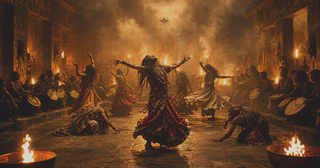
Every culture ever documented has developed a ritual in which people enter trance through rhythm, movement, and communal witness, and emerge with different beliefs, a reconstituted identity, or a healed sense of self. This is not coincidence. It is convergent engineering of the same neurological hardware from thousands of independent directions. Beneath the deity names and the drum styles, possession trance is a somatic rewrite protocol: the body is overwhelmed by rhythm until the default self-model softens, a new identity vector enters through the cosmological frame held by witnesses, and the community narratives the change into permanence.
What makes this extraordinary from an NLP and somatic-change perspective is the body-first logic. These traditions did not theorise their way to belief change. They discovered, through millennia of practice, that you cannot think your way to a new identity, but you can drum your way there. The warmth that spreads from your sternum during sustained rhythm, the dissolving sensation behind the eyes when the beat locks in, the strange looseness in the jaw when the witness group leans forward, these are not decoration. They are the mechanism itself.
This article surveys possession trance traditions across every inhabited continent, extracts the neurological architecture they all share, and offers practitioners a somatic framework for understanding how rhythm, dissociation, and communal witness combine to produce the deepest and most durable belief changes available to human beings.
🎯 THE BENEFITS OF POSSESSION TRANCE THROUGH DANCE
“I went in believing I was broken. I came out believing I was chosen. My body figured it out before my mind did.”, Anonymous
Possession trance through dance is not a curiosity of premodern peoples. It is one of the most reliably documented technologies for rapid, deep, and lasting belief change available to the human nervous system. Its benefits operate across multiple levels simultaneously, neurological, psychological, social, and somatic.
Identity restructuring at the pre-cognitive level. Trance states induced through rhythm and movement operate below the level of linguistic self-narrative. The beliefs that resist conscious intervention, “I am fundamentally unworthy,” “I am always alone,” “I cannot change”, are encoded somatically, in posture, breath pattern, and autonomic tone. Possession trance addresses them there, in the body, before the critical faculty can argue back. You feel the change as a sudden loosening in the chest, a release of chronic tension in the base of the skull, a warmth that begins in the solar plexus and moves upward without explanation.
Suppression of the default-mode network (DMN). Research shows that sustained rhythmic movement quiets the brain’s default-mode network, the circuit responsible for self-referential rumination, habitual narrative, and the “not-good-enough” loop that many people cannot exit through ordinary means. When the DMN quiets, the sense of a fixed, bounded self temporarily dissolves. This is not frightening in a culturally supported setting, it is profoundly relieving, experienced as expansion in the ribcage, a softening at the jaw hinge, a sense of the crown of the head opening upward.
Oxytocin flooding through synchronized movement. Moving in rhythm with other people triggers oxytocin release, and oxytocin does something extraordinary: it actively loosens established neural patterns, creating a brief window of neurological plasticity in which new beliefs can install with unusual ease. The warmth in the chest and the involuntary smile that arise during group dance are not mere side effects, they are oxytocin doing its work on your belief architecture.
Theta wave induction and heightened suggestibility. The 4 to 8 Hz brain state associated with trance, theta rhythm, is also the state of heightened learning, vivid imagery, and deep suggestibility. When theta dominates, the distinction between imagination and experience softens. What the community says is happening, begins to feel as if it is happening, in the body, right now. New beliefs arrive not as intellectual propositions but as somatic certainties.
Community validation of new identity. The most psychologically durable belief changes are not those you arrive at alone, they are those witnessed, named, and affirmed by a community. Possession trance traditions universally include a witness group that sees the transformation, calls it by name, and responds to the changed person differently. Your body knows it has been seen. The change is anchored by that seeing into long-term identity.
Cathartic release of somatic distress. Traditions from tarantism in medieval Italy to Zār in the Horn of Africa used exhaustive movement to metabolise stored physiological distress. What the body holds as chronic tension, grief, fear, rage, shame, can be discharged through sustained rhythmic movement in a witnessed, cosmologically framed context. What enters the ritual as a symptom often exits as a story: transformed, integrated, and no longer in charge.
Belonging and social reintegration. Possession trance is always communal. The individual who enters isolation through illness, trauma, or marginalization is received back into the group through the ritual body. The social reintegration is itself therapeutic, felt as a warmth across the shoulders, a sense of the back being supported, a softening of the habitual brace in the lower belly.
🏛️ ORIGINS OF POSSESSION TRANCE ACROSS CULTURES AND HISTORY
“Humanity has been downloading new operating systems through drums and dancing since before we had words for it.”, Anonymous
What follows is every major possession trance tradition documented across human history, organized by region. Each shares the same four-element architecture beneath radically different cultural clothing: rhythm, movement, community witness, and post-trance narrative.
West Africa and the African diaspora
Yoruba/Orisha (West Africa, Nigeria), The foundational template for much of the world’s possession theology. Devotees are initiated through multi-year processes culminating in the descent of an Orisha, a divine intermediary spirit, who “rides” the initiate’s body. The initiate becomes a new person with a new cosmic identity.
Haitian Vodou/Lwa, Evolved from Yoruba, Fon, and Kongo traditions under the violence of the transatlantic slave trade. Specific drum rhythms and sacred geometric symbols (vévé) summon named Lwa spirits who displace the devotee’s ordinary identity entirely.
Santería/Lucumí (Cuba), Yoruba Orisha tradition merged with Catholicism under colonial suppression. Batá drum rhythms summon specific Orisha; the possessed dancer’s body expresses each deity’s mythological character through a unique physical vocabulary.
Candomblé (Brazil), The most structurally intact preservation of Yoruba ritual. Possession here functions as identity multiplication rather than erasure, the initiate gains layered, plural selfhood defined by the spirits they can carry.
Umbanda/Macumba (Brazil), Syncretic tradition in which mediums are possessed by deceased indigenous peoples and former enslaved Africans (pretos velhos). Seekers receive counsel from ancestral authority speaking through the possessed medium.
African ritual complexes
Zār (Ethiopia, Sudan, Egypt, Horn of Africa, Iran), Rather than exorcising a possessing spirit, the Zār ceremony negotiates with it. The afflicted person moves from passive victim to host with agency; the Zār community provides moral orientation and social belonging that reconsolidate the transformed identity.
Bwiti/Iboga (Gabon, Congo, Fang people), Multi-day initiation using ibogaine root bark combined with continuous music and dance. Participants report ancestor encounters and death-and-rebirth experiences that produce categorical identity transformation. The uninitiated person is considered cosmologically incomplete until they pass through.
!Kung Healing Dance (Kalahari Desert), Women form a circle and sing while men dance around the fire until n/um (boiling energy) rises in the healer’s spine, producing trance from which healing power radiates to the assembled community.
Gnawa/Lila (Morocco), A fusion of Sufi practice and sub-Saharan African spirit possession. Specific musical modes (mluk) invoke named spirits associated with colours, herbs, and emotional states. The night-long lila ceremony is a full-spectrum possession and healing event.
Ancient Mediterranean
Dionysian Orgia (Ancient Greece), Ecstatic ceremonies featuring unrestrained masked dances by torchlight, wine, and sustained rhythmic movement producing ekstasis (literally: standing outside oneself). Temporary ego dissolution through the god’s possession was considered both sacred and necessary.
Maenads, Female devotees of Dionysus who fled to mountain forests and danced until they entered frenzy, reportedly acquiring supernatural strength. One of history’s earliest documented accounts of collective possession trance.
Cult of Cybele/Corybantes (Phrygia, ancient Turkey), Ecstatic priests who used cymbal-clashing, flute-playing, and frenzied dancing to induce therapeutic trance. Plato referenced their ritual as a form of cathartic surrender to rhythm.
Sufi Islam
Sema/Whirling Dervishes (Mevlevi Order, Turkey/Persia), The spinning (sama) overloads the vestibular system and disrupts ordinary body-schema. The right arm receives divine blessing; the left transmits it. The body becomes a channel for grace, not a vessel for a spirit.
Sufi Dhikr/Hadra (Global, multiple orders), Collective rhythmic repetition of divine names (dhikr) accompanied by rhythmic swaying, chanting, and breathing. Practised across dozens of Sufi orders worldwide as a path to the dissolution of the ego-self (nafs).
Gnawa Lila (Morocco), Already listed above under African complexes; worth noting separately as the clearest documented case of Sufi practice and sub-Saharan possession tradition fusing into a single ritual system.
Japan
Kagura (Shinto, 710 CE to present), One of Japan’s most ancient sacred art forms, its name deriving from kami’gakari meaning “oracular divination.” Shrine maidens (miko) perform specific choreographies with bells and batons to invite divine presence into the ritual space.
Noh Theatre (from 14th century), Scholars trace a direct developmental arc from unmasked possession dance in early Shinto Kagura to masked drama in Noh. The actor’s body gradually became the formalised container for spirits; the mask replaced dissociative trance as the technology of identity displacement.
Ainu Shamanism (Hokkaido), Indigenous Ainu shamans enter trance through chanting, percussion, and dance to communicate with kamuy (gods and spirits of nature). The ecstatic movement enacts the cosmic journey for the witnessing community.
China and East Asia
Wu Shamanism (Ancient China, from ~2000 BCE), The Chinese character for wu originally depicted a person performing ecstatic dance. These shamans, predominantly women in the earliest records, used dance as cosmological leverage to petition the spirit world for rain, healing, and ancestral negotiation.
Tangki/Ji Tong (China, Singapore, Malaysia, Taiwan, Southeast Asia), A 5,000-year-old practice in which the possessed medium is believed to be god incarnate. The trance is demonstrated through self-wounding (piercing cheeks, tongue, and back with swords and skewers) with the absence of blood proving divine protection.
Korean Mudang/Kut (Korea), Female shamans (mudang) perform the kut, a trance ceremony with 12 ritual procedures addressed to specific gods and spirits. The theatrical virtuosity of the mudang’s dance and costume changes draws witnesses into shared emotional and belief transformation.
Southeast Asia
Nat Kadaw (Myanmar), Spirit mediums dressed in elaborate costumes dance to identifying musical modules (specific rhythmic-melodic patterns) unique to each of Myanmar’s 37 Nats. Trembling hands signal the spirit’s arrival.
Jathilan/Jaranan/Kuda Lumping (Java, Indonesia), Young men dance with bamboo hobby-horses to relentless gamelan percussion until they enter full possession. The possessed dancers perform feats of endurance (eating glass, consuming fire, being whipped) before a ritual specialist exorcises the spirit.
Reak (West Java), Adolescent group trance in which boys dance to relentless drums until they believe they are possessed by spirits of natural forces. Elder shamans move through the group performing exorcisms. Trance rises and falls in waves through the group, a living demonstration of collective contagion through shared movement.
Sanghyang (Bali), Sacred trance dances in which performers are possessed by animal spirits or celestial nymphs. Pre-adolescent girls in the sanghyang dedari variant dance on glowing coals while in trance, believed to be protected by the possessing spirit.
Thai Spirit Mediums/Faun Phii (Northern Thailand), Women dance in trance for days in ancestral spirit ceremonies, dressing in costumes appropriate to each spirit and moving in slow, rhythmic patterns to a traditional gamelan orchestra.
South Asia and India
Theyyam (Kerala, India), Performers from Dalit communities become deities physically through ritual preparation, drumming, and dance. During the ceremony, upper-caste community members worship the Dalit performer as God, a profound annual social inversion through possession. The tradition predates organised Hinduism.
Devadasi/Classical Indian Temple Dance, Female temple dancers as mediators between human and divine. The abhinaya (expressive) dimension of Bharatanatyam involves fully embodying the emotional and spiritual states of deities through controlled somatic identification.
Tibetan Oracle/Nechung (Tibet), The state oracle enters trance to deliver prophecies. The physical transformation during possession, including changes in voice, posture, and apparent strength, is documented by witnesses over centuries of Tibetan institutional history.
Siberian and Central Asian shamanism
Siberian/Mongolian Shamanism, Shamans (called kam or böö) enter trance through drumming, chanting, and dancing to travel to other worlds and retrieve information or healing for the community. Unlike most possession traditions, the Siberian shaman leaves the body rather than being entered by an external spirit.
Tungus/Evenki Shamanism (Russian Far East), The source of the word “shaman” itself. Elaborate costumed performances in which the shaman’s drum is considered the vehicle for inter-world travel.
Indigenous Americas
Ghost Dance (Great Plains, USA, 1870 and 1890 movements), Participants danced in circles for days, entered trance, and reported visions of deceased relatives and cultural renewal. The 1890 movement, spread by the prophet Wovoka, became a mass technology for identity reconstitution under existential threat.
Sun Dance (Plains tribes), Sleep deprivation, fasting, physical ordeal (including flesh piercing), and community witnessing combine to produce vision states. A somatic ordeal architecture designed to install new purpose and identity.
Amazonian Ayahuasca Ceremony (Shipibo-Conibo, Shuar, Santo Daime, and hundreds of others), The healer’s sacred songs (icaros) navigate both healer and participant through visionary states induced by ayahuasca, directing the experience toward healing and identity reconstruction.
South America beyond the Amazon
Tinku/Diablada (Bolivia, Peru), Ceremonial combat-dance in which spilled blood fertilises Pachamama (Earth Mother). The Carnaval de Oruro blends pre-Columbian spirit possession with Catholic iconography; participants embody demonic and angelic forces through costuming, drumming, and days of continuous dancing.
Candomblé and Umbanda extensions (Venezuela, Colombia), Afro-Brazilian possession traditions spread northward and fused with indigenous Amazonian spirit cosmologies, producing hybrid possession systems unique to each region.
European traditions
Dancing Mania/Choreomania (Central Europe, 1374 to 1518), Beginning in Aachen in 1374, thousands danced uncontrollably for hours or days until collapse. Recurring in major outbreaks through the 1518 Strasbourg Dancing Plague, the condition was universally interpreted as possession, by devil or saint. Historian John Waller’s analysis concludes that extreme social stress enabled genuine trance states lasting impossibly long periods.
Tarantism/Tarantella (Southern Italy, 11th to 20th century), Sufferers believed to be “bitten” by the tarantula spider were surrounded by townspeople playing tambourines, mandolins, and guitars. They danced for hours or days until total exhaustion, at which point they were considered cured. A somatic catharsis machine in which the body’s distress was metabolised through witnessed, rhythmically structured movement.
Hasidic Judaism (Eastern Europe, 18th century to present), Founded by the Baal Shem Tov, Hasidism recentred Jewish practice around joy, song, and ecstatic dance (rikud) as the highest form of divine service. Dances continued until participants reached states of exaltation, often aided by covering the eyes and spinning in multiple directions, a precise somatic induction protocol.
Christian traditions
Pentecostal Shout/“Catching the Holy Ghost” (Global, 1900s to present), The world’s fastest-growing religious movement carries the most widespread de facto possession tradition within Christianity. Collective singing, clapping, and call-and-response amplify arousal states until the Holy Spirit descends and worshippers enter convulsive ecstatic states. Belief in God’s personal presence is installed somatically, bypassing cognitive resistance entirely.
African American Ring Shout (17th to 19th century), A circular shuffling dance practised by enslaved Africans in the American South, preserving West African possession-trance technology within a Christian framework. Scholars trace a direct lineage from this practice to gospel, blues, jazz, and eventually rock and roll.
Medieval Flagellants (13th to 14th century), Mass processions using physical pain, exhaustion, and collective rhythm to produce devotional altered states in which participants believed they were enacting Christ’s suffering and receiving divine forgiveness through the body.
Charismatic Renewal/Toronto Blessing (1990s to present), Mass involuntary physical manifestations, laughing, weeping, roaring, shaking, falling, interpreted as direct Holy Spirit possession. Spreading globally through church networks, this demonstrates the social contagion mechanism of possession trance operating in a contemporary Western context.
📜 PRINCIPLES OF POSSESSION TRANCE
Principle 1: Rhythm is the primary induction technology
Every possession tradition in the list above uses repetitive auditory stimulation, drum, tambourine, clapping, chanting, or spinning, as its primary entry point. This is not cultural preference. It is neurological precision. Repetitive rhythmic stimulus in the 4 to 8 Hz range (and the body movement that entrain to it) drives brain activity into theta, quiets the DMN, and begins the softening of ordinary self-identity that makes all subsequent work possible. You feel it as a gradual forgetting of where your body ends, a warmth settling across the back of the skull, a loosening of the narrative grip.
Principle 2: The community witness is structurally load-bearing
Possession trance is never a solo event. The witness group does not merely observe, they co-create the trance by holding the cosmological frame that gives the experience its meaning. Without witnesses who share the belief system, the same physiological state would be frightening rather than transformative. The felt sense of being seen, named, and received by a group is itself a neurological event, it releases oxytocin, deepens the trance, and begins the process of anchoring the new identity into social reality.
Principle 3: Dissociation is the vehicle, not the destination
The temporary suspension of the ordinary self-narrative, what traditions call being “ridden,” “mounted,” “filled,” or “vacated”, is not the goal of possession trance. It is the opening. The dissociative state creates a window of plasticity in which the old identity structure can be gently reorganized. What matters is what enters that window: the spirit’s identity, the deity’s character, the ancestor’s wisdom, or, in secular terms, the new belief about who this person fundamentally is.
Principle 4: The body leads every genuine belief change
Every tradition in this survey installs new beliefs through the body first. Dance, convulsion, spinning, exhaustion, self-wounding, or rhythmic breath, the somatic event precedes and produces the cognitive change, not the reverse. This is why intellectual persuasion alone rarely produces durable belief change: it bypasses the body, and the body retains the old encoding. When your sternum softens, when your jaw releases, when your throat opens in sound, the belief that was stored there releases with it.
Principle 5: The post-trance narrative consolidates the change
Without a post-trance narrative, spoken by a priest, elder, pastor, or community, the transformative experience dissipates without leaving a permanent structure. Every tradition understands this, even if it does not theorise it. The shaman interprets the journey. The priest names what spirit came. The pastor tells the congregation what they witnessed. In NLP terms, this is the linguistic anchoring that converts a somatic shift into a stable new identity. The story the community tells about what happened becomes the story you tell yourself.
Principle 6: Regular participation maintains the new ecology
A belief installed through possession trance does not automatically sustain itself. Every tradition builds in ritual maintenance, weekly church, seasonal ceremony, annual initiation, because the new belief ecology requires reinforcement in the same way that physical fitness requires continued practice. The body remembers what the mind forgets, and regular re-entry into the ritual community re-anchors the change at the somatic level.
Principle 7: Cultural patterning shapes the content of the change
The neurological hardware is universal; the software is cultural. Theta waves and oxytocin create the opening, but the community’s cosmology, expectations, and shared language determine what fills it. A Candomblé devotee emerges with an Orisha identity. A Pentecostal worshipper emerges with the certainty of divine presence. A shamanic initiate emerges with a new relationship to the spirit world. The mechanism is identical. The outcome reflects the cultural context with precision.
🗨️ GUIDING CLIENTS IN POSSESSION TRANCE
Observation and presence
Position yourself at the client’s side to unobtrusively observe subtle shifts in facial expressions, gestures, and skin tone while ensuring you do not interfere with their imaginative process or metaphor creation.
Vocal modulation
Use a gentle, melodic, and unhurried tone when speaking, allowing your voice to foster calm and receptivity.
Genuine engagement
Demonstrate active interest in the client’s process by listening attentively and supporting their exploratory journey.
Reflective communication
Echo the client’s words and delivery style. For example, if the client describes an exciting moment with a bright expression, quicker speech, and a higher tone, mirror these qualities in your response. As a practitioner, strive to match their affective cues, or consider formal training in expressive techniques to enhance these skills.
Connecting experience and inquiry
Seamlessly link questions and reflections to the client’s experiences using coordination (and, as, when), ensuring a smooth and empathetic flow throughout the interaction.
Introducing the process. Before working with rhythmic induction, establish a clear outcome. Ask: “What would you like to be different after this?” Then ask them to locate where they feel the current limitation in their body, specifically. Not “stressed,” but “a tightness in the left side of my throat, about two centimetres in, cool, dense, fixed.” This somatic mapping is your baseline.
Watching for trance indicators. As rhythm is introduced (tapping, clapping, recorded drums, or the practitioner’s voice alone), watch for: slower blinking, slight colour change across the cheeks, subtle postural drop in the shoulders, slower breathing, a characteristic softening at the corners of the mouth. These are your signals that the DMN is quieting and the window is opening.
Key questions to deepen the state. “And as you feel that rhythm… where does it land in your body first?” “What happens to that tightness… as the sound continues?” “And when you notice that warmth… what does it want to do next?”
Tracking progress. The somatic baseline you established at the start becomes your verification tool. As the session progresses, return to the original location: “And that cool density in your throat… what’s happening there now?” Any change, even a slight shift in temperature, texture, or location, indicates movement.
Recognising completion. The session is complete not when the client reports a new belief verbally, but when the somatic baseline has changed, and the new quality persists through several minutes of ordinary conversation. The body should feel different. The client’s posture, breathing pattern, and the quality of their eye contact will tell you before they find words for it.
💧 POSSESSION TRANCE AXEL MAGNUS SCRIPT BASED ON NLP PRINCIPLES
“I don’t need a drum. I’ll just talk very slowly until the same thing happens.”, Anonymous
NLP technique: Rhythmic Dissociation with Submodality Mapping Across
This session demonstrates how a practitioner can use verbal rhythm, pacing, and submodality mapping to produce a mild possession-trance state, accessing a resource identity that can be “mapped across” onto a limiting belief.
Axel Magnus: [seated at an angle beside the client, voice low and even] Before we do anything at all… I’d like you to just settle for a moment. Let your weight drop into the chair. Good. Now, what brings you here today?
Client: I want to stop freezing in front of groups. I have to present next month and even thinking about it, I feel… locked. Like something clamps down across my chest.
Axel Magnus: [nodding slowly] Clamps down across your chest. Can you find that right now, just by thinking about it?
Client: [slight wince] Yes. It’s immediate. Centre of my chest. Heavy. Like a stone.
Axel Magnus: A stone. How big?
Client: About the size of a fist.
Axel Magnus: And the temperature?
Client: Cold. Definitely cold.
Axel Magnus: Does it have a colour, if you just notice without thinking about it?
Client: [pause] Grey. Dark grey.
Axel Magnus: [writes briefly, voice staying low] Good. And is it moving or still?
Client: Still. It doesn’t move at all.
Axel Magnus: Perfect. Now I want to set that aside for a moment, not push it away, just… park it right there, exactly as it is. And I’d like you to think of a time, any time, it doesn’t have to be about presenting, when you were completely in your element. Moving, acting, doing, and you felt… almost more than yourself. As if something larger was moving through you.
Client: [brightens immediately] Yes. When I’m dancing. I forget I have a body. It’s just… flow.
Axel Magnus: [matching the brightening slightly in voice] When you’re dancing and you forget you have a body and it’s just flow. Step into that now. Where do you feel that in your body?
Client: [relaxes visibly] Chest. Same place, weirdly. But open. Warm. Like there’s light there instead.
Axel Magnus: Light instead. What colour?
Client: Gold. Amber.
Axel Magnus: Moving or still?
Client: [small smile] It pulses. Like a heartbeat. Slow.
Axel Magnus: [voice drops further, pace slows] Good. Now I want you to stay with that pulsing amber light… and I’d like to try something. I’m going to tap a slow rhythm on the arm of my chair… and I’d like you to simply let your attention move with it. Not think about it. Just… let it carry you.
[begins a slow, even tap, approximately one beat per second, and continues throughout]
And as that rhythm continues… you might notice that the warmth in your chest… begins to move with it a little… expanding slightly… with each beat… as if the rhythm is amplifying something that was already there…
Client: [eyes slightly defocused, breathing slowing] Mm. Yes.
Axel Magnus: [even lower] And I wonder if you can notice… that the part of you that dances… the part that goes into flow… that part has its own timing… its own pulse… and it knows things your thinking mind doesn’t know…
[continues slow tapping]
And as that amber warmth continues to pulse… I’d like you to very gently… let your attention drift toward that grey stone in the same location… not to fight it… not to fix it… just to… bring the warmth alongside it…
Client: [long pause] Something’s happening. It’s… softening. Not gone. But it’s not as cold.
Axel Magnus: Not as cold. What colour is it now?
Client: [surprised] It’s… kind of brownish? Warmer. The edges feel different.
Axel Magnus: The edges feel different. And that amber pulse… is it still there?
Client: Both are there. They’re… mixing?
Axel Magnus: [slows the tapping even further, voice barely above a whisper] They’re mixing. Good. Now… I’d like you to imagine, just imagine, that the part of you that dances… the part that has always known how to move through a room… has always known how to let something larger move through you… that part steps forward into the space where the stone was…
[pause of ten seconds]
And I wonder what happens to your chest right now…
Client: [long exhale] It’s warm. The stone is… smaller. Much smaller. I can still feel a trace of it, but the rest is… open.
Axel Magnus: [stops tapping; pause] Open. And if you imagine standing in front of that group next month… from this state… from the warmth and the pulse and the open chest… what do you notice?
Client: [slight surprise] It doesn’t feel like a threat anymore. It feels like… an audience. Like I’m the dancer and they’re… watching. That’s different.
Axel Magnus: [normal voice, warm] That’s very different. Hold that for a moment. Let your body remember what that feels like. [pause] Now, I want to set an anchor so you can return to this. Bring your thumb and middle finger together on your right hand… right now, while the warmth is full… and press gently. Good.
Client: [presses fingers together]
Axel Magnus: Any time before a presentation, or any time the cold grey returns, you press those two fingers together. Your body will remember this conversation before your mind does. The warmth knows the way back. And you’ve just demonstrated something your dancing body has always known: that you can be inhabited by something larger than the story that says you’ll freeze.
[pause]
How are you doing?
Client: [slow exhale, eyes refocusing] I feel… lighter. Genuinely lighter. And a bit surprised.
Axel Magnus: Good. That’s exactly right.
💪 MEDITATION FOR POSSESSION TRANCE
Find a comfortable position now… and you might allow your eyes to close, in their own time, as your body begins to settle… not forcing anything… simply allowing the weight to drop a little more with each breath…
And I wonder if you might begin to notice… the sound of your own heartbeat… or perhaps just the gentle rise and fall of your chest… the way your body knows, without any effort at all, exactly how to breathe…
As you continue to rest here… you might find it interesting to notice that somewhere beneath the ordinary hum of thought… there is a rhythm already present… older than your name… older than your story about yourself… and perhaps you can begin to sense it now… not as something new… but as something you are remembering…
Imagine for a moment… that far beneath the surface of your skin… there is a drumbeat… very slow at first… one beat every few seconds… like the pulse of the earth itself… and as you breathe in… the beat deepens… and as you breathe out… it spreads a little further through your body…
And I wonder if you might begin to notice… where in your body that rhythm lands first… perhaps a warmth in the centre of your chest… perhaps a gentle vibration along the soles of your feet… perhaps a softening behind the eyes…
As the rhythm continues to move through you… you might find that your sense of the edges of your body… begins to soften a little… the boundary between you and the room growing slightly less certain… not frightening… not disorienting… simply… larger… as if you have more room to be than you usually allow yourself…
And as that space opens… I’d like to invite you to sense, just sense, without effort, a quality that lives deeper than your ordinary identity… deeper than your roles, your history, your limitations… a quality that has always been present… the part of you that knew how to move before you learned self-consciousness… the part that dances when no one is watching… the part that has survived every difficulty by finding, somehow, a new way to move through…
Let that quality begin to surface now… like warmth rising from deep water… notice where it first appears in your body… perhaps a loosening across the shoulders… perhaps a fullness in the throat… or an expansion across the sternum… let it be wherever it is…
And as it rises… you might begin to sense that this part of you… this deeper current… has always known something important about who you are… and you might find yourself curious about what it knows… not needing to put it into words yet… simply… feeling it… as a warmth, or a steadiness, or a quiet power moving upward through the trunk of your body…
Now… let the rhythm in your body deepen one more time… and as it does… allow this quality, this warmth, this steadiness, this knowing, to settle into every part of you that has been holding the old story tightly… every tense place in the jaw… the compressed space behind the sternum… the habitual brace in the low belly… and let it move through those places… not fighting them… simply filling them… the way water finds every available space without effort…
Take as long as you need here… there is nothing to rush… and when you are ready… begin to bring the rhythm back toward ordinary tempo… begin to sense the edges of your body returning… a little more solid… a little more defined… but carrying this warmth with you… as a resource you can return to…
Begin to sense the room around you again… the sounds, the temperature… and when your eyes are ready to open… let them open slowly… and notice what you notice first…
Welcome back. Your body has been here the whole time, it just knew something your mind is only beginning to catch up with.
🗣️ ANECDOTE ABOUT POSSESSION TRANCE
Her name, for these purposes, is Renata. She came to me after three years of what her GP called generalised anxiety, what her therapist called a fragile sense of self, and what she called, with considerable precision, “feeling like a tenant in my own body.”
She was thirty-four, a project manager, organised and competent. Her anxiety presented not as panic but as a chronic low-level vigilance, a constant tightening across her upper chest, a sensation she described as “someone pressing a thumb into the centre of my sternum, constantly.” She had done cognitive behavioural therapy. She had tried meditation apps. She had read the books. None of it had touched the thumb.
In our third session, she mentioned offhandedly that she had grown up in a Yoruba-influenced household in South London. Her grandmother had been an initiated Candomblé practitioner who brought the tradition from Brazil. Renata had left the community at eighteen, “too much,” she said, “too loud, too embodied, too unlike the person I was trying to become.” But something in her voice changed when she described the ceremonies. A softening around the eyes. The thumb on her sternum, she reported, disappeared when she spoke about it.
I asked her what she remembered most clearly from those ceremonies. She was quiet for a long time.
“The drums,” she said finally. “And the way everyone moved together. You couldn’t stay separate. Your body just… joined. And for those hours, I didn’t feel like Renata who was trying to hold everything together. I felt like something larger was using me. It wasn’t frightening. It was the most relieved I have ever felt in my body.”
We did not recreate a Candomblé ceremony. But in the following session, I introduced a slow rhythmic component into our work, a recording of a West African djembe at a resting pulse tempo, and asked her to let her attention move with it rather than managing it. Within eight minutes, her posture had transformed. The chronic forward lean of the anxiously vigilant person softened into something upright and open. The corners of her mouth relaxed into a faint, involuntary curve.
I asked about the thumb.
“Gone,” she said, sounding slightly astonished. “There’s warmth there instead.”
We worked with what had opened, mapping the quality of that warmth, the postural shift, the sense of “being used by something larger”, as a resource state she could access deliberately. We spent time learning what it felt like somatically: the warmth spreading from sternum to collarbones, the drop in the shoulders, the particular quality of vision when the DMN quiets and the world stops being a threat to be managed.
By the end of that session, she could produce the state in under thirty seconds using a combination of slow breath, a remembered drum pattern, and a specific gesture, one hand on the sternum, one breath to let the warmth expand.
Six months later, she wrote to me. She had returned to her grandmother’s community, not as a believer in the traditional sense, not as someone who had resolved her intellectual questions about what the spirits are or are not, but as someone who had recognised that her body had always known something her adult identity had worked very hard to forget. She was, she said, less like a tenant and more like a resident. The thumb had not returned.
What struck me most was something she added at the end of the letter: “The Candomblé elders weren’t surprised. My grandmother said: ‘The Orisha always knew you were still in there.’”
I have thought about that sentence many times since.
👣 THE BASIC PROCESS OF POSSESSION TRANCE
Step 1: Set a clear somatic outcome
Before introducing any rhythmic element, establish what you want to be different, and locate it precisely in the body. Not “feel more confident,” but “the tightness in my throat that arrives before I speak.” This somatic specificity is your compass for the whole process. Write it down if you need to: location, size, temperature, texture, movement or stillness, colour if one appears.
What to notice: a slight shift in breathing as you articulate the limitation clearly. Your body already knows it.
Step 2: Find your resource state somatically
Access a memory of being fully in your element, flow, aliveness, competence, joy. Locate that quality in the body with the same precision. Where is it? What temperature, texture, quality? This is the state you will eventually invite to move alongside and through the limitation. Most people are surprised to find both states occupy overlapping regions of the body.
What to notice: an immediate postural change as the resource memory activates. The shoulders may drop. The chest may expand. The quality of your breathing will shift. Let these happen.
Step 3: Introduce the rhythm
Select a rhythmic stimulus appropriate to your setting, a drum recording at 60 to 80 beats per minute, slow hand clapping, tapping on your own thigh, or a resonant humming tone. Begin at whatever pace feels natural and let your attention move with the rhythm rather than thinking about it. This is a crucial distinction: observing rhythm maintains you in an ordinary state; merging attention with rhythm begins the induction.
What to notice: a gradual softening of the edge between self and sound, a warmth that begins to settle across the back of the skull or behind the breastbone, a slight loosening at the jaw.
Step 4: Deepen through sustained movement or breath
Now add a physical component, even minimal. Slow rhythmic swaying, rocking slightly forward and back, synchronizing breath to the beat, or (in a group setting) moving with others. Sustained rhythmic movement deepens theta activity and adds the somatic dimension that pure auditory rhythm cannot reach alone. Five minutes of this is often sufficient for a noticeable state change.
What to notice: the ordinary sense of self-narration (the running commentary about whether you’re doing this correctly) will begin to quiet. This is the DMN suppression you are looking for. Do not chase it, just notice when it arrives.
Step 5: Work with the resource state at depth
Once the rhythm has loosened the ordinary identity structure, bring the resource state you located in Step 2 fully forward. Let it expand with the rhythm, each beat amplifying the warmth, the openness, the sense of being larger than your habitual self-definition. This is the moment when the possession-trance traditions would say a spirit has arrived. In somatic NLP terms, a deeper identity resource is now accessible and amplified.
What to notice: involuntary physical changes, a sensation of warmth spreading outward from the resource location, a feeling of mild lightness or buoyancy, a spontaneous change in posture.
Step 6: Bring the resource alongside the limitation
Now, from within the resource state, allow your attention to move toward the somatic limitation you identified in Step 1. Do not fight it or try to eliminate it, simply bring the warmth and openness alongside it, the way sunlight arrives in a cold room. What changes in the limitation’s quality, temperature, texture, movement? Even a slight change is significant.
What to notice: most people report the limitation becoming less certain, less fixed, cooler or warmer than before, or beginning to move where it was previously static. These are not metaphors, they are neurological events, detectable as submodality changes in the body’s representational system.
Step 7: Set an anchor and create a maintenance practice
As the resource state is full and the limitation has shifted, set a physical anchor, a specific touch, gesture, or pressure that links this state to a repeatable trigger. Press two fingers together, place a hand on the sternum, or create any gesture that can be reproduced reliably. Use this anchor daily for at least two weeks to consolidate the change through repetition.
Step 8: Narrate the change
After the session, speak or write what happened. Not a clinical description, a story. “I went in carrying a cold stone in my chest. I found warmth. The stone softened. I am someone who knows how to let something larger move through them.” This post-trance narrative is what every tradition from Candomblé to Pentecostal Christianity employs to make the somatic change permanent. The story anchors the experience into long-term identity rather than letting it dissipate as a pleasant memory.
▶️ VIDEO ABOUT POSSESSION TRANCE
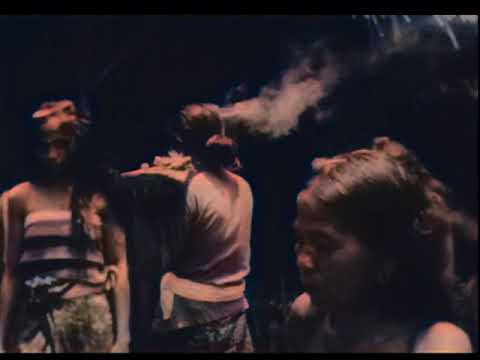
This short documentary, AI-colorized from the original 1937 footage shot by anthropologists Margaret Mead and Gregory Bateson, records a staged performance of the Kris Dance in Bali, documenting trance, ritual possession, and ceremonial movement within Balinese religious practice. Watch especially for the transition moments when ordinary movement becomes possession, the change in postural quality, the quality of gaze, and the responses of the witnessing community. These are the somatic signatures of the DMN quieting and a new identity state entering the body.
❓ FAQ ABOUT POSSESSION TRANCE
Question: Is possession trance the same as being hypnotised?
Answer: They share the same neurological substrate, theta wave activity, DMN suppression, heightened suggestibility, but the social architecture is radically different. Hypnosis in its clinical form is a dyadic relationship between practitioner and subject. Possession trance is fundamentally communal: the witness group, the cosmological frame they hold, and the shared belief system all participate in co-creating the experience. This is not a minor distinction. The community’s expectation shapes what enters the trance state and what the person emerges believing. In both cases, the body is the primary vehicle; in possession trance, the community is the therapist.
Question: How can I tell whether I have actually shifted a belief or just had a pleasant experience?
Answer: Check the body. If the somatic baseline you established before the session has genuinely changed, different temperature, texture, or location; movement where there was stillness, the change is real. If the verbal report changes but the body report remains identical, the shift is cognitive rather than somatic. The possession traditions knew this intuitively: they trusted the body’s behaviour during trance (convulsion, altered posture, change of voice) over the person’s verbal report precisely because the body does not perform what it has not experienced.
Question: Do I have to believe in spirits for this to work?
Answer: No. The neurological mechanism operates independent of the cosmological interpretation. What matters is the rhythm, the movement, the witness, and the post-trance narrative, not the metaphysical label attached to them. Secular practitioners working with ecstatic dance, somatics, and NLP regularly produce the same neurological state and the same quality of belief change without any spirit framework. The cosmology is the community’s agreed-upon narrative for what the mechanism means, the mechanism itself is neurological and therefore universal.
Question: Is it safe? Can trance states cause psychological harm?
Answer: Culturally supported possession trance, practised within a community that provides cosmological context, skilled practitioners, and post-trance narrative, has been practised for millennia with an excellent safety record. Risks increase significantly when trance is induced without adequate preparation, without a witness community, without a skilled guide, or in individuals with unprocessed trauma or active psychotic disorders. The traditions are not naive about this: every possession tradition includes specialists (priest, shaman, pawang, elder) whose role is precisely to manage the depth and direction of the state and to perform whatever intervention is needed if something goes unanticipated. Please seek guidance from a qualified practitioner before attempting deep rhythmic induction work if you have a history of dissociative disorders.
Question: Why does the witness community matter so much?
Answer: Because altered states are shaped by social expectancy. Research in cultural neuroscience consistently shows that the same physiological state produces radically different subjective experiences and behavioral outcomes depending on the cultural context in which it occurs. In Candomblé, theta-state dissociation is narrated as Orisha descent and produces identity expansion. In a secular context without a frame, the same state might be experienced as frightening disorientation. The community’s belief provides the meaning-container that makes the neurological opening productive rather than merely destabilizing.
Question: How long does it take for the change to last?
Answer: This depends entirely on the maintenance practice. Trance-induced belief changes without post-trance narrative and without regular reinforcement degrade over time, this was well understood by ancient Greek practitioners who noted that each ekstasis had to be renewed. With a clear somatic anchor, daily practice for two to four weeks, and participation in a community that validates the new identity, changes installed through rhythmic trance can be highly durable. The key variable is not the intensity of the initial experience but the quality of the integration afterward.
Question: Can this approach work with trauma?
Answer: With significant cautions. Possession trance and rhythmic dissociation can access somatic material that is not yet ready to surface, and in the absence of adequate therapeutic containment, this can be destabilizing rather than healing. If you or a client carries unprocessed trauma, the rhythmic component should be introduced very gradually and within an explicit therapeutic frame with clear contracting, grounding resources available, and the ability to exit the state cleanly. This is not a solo activity for trauma work.
Question: Is this relevant to NLP practitioners who have no background in ritual traditions?
Answer: Highly relevant. The NLP practitioner who understands the mechanism behind possession trance has a significant conceptual advantage: they understand why communal context, rhythmic induction, and post-trance narrative are not incidental decorations but functional components of the belief-change architecture. The practitioner’s voice, pacing, and rhythm are already operating as low-level entrainment tools. Using these consciously, with an understanding of the DMN suppression and oxytocin release they are facilitating, makes the work considerably more precise.
😆 JOKES ABOUT POSSESSION TRANCE
-
“I tried meditation for belief change for five years. Turns out all I needed was a drum and forty minutes of not being sure what my name was.”, Anonymous
-
“The spirits never possess the person who is thinking about their grocery list. There is a lesson there about presence.”, Anonymous
-
“My therapist asked what I thought was happening during the trance. I said: ‘My limiting beliefs were being evicted by something with better furniture.’ She wrote that down.”, Anonymous
-
“People ask if I’m afraid of being possessed. I say: I’ve been possessed by imposter syndrome for thirty years. Whatever else shows up is an improvement.”, Anonymous
-
“The interesting thing about the Whirling Dervishes is that they spin until they forget they are spinning. I tried this with my anxiety. I recommend starting with a gentler rotation.”, Anonymous
-
“My body understood possession trance before my mind did. My mind is still filing an objection. My body has moved on.”, Anonymous
🦋 METAPHORS FOR POSSESSION TRANCE
-
The riverbed and the flood. Your ordinary identity is a dry riverbed, a fixed channel carved by years of repetitive thought, worn smooth by habitual narrative. Possession trance is the seasonal flood: too much water, arriving too fast, to stay in the channel. It spills, spreads, and when it recedes, the landscape is different. New pathways have been carved. The old channel remains, but it is no longer the only route water can take.
-
The operating system update. You cannot upgrade the operating system while the applications are running. You have to shut them down first, close the tabs, stop the processes, accept the brief dark screen of a restart. The trance state is that dark screen. The community is the installer that ensures the new software loads correctly. When you come back online, you are running a different version of yourself.
-
The tuning fork and the bell. A tuning fork held close to a bell causes the bell to ring at the same frequency without being touched. Communal rhythm is the tuning fork; your nervous system is the bell. You do not have to do anything. You do not have to decide or understand. You only have to be close enough, and long enough, and the resonance happens by itself.
-
The weaver’s loom. Every belief you carry is a thread woven into the fabric of your identity, tight, particular, in a fixed position relative to every other thread. Possession trance is the moment the loom loosens: the threads do not break, but their tension relaxes enough that the pattern can be adjusted, a thread rewoven from one position to another. When the loom tightens again, a new design holds. You are still the same cloth. The pattern is different.
-
The fire and the metal. A blacksmith cannot shape cold iron. The metal must be heated until it becomes briefly malleable, hot enough to be worked but not so hot it loses its form entirely. Possession trance heats the self to precisely that temperature. The community holds the fire and the form. The practitioner holds the hammer. The work happens in the window between rigidity and dissolution.
-
The theatre curtain. Your ordinary identity is the performance happening downstage, under full light, speaking its familiar lines. Possession trance is the moment someone pulls back the curtain to reveal what was always happening upstage in the dark, a much larger cast, a much older story, a set that stretches further back than you could see from the front row. The performance continues; but you can no longer pretend it is the whole theatre.
-
The pause between heartbeats. There is a moment between the lub and the dub when the heart is neither contracting nor expanding, a brief, necessary suspension. This is the precise moment when the trance does its work: not during the drum, not after the drum, but in the stillness the drum creates. The new belief arrives not with a sound, but in the pause between two sounds, when the body is open and nothing has yet been decided.
🧑🦲 AXEL MAGNUS’S EXPERIENCE WITH POSSESSION TRANCE
I should tell you that I came to this topic sideways, as I come to most things that matter.
I was fourteen years old in Czechoslovakia when I first understood, without language for it, that the self is not a solid structure. I was walking home after school on an ordinary winter afternoon, grey sky, ice on the pavement, and without warning, or rather, with the particular warning I would only later recognise as a precursor, I stepped outside myself. Not dramatically. Not with angels or fire. The feeling was more like a glove turning inside out: what had been inside was now outside, what had been outside was now inside, and the thing called Axel was somewhere adjacent to me, watching.
It lasted maybe forty seconds. When I returned, the street was the same street. I was the same age. But something about the reliability of the structure called Me had been quietly, permanently revised.
I did not know, then, that this was a documented phenomenon, that cultures across every continent had built entire cosmological systems around precisely this experience, and that these systems were not primitive attempts to explain a malfunction but sophisticated technologies for producing the same state deliberately, in service of something. I thought I was the only one. The feeling of being the only one with a particular interior experience is, I have since learned, one of the most reliable signs that the experience is in fact universal.
Years later, performing as a magician in Valencia, standing in front of two hundred people who had paid to be surprised, I discovered something that I now recognise as a functional equivalent of possession trance induction. There is a moment in any performance where the preparation falls away and something takes over. The technique is still there, the angles are still correct, but the agent performing them is no longer the anxious, effortful person who rehearsed. Something looser, more spacious, and considerably more competent has come forward. My yoga students called it “being in the flow.” My NLP teachers called it “second position.” In the Candomblé community, they would recognise it immediately.
When I began studying the anthropology of possession trance in earnest, reading Janice Boddy on Zār, Rebecca Seligman on Candomblé, the neuroscience of theta induction, the structural parallels across traditions, I felt the same recognition you feel when you finally find the name for something you have known somatically for years. The term for it in Czech is to, just that simple word, meaning simply: this, yes, this exact thing.
What possession trance told me, across all these traditions, is something I had felt in that Prague street and on the Valencia stage but never quite articulated: the self that freezes, the self that doubts, the self that has learned to make itself small, that self is a construction. A useful one, usually. But a construction. And under certain conditions, rhythm, witness, release, community, another construction is possible. Not a better ego, but a larger space. Not a fixed identity, but access to the identity that already lives beneath the one you’ve been managing.
I still get that inside-out feeling occasionally. Less disorienting now. I know what it is: the DMN stepping back, the theta rising, the ordinary management of self taking a brief sabbatical. I have learned to treat it as an invitation rather than an alarm. The drum is always already playing. You only have to stop insisting on keeping the beat yourself.
🕳️ THE LIMITATIONS OR UNCERTAINTIES IN POSSESSION TRANCE
Not a universal solution. Possession trance is a powerful and clinically validated state for producing rapid belief change in many people. It is not appropriate for all people, all situations, or all types of change. Some individuals find rhythmic induction destabilising rather than liberating, particularly those who have strong rational-cognitive processing preferences or who have previously experienced unwanted dissociation. The approach should be introduced gradually and with clear contracting.
Contraindications requiring caution. Active psychotic episodes, unprocessed severe trauma, borderline personality disorder, and certain dissociative conditions may be exacerbated rather than helped by induced trance states. Anyone with a history of these conditions should work with a qualified mental health professional before attempting rhythmic trance induction, even in its milder NLP-informed forms.
The community problem. In traditional contexts, possession trance operates within a community that provides cosmological frame, skilled specialists, and social integration for the changed person. Most Westerners attempting to work with these principles do so without a genuine community structure, which weakens both the induction and the integration. Solo practice or dyadic clinical work can access the neurological mechanism but lacks the social anchoring that makes traditional trance so durable.
Cultural appropriation considerations. Many of the traditions described in this article are living practices belonging to specific lineages and communities. Using their aesthetic elements, Candomblé rhythms, Yoruba deities, Sufi spinning, outside of proper transmission and training is not only ethically problematic but practically ineffective: the cosmological context is integral to the mechanism, not decorative. Work with the principles; be careful with the forms.
Research gaps. While the neuroscience of trance states is increasingly well documented, the specific mechanisms by which possession trance produces long-term belief change, as opposed to temporary state changes, remain incompletely understood. We lack longitudinal studies of belief change durability following trance-based interventions. The anthropological literature is rich; the clinical outcomes literature is thin.
Risk of regression without maintenance. Beliefs installed through trance without adequate maintenance practice tend to fade within weeks to months. This is not a failure of the method, it is a documented feature understood by every tradition, all of which build in regular ritual participation precisely for this reason. Any practitioner using these principles should build a clear maintenance structure into the work.
The interpretation variable. The post-trance narrative is powerful precisely because it is directional, it shapes which beliefs consolidate. This means a careless or harmful post-trance narrative (from an untrained or exploitative practitioner, or from a community with harmful beliefs) can install damaging rather than healing frameworks. The witness community and the narrative they provide are not neutral containers. They require the same ethical scrutiny as any other powerful intervention.
Individual variation is significant. Theta induction time, trance depth, and the somatic quality of the experience vary considerably between individuals. Some people enter deep trance states within minutes; others take multiple sessions of consistent practice. This variation does not mean the work is unsuccessful, but practitioners and clients should calibrate expectations accordingly rather than treating deep trance as the only valid outcome.
✏️ CONCLUSION
What connects a Yoruba initiation ceremony in Lagos, a Pentecostal church in Birmingham, a Javanese horse trance in Central Java, and a Sufi hadra in Morocco is not geography or theology. It is the body. Specifically, it is the body under the specific conditions of sustained rhythm, communal witness, and intentional identity dissolution, conditions that every culture on earth has discovered, apparently independently, and built entire cosmological systems around.
The reason this matters to practitioners of NLP and somatic change is not academic. It is practical. These traditions have been running controlled experiments on human belief change for thousands of years. Their results, encoded in ritual structure, cosmological narrative, and community architecture, are the most comprehensive dataset we have on how deeply held identity-level beliefs actually shift. Not how we think they should shift. How they do.
What they consistently show is that the body is not a vehicle for the mind’s instructions. It is the primary site of belief itself, the place where old certainties are stored as tension, temperature, and chronic holding pattern, and the place where new certainties arrive first, as warmth, expansion, and release. The drum does not illustrate this. The drum demonstrates it, every time someone stops thinking and starts moving.
Your beliefs live in your body. So does the possibility of changing them. Both have always been there, waiting for the right rhythm.
📚 REFERENCES
-
George Lakoff & Mark Johnson, 1980; Metaphors We Live By
-
Steve & Connirae Andreas, 1987; Change Your Mind and Keep the Change: Advanced NLP Submodalities Interventions
-
Julian Jaynes, 1976; The Origin of Consciousness in the Breakdown of the Bicameral Mind
-
Andreas, S. (2002). Transforming yourself: Becoming who you want to be. Real People Press.
-
Connirae Andreas & Steve Andreas, 1989; Heart of the Mind: Engaging Your Inner Power to Change with Neuro-Linguistic Programming
-
Bandler, R., & Grinder, J. (1981). Tranceformations: Neuro-linguistic programming and the structure of hypnosis. Real People Press.
-
Connirae Andreas & Tamara Andreas, 1994; Core Transformation: Reaching the Wellspring Within
-
Video DVD Transforming Yourself Complete 3-day Training with Steve Andreas
-
Boddy, J. (1989). Wombs and alien spirits: Women, men and the Zār cult in Northern Sudan. University of Wisconsin Press.
-
Seligman, R. & Kirmayer, L. (2008). Dissociative experience and cultural neuroscience: Narrative, metaphor and mechanism. Culture, Medicine and Psychiatry, 32(1), 31–64.
-
Waller, J. (2008). A time to dance, a time to die: The extraordinary story of the dancing plague of 1518. Icon Books.
-
Rouget, G. (1985). Music and trance: A theory of the relations between music and possession. University of Chicago Press.
-
Sylvan, R. (2005). Trance formation: The spiritual and religious dimensions of global rave culture. Routledge.
-
Lewis, I. M. (2003). Ecstatic religion: A study of shamanism and spirit possession. Routledge.
-
Goldman, M. (2007). How to learn in an Afro-Brazilian spirit possession religion. Hau: Journal of Ethnographic Theory.
-
Margaret Mead & Gregory Bateson, Trance and Dance in Bali (filmed 1937, released 1952)
-
PMC8070722, Rhythmic entrainment, trance and altered states (PubMed Central)
-
PMC12310872, ANS arousal, social expectancy and possession trance (PubMed Central)
-
PMC5156567, Cultural neuroscience and narrative in Candomblé (PubMed Central)
-
Image Credit - Perplexity - WHY EVERY CULTURE ON EARTH HAS A POSSESSION RITUAL
🎬 MOVIES ABOUT POSSESSION TRANCE OR RITUAL DANCE
- The Serpent and the Rainbow (1988), Wes Craven’s dramatisation of Wade Davis’s investigation of Haitian Vodou and zombification
- Beasts of the Southern Wild (2012), A poetic exploration of community ritual, ancestral belief, and somatic knowledge in a marginalised community
- The Eyes of Tammy Faye (2021), Inadvertently documents the Pentecostal arousal contagion mechanism in a biographical register
- The Wicker Man (1973), Dramatises pagan collective ritual as belief installation technology, for better and worse
📺 TV SHOWS ABOUT POSSESSION TRANCE OR RITUAL DANCE
- American Gods (2017–2021), Dramatises Yoruba, Norse, and other deity-possession traditions through a contemporary American lens
- The Knick (2014–2015), Includes documentary-style portrayal of turn-of-the-century folk healing practices including trance states
- Lovecraft Country (2020), Engages seriously with Afro-American spiritual traditions including trance and possession as forms of resistance
🎭 DOCUMENTARIES ABOUT POSSESSION TRANCE OR RITUAL DANCE
- Trance and Dance in Bali (Mead & Bateson, 1952), The foundational ethnographic document; available free online
- Divine Horsemen: The Living Gods of Haiti (Maya Deren, 1985), Filmed 1947–1951; the most intimate and artistically serious document of Haitian Vodou possession trance ever made
- Genèse d’un repas (Luc Moullet, 1978), Traces the global food supply chain, including Afro-Brazilian ritual contexts
- Icaros (2016), Documents Amazonian ayahuasca ceremony and the role of the icaro song in navigating altered states
📚 NOVELS ABOUT POSSESSION TRANCE OR RITUAL DANCE
- Toni Morrison, Beloved (1987), The possessed body as the site of unresolved ancestral trauma, narrated through somatic experience
- Zora Neale Hurston, Their Eyes Were Watching God (1937), Written by a trained anthropologist who documented Vodou possession trance; somatic and spiritual embodiment run throughout
- Patrick Chamoiseau, Texaco (1992), Martinican novel saturated with Creole spiritual practice including possession and ancestral presence
- Wilson Harris, Palace of the Peacock (1960), Guyanese novel exploring shamanic journey, identity dissolution, and communal trance through its prose rhythm itself